The world has entered a new phase of strategic uncertainty and heightened risks following Russia’s announcement that it is suspending its participation in the New START Treaty, the last remaining nuclear arms control agreement with the United States. This decision, which precedes the treaty’s formal expiration in February 2026, raises serious concerns about a potential three-dimensional nuclear arms race that could include China, threatening to undermine the foundations of global stability that have endured for decades.
Historical background: The end of the arms control era
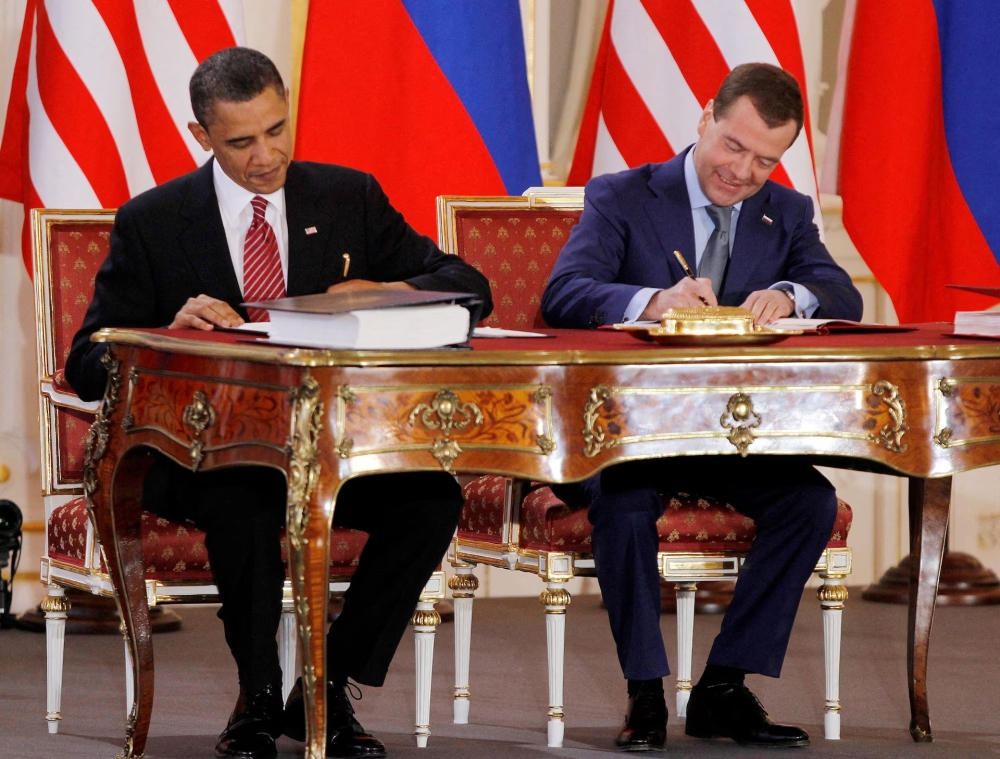
The New START Treaty, signed by Presidents Barack Obama and Dmitry Medvedev in Prague in 2010, is the culmination of decades of diplomatic efforts between Washington and Moscow to control their massive Cold War-era nuclear arsenals. Replacing earlier agreements such as START I and SORT, the treaty placed clear limits on the number of deployed strategic nuclear warheads (1,550 for each side) and their delivery systems, including intercontinental ballistic missiles, submarines, and strategic bombers (800 launchers). Crucially, it established a rigorous system of mutual verification, including on-site inspections and data exchanges, fostering transparency and trust between the world’s two largest nuclear powers. In 2021, the treaty was extended for another five years, a move hailed internationally as essential for maintaining strategic stability.
The current crisis and its potential repercussions
Russia’s decision in February 2023 to suspend its commitments dealt a severe blow to the global arms control architecture. Moscow justified its move by citing Washington’s support for Ukraine in the ongoing war, arguing that it was illogical to allow American inspectors access to its sensitive nuclear sites while the United States sought to inflict a “strategic defeat” on Russia. With inspections and data exchanges halted, the only reliable source of information on the size and development of both sides’ nuclear arsenals was lost, fueling suspicion and increasing the risk of miscalculation during times of crisis.
Multidimensional global impact
The collapse of the treaty has repercussions not only for US-Russian relations but also for the entire international arena. Regionally , European states are deeply concerned, as the absence of nuclear constraints increases the direct threats to their security. Internationally , this development poses a serious challenge to the Treaty on the Non-Proliferation of Nuclear Weapons (NPT), potentially encouraging other states to pursue nuclear weapons given the lack of constraints on major powers. The US insistence on including China in any future negotiations further complicates matters. Beijing, which is rapidly expanding its nuclear arsenal, has so far refused to participate in any trilateral talks, arguing that its arsenal remains significantly smaller than those of Washington and Moscow. Without any serious dialogue, the world finds itself in a more precarious position than ever before, where a new arms race could become a reality, reminiscent of the darkest days of the Cold War but within a more complex and dangerous geopolitical environment.