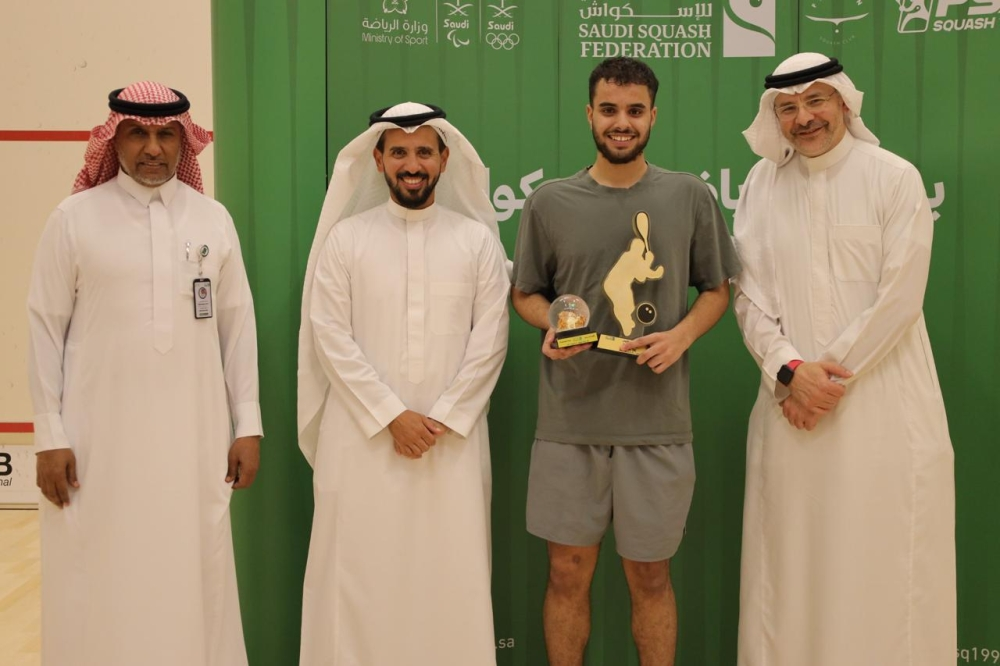
The Riyadh International Squash Championship for Men (PSA 3K) concluded in the Saudi capital, Riyadh, with Egyptian player Karim Badawi crowned champion after a fierce and exciting competition. Dr. Adel Al-Aqili, President of the Saudi Squash Federation, presented the awards to the winners at the closing ceremony, which was attended by Mr. Abdulaziz Baeshen, CEO and Secretary General of the Saudi Olympic and Paralympic Committee, and a number of squash enthusiasts.
The tournament was held over three days, from February 12th to 14th, with 16 professional players representing five countries: Saudi Arabia (the host country), Egypt, Kuwait, Oman, and Canada. The final match was a thrilling encounter between Egypt's Karim Badawi and Saudi Arabia's Mohammed Al-Nisfan, which ended with Badawi winning three sets to one, thus claiming the championship title. Al-Nisfan finished as runner-up after a commendable performance that earned him the admiration of the fans.
A strong boost for Saudi squash within Vision 2030
The Kingdom's hosting of this tournament, which is being held for the first time on its soil, comes as part of a broader strategy aimed at enhancing Saudi Arabia's position on the global sports map, in line with the objectives of the Kingdom's Vision 2030. The Saudi Squash Federation, with the support of the Ministry of Sports and the Olympic and Paralympic Committee, seeks to develop the game at the local level by organizing and hosting international tournaments that raise the level of competition and give Saudi players the opportunity to interact with different schools and gain valuable international experience.
The importance of the tournament and its future impact
The Professional Squash Association (PSA) tournaments are a global platform where the world's best players compete. Although the Riyadh tournament is a 3K event, it also serves as an important opportunity for up-and-coming players to accumulate points and improve their world ranking. The fact that Saudi player Mohammed Al-Nisfan reached the final is a positive indicator of the development of local players and their ability to compete strongly on the international stage. Furthermore, the tournament's organizational success and impressive spectator turnout pave the way for the Kingdom to host larger tournaments in the future, contributing to the increased popularity of the sport and attracting more young talent.
The dominance of Egyptian players in world squash titles, exemplified by Karim Badawi's victory, reflects the scale of the challenge and the fierce competition in this sport. Through these tournaments, Saudi and Gulf players gain the necessary experience to compete with these global powers, promising a bright future for squash in the region.