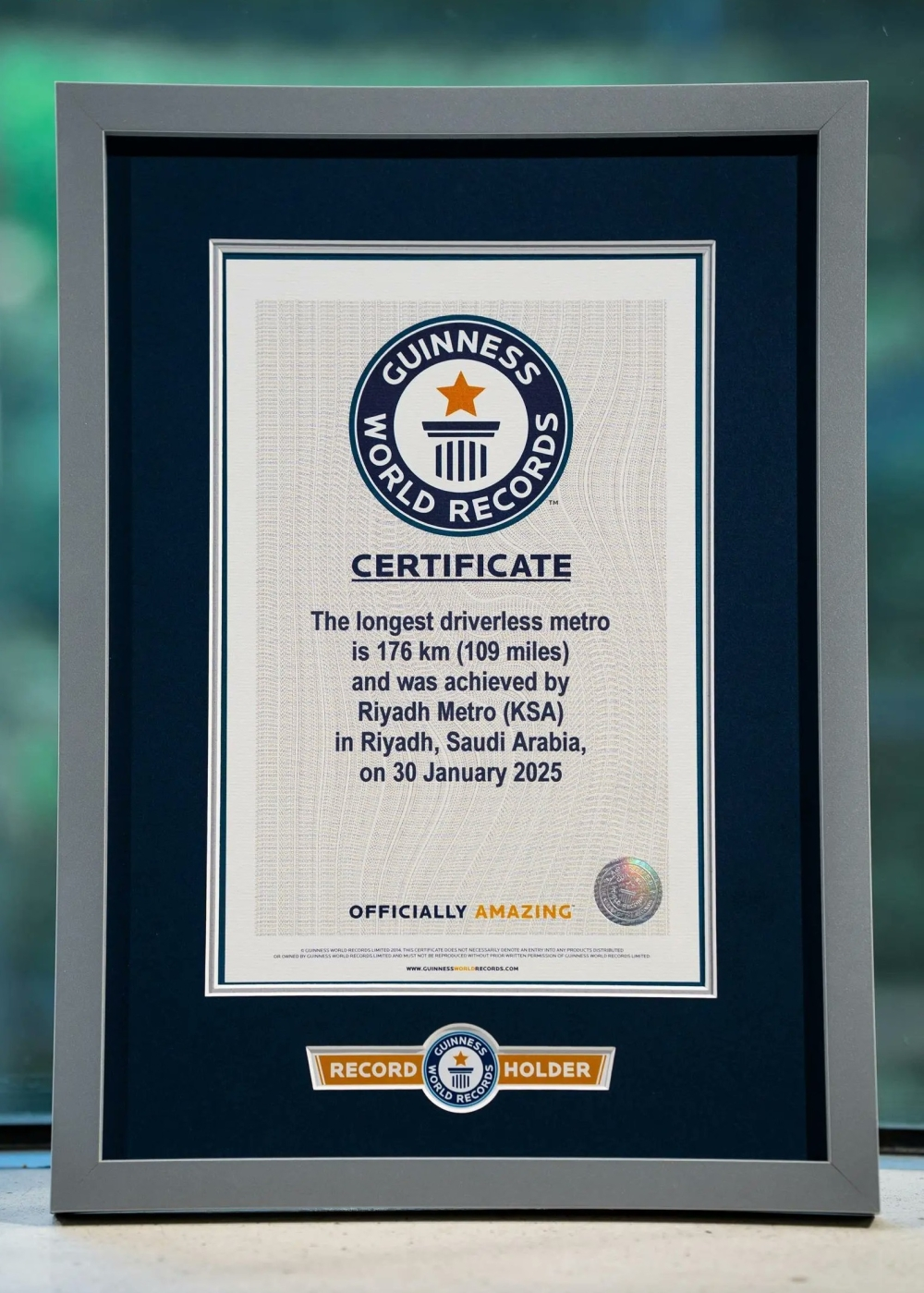
In a historic achievement highlighting the technological and urban advancements in Saudi Arabia, the Riyadh Metro has officially been recognized by Guinness World Records. This global accolade establishes it as the world's longest fully driverless metro network, stretching 176 kilometers. This accomplishment is not merely a record; it is a testament to the ambitious goals of Vision 2030, which aims to transform the capital into one of the world's most advanced and sustainable cities.
Project background and strategic objectives
The Riyadh Metro project, officially known as the King Abdulaziz Public Transport Project in Riyadh, is one of the world's largest urban transport infrastructure projects. It was launched in response to the capital's rapid population growth over the past decades, which has led to significant traffic challenges. The project aims to provide integrated and efficient public transport solutions that reduce reliance on private vehicles and contribute to reshaping the city's urban fabric. It is an integral part of Riyadh's development plans to become a global economic hub and a key component of the Vision 2030 objectives.
Network details and technologies used
The Riyadh Metro network comprises six main lines with 85 strategically located stations to cover most of the city's vital areas and population centers, including King Khalid International Airport, the King Abdullah Financial District, major universities, and commercial districts. The network utilizes state-of-the-art automated operating technology (GoA4), with fully driverless trains controlled and monitored from advanced central control rooms that ensure the highest levels of accuracy, safety, and operational efficiency around the clock.
Expected impact at the local and national levels
The full operation of the Riyadh Metro is expected to revolutionize the lives of the capital's residents and visitors. Locally, the project will significantly alleviate traffic congestion, reduce daily commute times, and provide a reliable, safe, and affordable mode of transportation for millions of passengers. It will also enhance connectivity between different neighborhoods and increase the value of properties surrounding the stations. Nationally, this project positions the Kingdom as a leader in sustainable transportation and smart cities, offering a model that can be replicated in other Saudi cities.
Economic and environmental importance
The project's impact extends far beyond traffic. Economically, the Riyadh Metro will enhance the city's attractiveness as an investment destination, facilitate workforce mobility, and create thousands of direct and indirect job opportunities. Environmentally, the project represents a significant step towards sustainability, leading to a substantial reduction in carbon emissions and fuel consumption, thus improving air quality and making Riyadh a more eco-friendly city, in line with the goals of the Saudi Green Initiative.
A global achievement by international standards
The Riyadh Metro's entry into the Guinness World Records is not the end goal, but rather the beginning of a new phase of urban development in the Kingdom. This global achievement underscores the Kingdom's ability to execute mega-projects to international standards, reinforces Riyadh's position as a smart and sustainable city, and sets a new benchmark for public transportation projects in the region and the world, reflecting the Royal Commission for Riyadh City's commitment to continuous innovation and development.