The Riyadh International Philosophy Conference 2025 continued its proceedings amidst a notable international presence, solidifying the Saudi capital's position as a leading global platform for intellectual dialogue. Under the theme "Philosophy Between East and West: Concepts, Origins, and Mutual Influences," the sessions featured in-depth discussions aimed at deconstructing historical determinisms and building new bridges of knowledge between different civilizations.
A renewed cultural context and a future vision
This conference comes within the context of the unprecedented cultural movement taking place in the Kingdom of Saudi Arabia as part of Vision 2030, which places particular emphasis on strengthening the culture and intellectual sector and encouraging knowledge exchange with the world. Interest in philosophy in the Kingdom is no longer a passing phenomenon, but has transformed into a strategic path aimed at promoting the values of critical thinking, acceptance of others, and active participation in the production of human knowledge, reflecting a fundamental shift in the local and regional cultural landscape.
Critique of historical centrism and the construction of knowledge
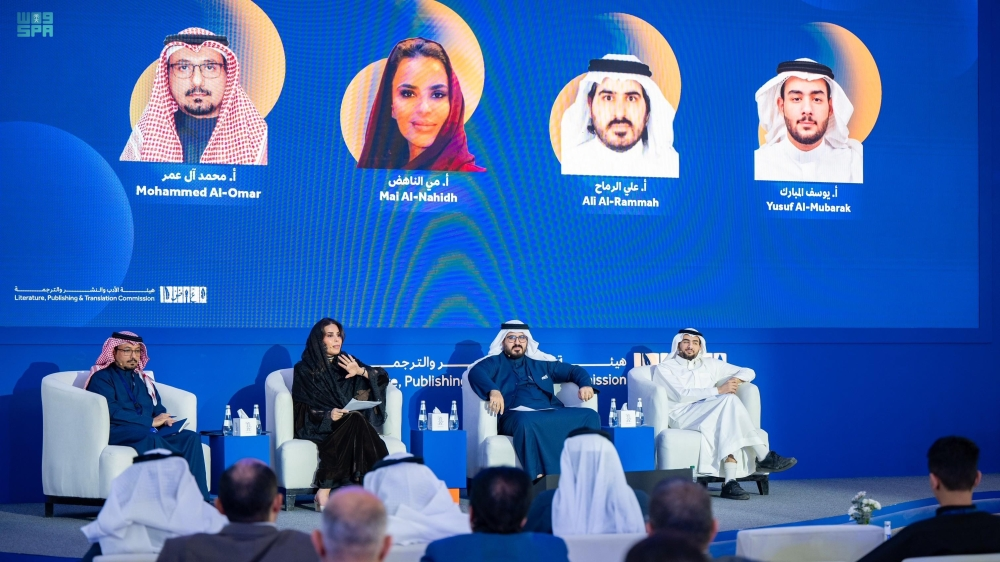
In a pivotal session titled "Philosophy and its Centrality in History," moderated by Mohammed Al-Omar with the participation of Ali Al-Rammah, Mai Al-Nahidh, and Yousef Al-Mubarak, the foundational role of rationality in understanding the course of history was highlighted. The session addressed:
- The Hegelian influence: restoring his role as a major influence in the construction of historical thought systems.
- Karl Popper's critique: presenting an alternative reading that calls for openness and a critique of absolute centralism, considering external criticism as a condition for liberation from "civilizational prisons".
- Civilizational transformation: Emphasizing the shift of human conflict from "swords to pens," which promotes a trend towards knowledge building rather than destruction.
East-West Interaction: A Return to Roots
In the context of exploring intellectual exchange, the session on "Eastern-Greek Philosophy," moderated by Mashael Al-Hammad with the participation of Al-Mabrouk Al-Shaibani Al-Mansouri, Hamed Al-Iqbali, and Badour Al-Faleh, discussed pathways of mutual influence. The session highlighted the following points:
- The return of Eastern thought: Studies have indicated a growing interest in Eastern thought since the 1970s as a tool for critiquing Western modernity.
- Ibn Sina's status: He was celebrated as the "Third Teacher" who reformulated the concept of existence, giving Islamic philosophy a significant presence in Western thought.
- Qur’anic Dialogue: Presenting a pragmatic reading of dialogue in the Holy Qur’an as a sophisticated model of argumentative logic and the principles of human communication, alongside Aristotle’s ethical theories.
Islamic philosophy and the problems of the modern age
The discussions concluded with a session titled "The Philosophical Structure and Epistemological Contributions of Islamic Philosophy," featuring Ahmed Al-Anizan and Hessa Al-Mufarrah, and moderated by Eid Al-Juhani. The session addressed several complex contemporary issues
- Representations of Evil and Literature: The session linked moral thought and narratives of Western literature such as "1984" and "Brave New World," and compared them with Arab models such as "The Shell" and "Utopia," to illustrate the difference in the roots of philosophical problems between the two contexts.
- Jurisprudence and Ethics: Discussed the possibility of building a normative theory inspired by Islamic jurisprudence that balances the doctrines of utility and duty.
- Academic attendees: The session criticized the Western interest in Islamic philosophy being limited to major texts, calling for a re-reading of theological and fundamentalist heritage with a modern approach.
In conclusion, the conference affirmed that philosophy remains a shared human project in the search for truth, and that Riyadh has become a pivotal player in redirecting the compass towards a more just and diverse global philosophical dialogue.