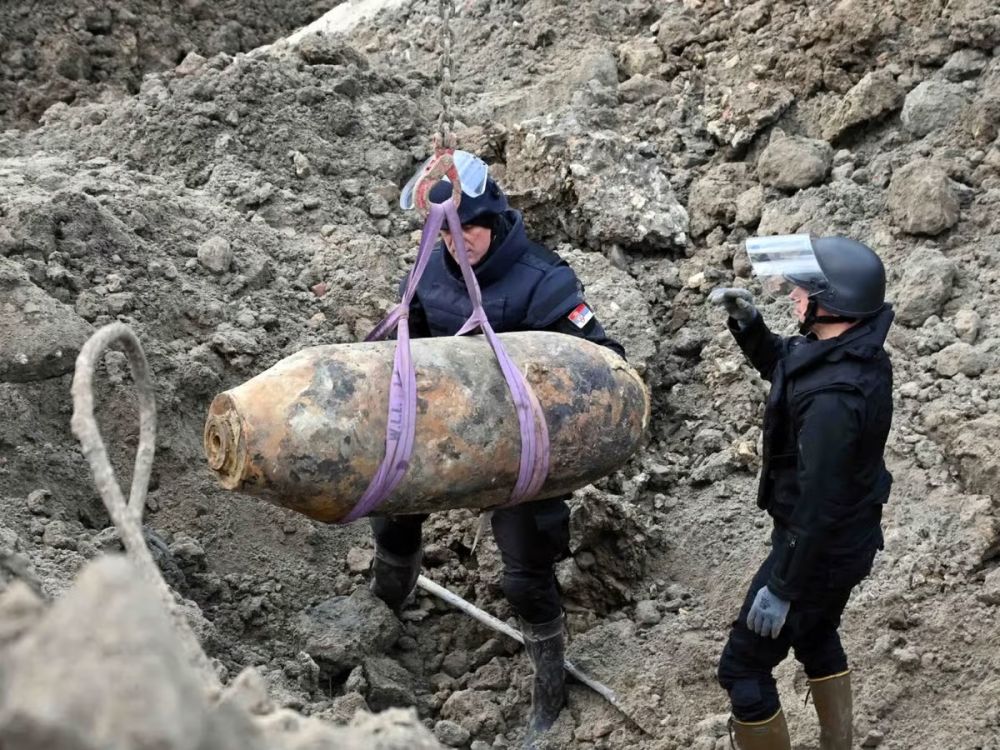
In a delicate security operation that required a large-scale mobilization, Serbian authorities announced the successful removal of a massive 470-kilogram aerial bomb dating back to World War II. The bomb was discovered at a construction site in central Belgrade. This incident once again highlights the heavy legacy of past wars in Europe and the dangers that lie buried underground, decades after the end of conflicts.
Details of the security operation and safety procedures
Serbian police explained that the discovered bomb was an American-made AN-M44 and contained a massive quantity of explosives. Given the workshop's sensitive location near populated residential areas and a shopping center, bomb disposal teams handled the situation with extreme caution. Before commencing the removal operation, authorities conducted a thorough engineering survey to ensure completely safe conditions. Residents of nearby buildings were asked to temporarily evacuate their homes and move their vehicles to facilitate the movement of heavy machinery and prevent any accidental damage.
The bomb was successfully transported to a military training center located 180 kilometers from the capital, where experts will safely dismantle and destroy it in the coming days, away from populated areas.
Historical context: The Allied bombing of Belgrade in 1944
This discovery brings to mind a turbulent period in Belgrade's history; the bomb is a remnant of the intense Allied air raids of 1944. As World War II drew to a close, American and British aircraft launched attacks targeting Nazi German positions and infrastructure in the former Yugoslavia. The primary objective was to weaken the Nazi grip in preparation for the liberation of Belgrade, but these raids left behind a number of unexploded bombs that continue to surface occasionally during modern construction and excavation work.
Serbia has a long history of war remnants
This incident is not unique in Serbia, a country that has witnessed numerous conflicts throughout the last century. In September 2024, an artillery shell weighing approximately 300 kilograms and dating back nearly 100 years (to the First World War era) was unearthed near the Serbian Parliament building. Recent years have also seen the discovery of bombs from the 1999 NATO bombing campaign, as well as a 242-kilogram World War II bomb that was removed in 2021 from a Belgrade suburb. These recurring discoveries underscore the importance of conducting thorough geological and security surveys before embarking on major urban development projects in historic European cities.