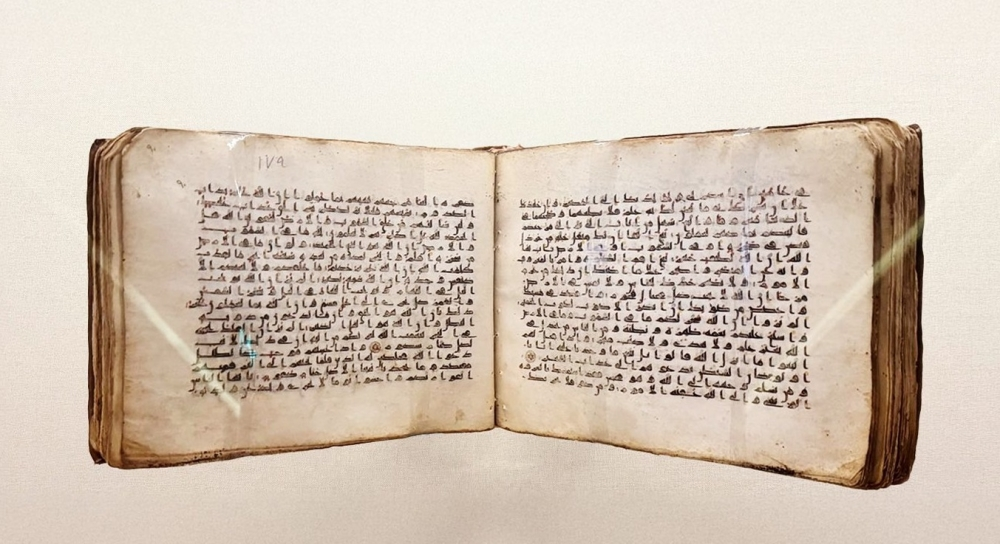
In a move that reflects the historical and cultural depth of Mecca, the Holy Quran Museum in the Hira Cultural District houses one of the most precious Islamic treasures, a rare Kufic Quran , which is a living historical document that tells the story of the beginnings of the writing of the Holy Quran and the development of Arabic calligraphy in the early Islamic eras.
Details of the rare manuscript
This manuscript is of exceptional archaeological value, dating from the 2nd to the 3rd century AH (corresponding to the 8th or 9th century CE). Its verses are written in exquisite Kufic script on parchment (treated leather), which was the primary writing medium before the widespread adoption of paper in the Islamic world. This section covers a textual area beginning with verse 50 of Surah Al Imran and extending to the end of Surah Abasa.
Kufic script and the ship-like shape: artistic and historical significance
What distinguishes this Qur'an is its "ship-like" (horizontal) format, a style common in early Qur'ans during the first three centuries of the Hijra. This format reflects the artistic characteristics of that era, where calligraphers tended to extend letters horizontally to lend an air of grandeur and solemnity to the Qur'anic text, necessitating the use of wide pages that complemented the sharp angles and unique aesthetic features of the Kufic script.
The Kufic script is one of the oldest and most prestigious Arabic scripts, as it originated in the city of Kufa and was adopted by the Islamic state for writing Qur’ans and architectural inscriptions for many centuries, making this manuscript a true witness to a pivotal stage in the history of Islamic arts.
Institutional cooperation and heritage preservation
This initiative is the fruit of fruitful cooperation between cultural institutions. This rare Quran, originally housed in the King Fahd National Library , was loaned for display as part of the Museum of the Holy Quran's mission. The exhibition aims to highlight the efforts of Muslims throughout history in serving the Book of God, from its recording and preservation to the meticulous care of its ornamentation and binding, reflecting their absolute dedication to safeguarding the Quranic text.
Hira Cultural District: A Global Enrichment Destination
The display of this Quran is not merely for museum purposes; it directly contributes to enriching the experience of visitors, pilgrims, and Umrah performers coming to the Hira Cultural District. Located next to Mount Hira, the site of the revelation, the district provides visitors with a spiritual and physical connection between the place of the Quran's revelation and the history of its compilation. These exhibits underscore the status of Mecca not only as the Qibla for Muslims but also as a cradle of Islamic cultural heritage and a global destination for researchers and those interested in the history, sciences, and arts of the Quran, in line with the Kingdom's vision to enrich the experience of the guests of God.