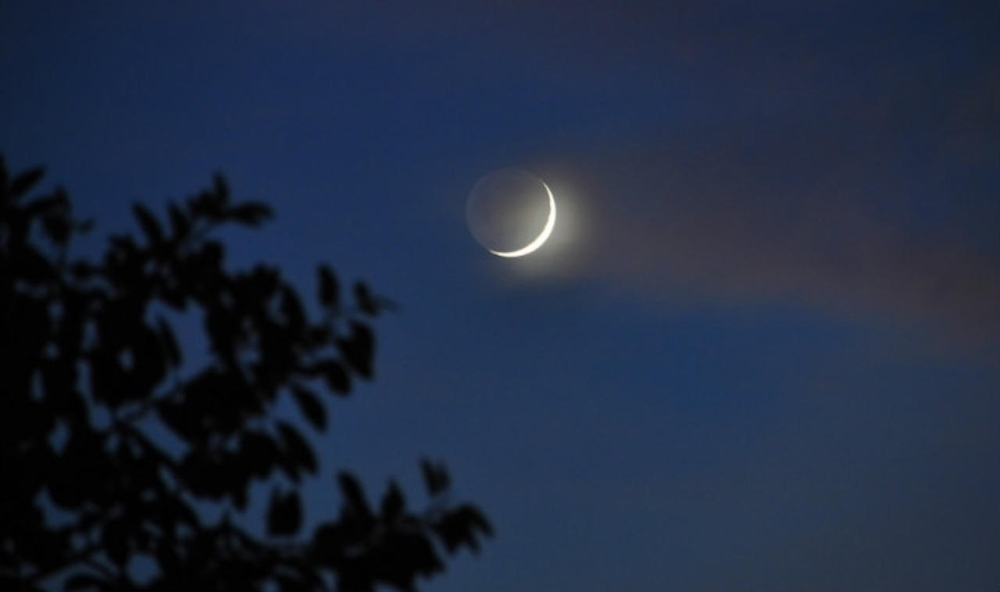
The head of the Jeddah Astronomical Society, Engineer Majid Abu Zahra, announced that the Earth will witness a rare and remarkable astronomical phenomenon on Tuesday, February 17, 2026, corresponding to 29 Sha'ban 1447 AH, when an annular solar eclipse, known as the "ring of fire," will occur. This phenomenon gains added significance due to its precise coincidence with the new moon of Ramadan, representing a unique event that combines precise astronomical calculations with an important religious occasion.
What is an annular solar eclipse?
An annular eclipse is a special type of solar eclipse that occurs when the Moon passes between the Earth and the Sun, but is at a relatively far point in its elliptical orbit around the Earth (apogee). This distance makes its apparent size slightly smaller than the Sun's apparent size, and therefore it cannot completely block the Sun's disk. Instead, the Moon covers only the center of the Sun, leaving a bright ring of sunlight surrounding it—the phenomenon that gives it the name "ring of fire." This differs from a total eclipse, which occurs when the Moon is close enough to completely block the Sun, revealing its stunning outer corona.
The historical context and scientific importance of the eclipse
Throughout history, ancient civilizations viewed eclipses with awe and reverence, often interpreting them as harbingers of doom or divine events. Today, however, these phenomena have become invaluable scientific opportunities eagerly awaited by astronomers. Studying eclipses offers scientists a unique chance to observe the Sun's outer atmosphere (the corona), which is usually obscured by the Sun's intense brightness. These events also help verify the accuracy of celestial motion calculations and provide valuable data for studying the Sun's effects on Earth's atmosphere.
Eclipse path and viewing areas
Abu Zahra explained that the path of the 2026 annular eclipse will be geographically very limited, crossing remote and uninhabited areas of Antarctica. This extreme location makes viewing the full "ring of fire" a significant logistical challenge, and is restricted to a very small number of scientists and researchers stationed at scientific stations there, such as the French-Italian Concordia station and the Russian Mirny station. The total annular phase of the eclipse will last no more than two minutes and 20 seconds at the best locations. Meanwhile, the eclipse will be visible as a partial eclipse in wider areas, including parts of southern South America, southwestern Africa, and large areas of the Southern Ocean. Abu Zahra confirmed that the eclipse will not be visible in the skies of Saudi Arabia or any other Arab country.
The precise timing of the astronomical phenomenon
According to astronomical calculations and Saudi time, the stages of the eclipse will begin as follows:
- Beginning of the partial eclipse: 12:56 PM.
- The annular eclipse begins at 2:42 PM.
- The conjunction of the Ramadan crescent: 3:01 PM (astronomical birth of the crescent).
- The peak of the annular eclipse will be at 3:12 PM, when the moon will cover approximately 96% of the sun's disk.
- End of the annular eclipse: 3:41 PM.
- The end of the partial eclipse: 5:27 PM, which is when the phenomenon will end completely.
Abu Zahra concluded by emphasizing that the coincidence of this astronomical event with the day of the Ramadan crescent sighting serves as a powerful reminder of the precision and regularity of the celestial bodies' movements that govern the Islamic calendar. However, he stressed that the official start of Ramadan in the Kingdom is determined by the legitimate sighting of the new crescent after sunset, as announced by the Supreme Court, and not solely by astronomical calculations.