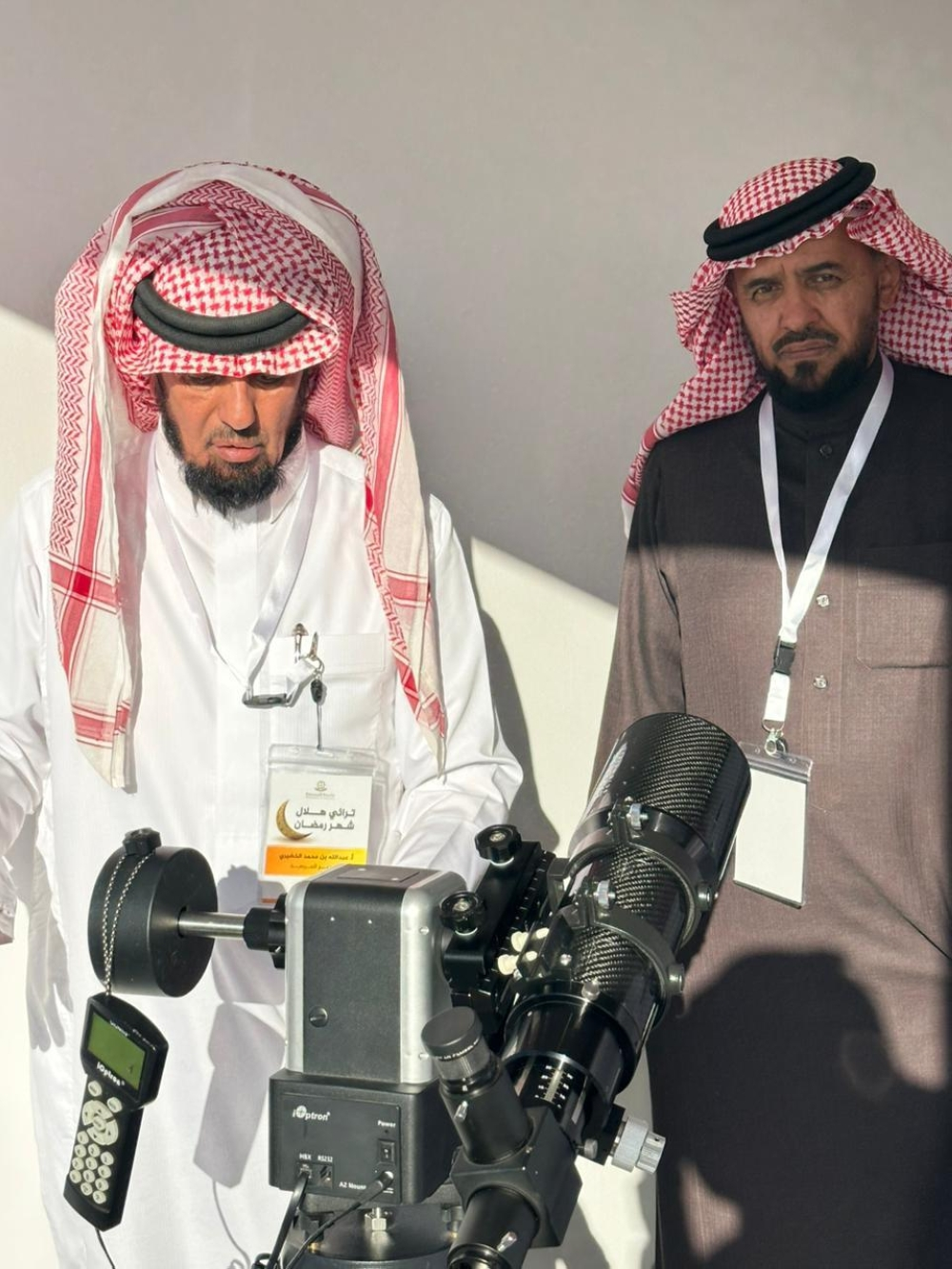
Renowned astronomer Abdullah Al-Khudairi, from the Hawtat Sudair Observatory, announced that the rare astronomical conditions this year have complicated the task of sighting the crescent moon for the holy month of Ramadan, noting that the final decision rests with the Supreme Court of Saudi Arabia. Although the weather in Hawtat Sudair was described as ideal in terms of clarity and lack of visual obstructions, the coincidence of the sighting with an exceptional astronomical phenomenon—an annular solar eclipse—presents significant technical challenges for observers.
Historical background and importance of the vision
The sighting of the crescent moon for Ramadan is a long-established Islamic tradition. Muslims rely on the legally prescribed method of naked-eye observation to determine the beginning of lunar months, in accordance with the Prophetic tradition, “Fast when you see it (the crescent moon) and break your fast when you see it.” This process is of paramount importance in the Kingdom of Saudi Arabia, which holds a symbolic position in the Islamic world. The Hawtat Sudair region is considered one of the Kingdom’s most prominent astronomical observation sites due to its clear skies and distance from light pollution, which lends significant weight to the testimony of its observers before the official moon-sighting committees.
Unprecedented astronomical challenges
Al-Khudairi explained that the sighting of the crescent moon coincides exceptionally with an annular solar eclipse, the phases of which will end at 5:27 PM. He added that the observatory's precise astronomical calculations indicate that the elongation angle between the centers of the sun and moon does not exceed one degree, a very critical angle that makes visibility extremely difficult. He also revealed that the window of opportunity to see the crescent after sunset is very short, with its visibility lasting only 70 to 75 seconds. Al-Khudairi described these numerical data as presenting "technical challenges" that may prevent clear visual observation, even with the most powerful telescopes.
Local and international importance and impact
The decision of the Supreme Court in Saudi Arabia not only determines the start of Ramadan for millions of citizens and residents within the Kingdom, but is also eagerly awaited by hundreds of millions of Muslims worldwide. Many Islamic countries and Muslim communities in the West follow the Kingdom's announcement, giving this event broad regional and international impact. Given these complex astronomical circumstances, anticipation is high for the official ruling that will settle the debate and determine the start date of the holy month, emphasizing that the legally valid testimony is the foundation, and that astronomical calculations remain a supplementary tool and not a substitute for the legitimate sighting determined by the competent judicial authorities.