An anticipated astronomical phenomenon in the region's skies
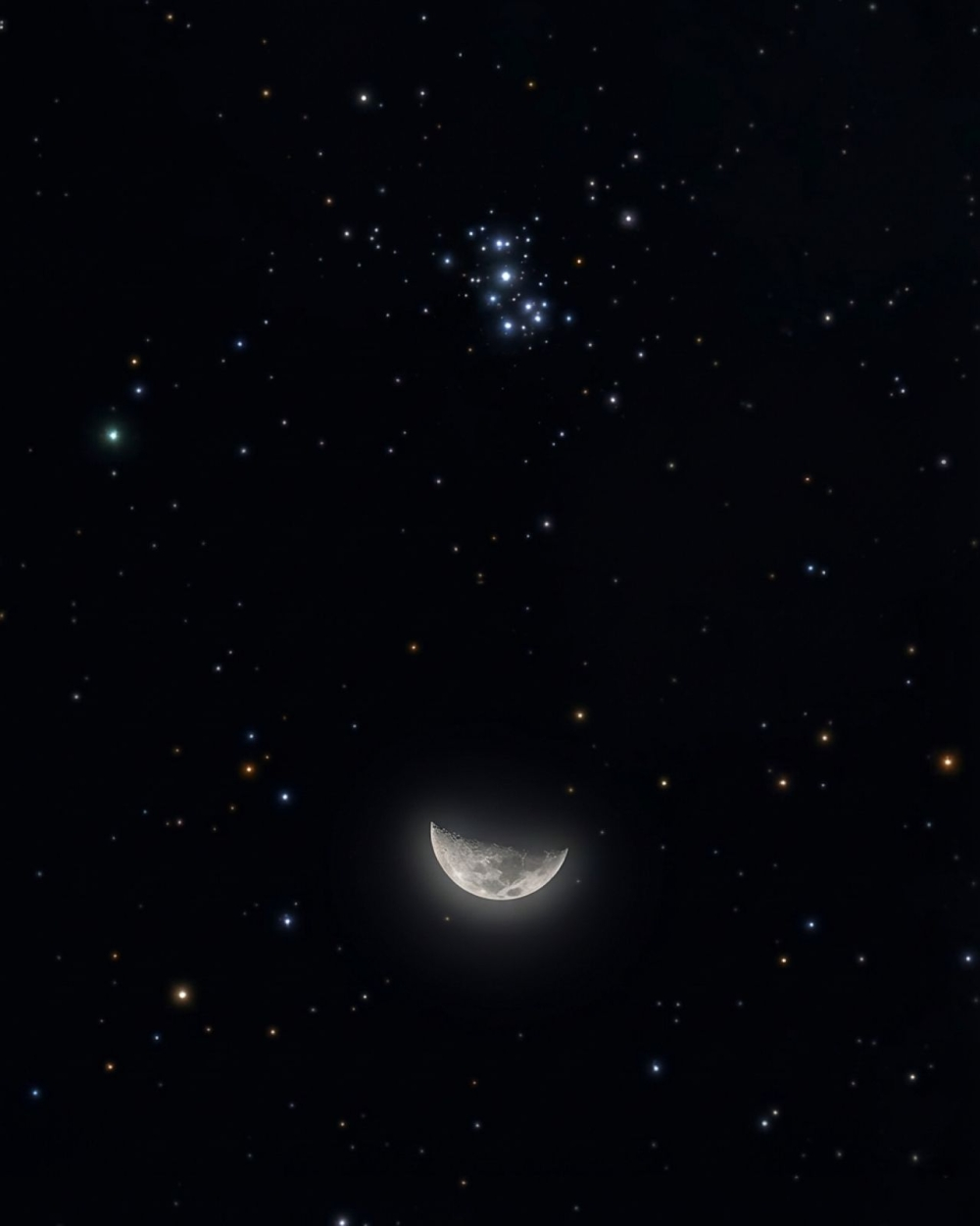
The Jeddah Astronomical Society announced a remarkable astronomical phenomenon that will grace the skies of the Arab world on the evening of Monday, February 23, 2026, as the crescent moon of Ramadan aligns with the famous Pleiades star cluster. The Society's president, Engineer Majid Abu Zahra, explained that this conjunction will create a stunning celestial display easily observable shortly after sunset and the onset of darkness, offering astronomy enthusiasts and those interested in the cosmos a unique opportunity to contemplate the beauty of the universe.
The historical and cultural context of the Pleiades cluster
The Pleiades star cluster, also known as the Seven Sisters, holds a special place in Arab and human heritage throughout the ages. In Arab culture, the Pleiades' appearance was associated with specific seasons, serving as a guide for farmers to determine planting and harvesting times, and for sailors and desert travelers to determine directions. It has been mentioned in numerous ancient Arabic poems and verses as a symbol of beauty, loftiness, and grandeur. Globally, this star cluster has garnered attention from various civilizations, from the ancient Greeks to the Japanese, who call it "Subaru" and have adopted it as the logo for their famous car brand.
Details of the phenomenon and its scientific importance
Scientifically, the Pleiades star cluster is classified as an open star cluster, a collection of relatively young stars that formed from the same cloud of cosmic gas and dust. Located approximately 440 light-years from Earth, this cluster contains hundreds of stars, but only six or seven of them are visible to the naked eye under ideal conditions. The Pleiades stars are characterized by their bright blue color, which indicates their high temperature and young age, estimated at only about 100 million years. Abu Zahra pointed out that the conjunction between the Moon and the Pleiades is merely an apparent conjunction, occurring because the two celestial bodies appear to be on the same line of sight from our perspective on Earth, while in reality, they are separated by vast distances in space. Over millions of years, the stars in this cluster will gradually begin to drift apart due to the weakening gravitational force that binds them together.
How to detect and photograph the conjunction
To witness this celestial event, it is recommended to look westward after sunset. The crescent moon will be waxing and will appear close to the bright Pleiades star cluster. While the moon's brightness may slightly obscure the fainter stars in the cluster, using binoculars or a small telescope will reveal stunning detail and a greater number of stars. For astrophotography enthusiasts, this conjunction presents an ideal opportunity to capture images that combine the delicate crescent moon with the glittering Pleiades in a single frame. Using long exposure techniques, the faint blue nebula surrounding the cluster's stars—the remnants of the cloud from which these stars were born—can be revealed.
The impact and dimensions of the phenomenon
This astronomical phenomenon gains added significance as it coincides with the spiritual atmosphere of the holy month of Ramadan, connecting humanity to the grandeur of the universe and inviting contemplation of creation. Such events also contribute to raising awareness of astronomy and encouraging new generations to explore the mysteries of the heavens. It should be noted that the best viewing locations are far from bright city lights (light pollution), where the sky is clearer and darker, allowing for a more detailed view of the celestial scene.