Introduction: Ramadan 2026 combines spirituality and the wonders of astronomy
The Jeddah Astronomical Society announced that the skies of Saudi Arabia and the Arab region will witness a series of remarkable astronomical phenomena during the holy month of Ramadan in 1447 AH (corresponding to 2026 CE). According to the Society's president, Engineer Majid Abu Zahra, the blessed month will offer an exceptional opportunity for astronomy enthusiasts, photographers, and the general public to enjoy celestial displays combining the beauty of planetary conjunctions, the magnificence of a total lunar eclipse, and the precise timing of the spring equinox, thus adding a cosmic dimension to the spiritual atmosphere of the month.
The historical context of the importance of astronomy in the Islamic world
Astronomy has always been closely linked to Islamic civilization. Early Muslims used it to determine prayer times, the direction of the Qibla (direction of prayer), and the beginnings of lunar months such as Ramadan and Shawwal. Astronomical observatories established in Baghdad, Damascus, Cairo, and other cities served as beacons of knowledge, illuminating the paths of learning for the world. In modern times, organizations like the Jeddah Astronomical Society continue this great legacy by spreading astronomical awareness and connecting the public with the wonders of the universe. These phenomena expected in Ramadan 2026 serve as an open invitation to reflect on the magnificence of creation.
A dazzling start: a quartet adorns the western horizon
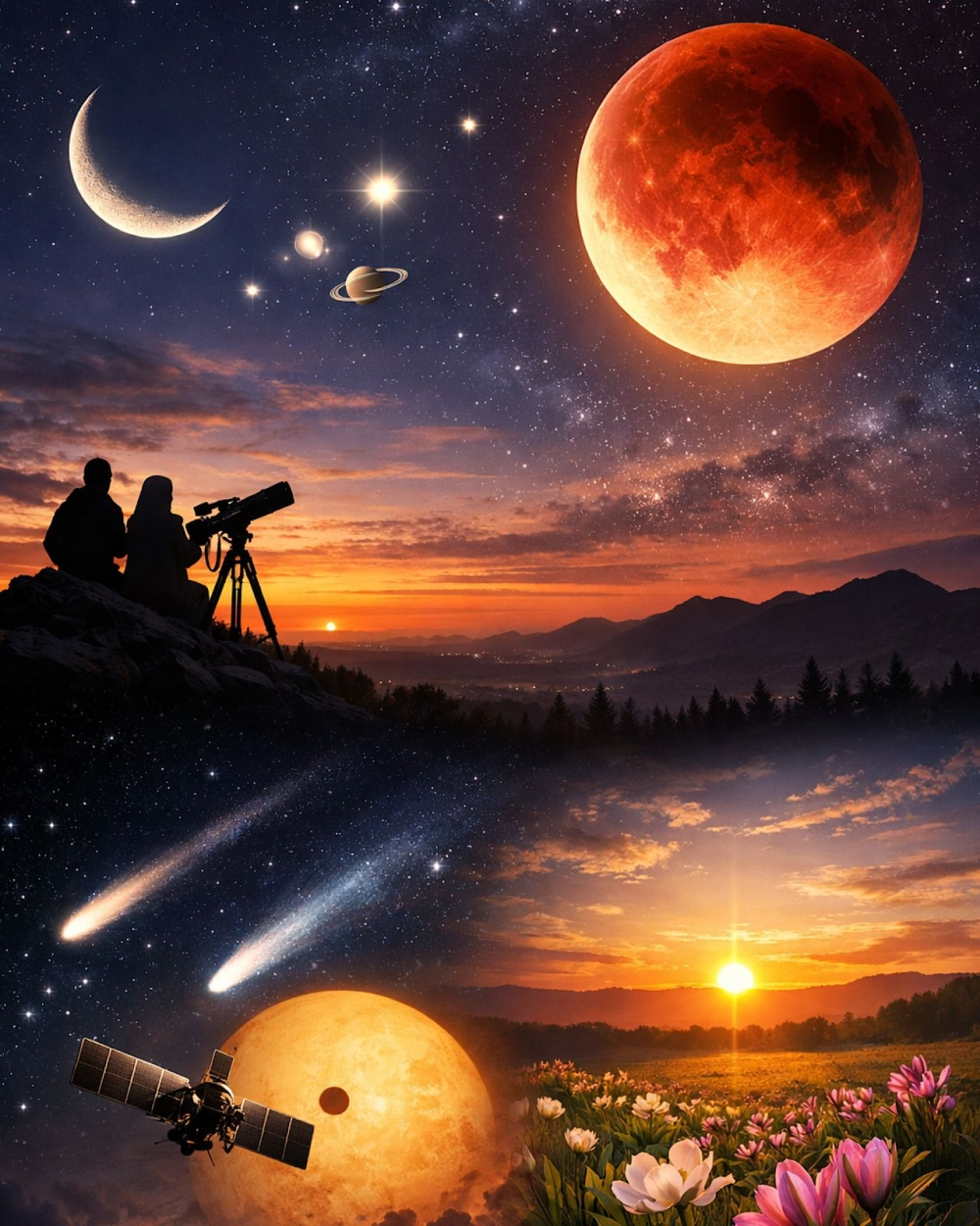
The first celestial display will begin on the evening of Thursday, February 19, 2026, when the crescent moon will align in a beautiful conjunction with three bright planets: Saturn, Mercury, and Venus. This planetary alignment will appear as a low arc of light just above the western horizon after sunset. This spectacle will be visible to the naked eye, weather permitting, and will be a captivating astronomical tableau welcoming the holy month. The view will be even more beautiful when observed through binoculars or small telescopes, revealing even greater detail of the planets and the moon.
The climax of the events: a total lunar eclipse, the "Lavender Moon"
The middle of Ramadan, specifically March 3, 2026, coincides with a full moon and the most prominent phenomenon: a total lunar eclipse, known in some cultures as the "Lavender Moon." A total lunar eclipse occurs when the moon passes completely through the Earth's shadow (umbra), blocking direct sunlight and giving it a faint reddish or coppery hue, a phenomenon known as a "blood moon.".
Abu Zahra explained that this total lunar eclipse will not be visible in most of Saudi Arabia and the Arab world. However, some eastern regions of Oman and the United Arab Emirates may experience the beginning of the eclipse as a penumbral eclipse, where the moon's light dims very slightly. The total phases of the eclipse will be clearly visible in other parts of the world, such as the Americas, Europe, and Africa. Despite its limited visibility in our region, this event remains of global scientific importance, as it allows scientists to study Earth's atmosphere by analyzing the light refracted by the moon's surface.
The spring equinox: a balance between night and day
As Ramadan draws to a close, specifically on March 20, 2026, the spring equinox will occur. This moment marks the astronomical beginning of spring in the Northern Hemisphere, when the sun is directly overhead at the equator. As a result, day and night are of approximately equal length across the globe. This recurring astronomical event not only represents the changing of the seasons but has also held significant historical importance in determining planting dates and celebrations for many ancient civilizations.
Other monitoring opportunities during the holy month
In addition to these major phenomena, Abu Zahra confirmed that the nights of Ramadan 2026 will be relatively quiet in terms of bright meteor showers or comets visible to the naked eye. However, advanced astronomy enthusiasts will have the opportunity to observe some fainter comets, such as 88P/Howell and C/2024 E1, using telescopes. Ramadan nights also remain an ideal time to follow the daily phases of the moon, observe the International Space Station as a bright point of light crossing the sky, and explore deep-sky objects like nebulae and galaxies through telescopes.