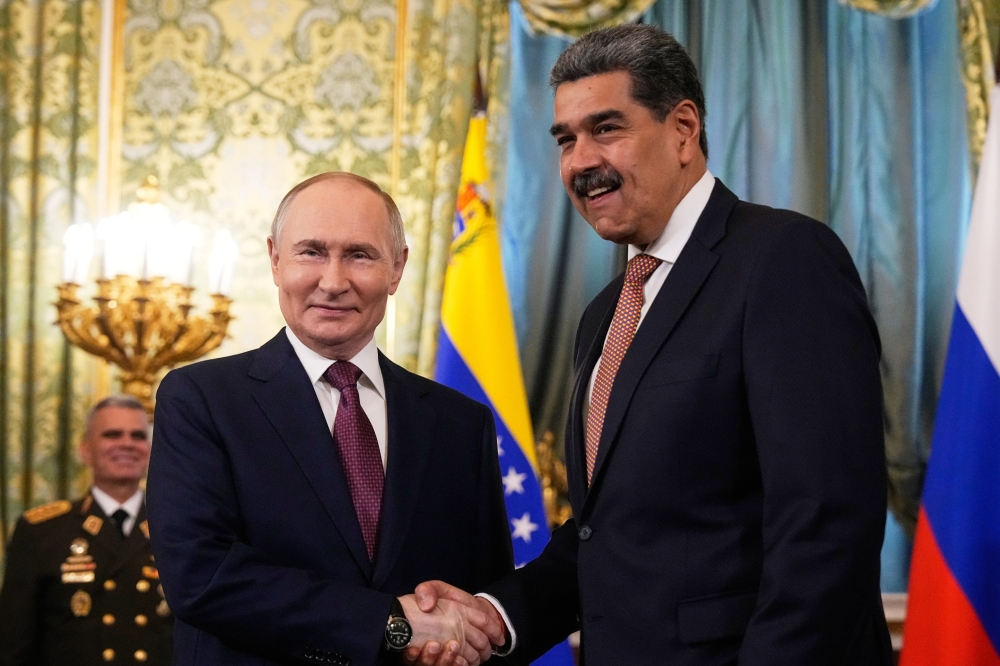
In a significant development reflecting the depth of the geopolitical conflict in Latin America, the Kremlin announced on Thursday that Russian President Vladimir Putin had reaffirmed his full support for his Venezuelan counterpart, Nicolás Maduro. This came during a telephone call between the two leaders at a highly sensitive time, marked by escalating tensions between Caracas and Washington, particularly following the recent US seizure of an oil tanker off the Venezuelan coast.
Contact details and the Russian position
According to a statement released by the Kremlin following the call, President Putin expressed his unwavering solidarity with the Venezuelan people, reaffirming his steadfast support for the policies of the Maduro government aimed at protecting Venezuelan national interests and sovereignty in the face of what he described as “increasing external pressures.” The discussion went beyond mere political support; the two leaders also affirmed their mutual commitment to advancing joint Russian-Venezuelan projects, particularly in vital sectors including the economy, energy, and trade, reflecting Moscow’s desire to maintain the economic lifeline of its South American ally.
Background to the American escalation
This Russian support comes at a time when the US government is escalating its economic and military measures to tighten the noose around the socialist Venezuelan president. Former US President Donald Trump recently stated in an interview with Politico that Maduro's days in power are "numbered." Concurrently, Washington has deployed a large military force in the Caribbean since last summer under the pretext of combating drug trafficking. However, the seizure of the oil tanker sets a dangerous precedent in this crisis, as Washington is directly targeting the hydrocarbons sector, which constitutes Venezuela's primary, and almost sole, source of hard currency revenue.
The historical roots of the Russian-Venezuelan alliance
To understand the dimensions of this support, one must consider the historical context of relations between the two countries. Since the era of the late President Hugo Chávez, Venezuela has sought to build a strategic alliance with Russia to break the traditional American hegemony in the Western Hemisphere. Russia has invested billions of dollars in Venezuela’s oil sector and provided substantial loans, as well as military and technical support to Caracas. Last May, Maduro announced the strengthening of this rapprochement through the signing of a new cooperation treaty, confirming that Moscow views Venezuela as a strategic base of influence that cannot be easily relinquished.
Repercussions of the crisis on the international stage
This escalation carries implications that extend beyond Venezuela's borders; it evokes memories of the Cold War and great power struggles. Putin's support for Maduro sends a clear message that Russia is prepared to defy US sanctions and protect its allies. This situation presents the region with open-ended scenarios, as continued US pressure and corresponding Russian support could prolong the political and economic crisis in Venezuela, with potential repercussions for global energy markets given Venezuela's vast oil reserves.