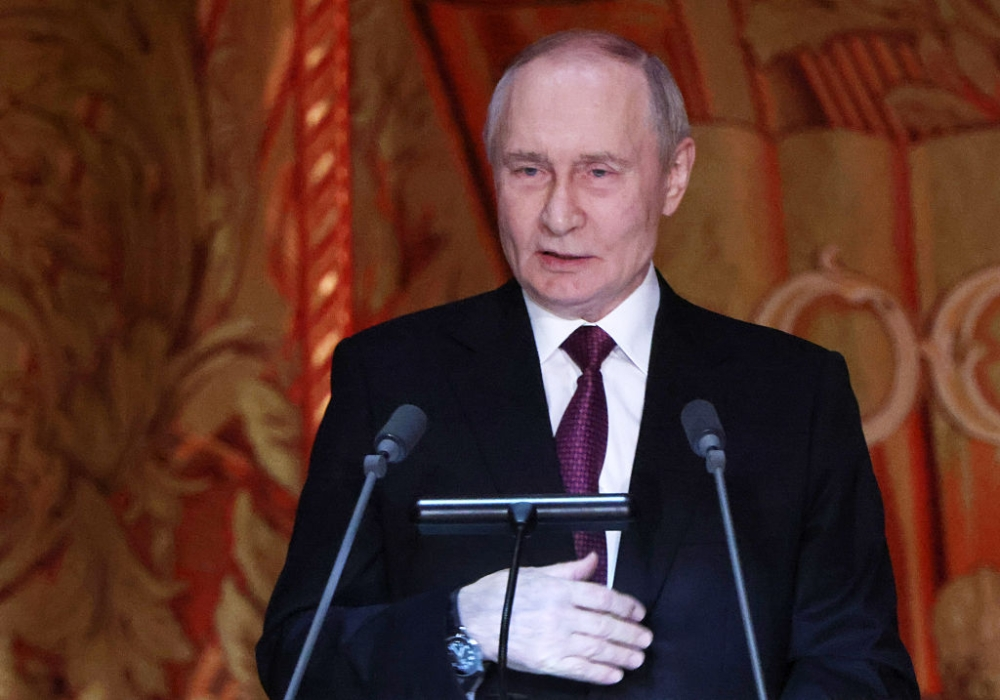
Russian President Vladimir Putin declared that the development of Russia's nuclear forces has become an "absolute priority," a statement reflecting a major strategic shift in Russian defense policy. The announcement, made in a televised address marking "Defender of the Fatherland Day," a national holiday honoring the armed forces, comes amid heightened geopolitical tensions, particularly following Russia's suspension of its participation in the New START treaty, the last major nuclear arms control agreement with the United States.
Putin emphasized that “the development of the nuclear triad, which guarantees effective strategic deterrence and the balance of power in the world, remains our absolute priority.” The “nuclear triad” refers to land-based, sea-based, and air-based nuclear capabilities, including intercontinental ballistic missiles, nuclear-armed submarines, and strategic bombers. The Russian president pledged to continue strengthening the overall capabilities of the army and navy, noting that the defense industry will leverage the experience gained during the conflict in Ukraine to modernize all branches of the armed forces.
Historical context: The collapse of the last pillars of arms control
The New START Treaty, signed in 2010 by Presidents Barack Obama and Dmitry Medvedev, represents the culmination of decades of arms control efforts that began during the Cold War. The treaty imposed limits on the number of strategic nuclear warheads that both Russia and the United States could deploy and set a ceiling on the number of missiles and launchers capable of carrying them. In February 2023, Russia announced its withdrawal from the treaty, accusing Washington of supporting Ukraine in the conflict. This led to the suspension of mutual verification and data exchange mechanisms, effectively rendering the treaty ineffective and sparking widespread international concern.
The importance and expected impact of the Russian decision
Putin’s decision to prioritize nuclear forces has profound implications at the domestic, regional, and international levels. Domestically, the decision aims to garner internal support and bolster a sense of national sovereignty and strength in the face of Western pressure. Regionally, it serves as a clear deterrent message to NATO countries, particularly those bordering Russia, indicating that Moscow is prepared to defend its strategic interests by all available means.
Internationally, this trend raises serious concerns about a new and uncontrolled nuclear arms race. In the absence of binding treaties, other nuclear powers, such as China, may feel compelled to expand their arsenals to maintain the balance of power, further destabilizing the world and increasing the risk of miscalculation that could lead to nuclear conflict. This shift marks the end of an era of relative cooperation on arms control and ushers the world into a new phase of uncertainty and risky strategic competition.