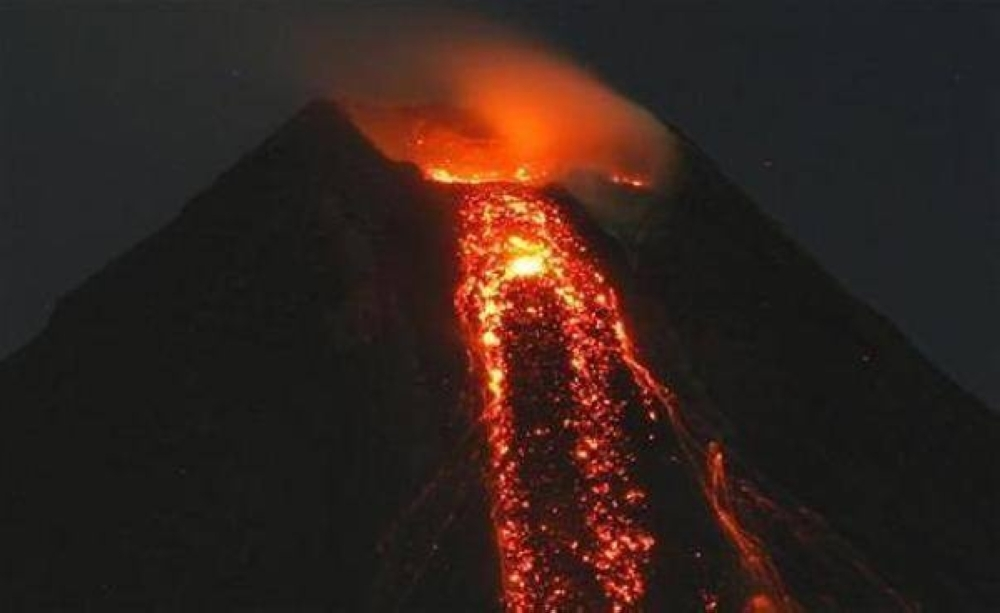
Philippine authorities announced today that they have raised the alert level for Mayon Volcano in Albay province, in the central part of the country, to level three on a five-point scale. This decisive action comes in response to alarming geological indicators detected by the Philippine Institute of Volcanology and Seismology (PHIVOLCS), which show magma rising towards the volcano's crater, raising the possibility of a "hazardous eruption" within the next few days or weeks.
Warning details and potential risks
The institute explained in its official statement that raising the alert level means the volcano is experiencing high magmatic activity. A lava dome has been observed forming at the summit, accompanied by frequent rockfalls and pyroclastic flows. Consequently, authorities emphasized the need to evacuate residents within the "permanent danger zone," which extends six kilometers around the volcano, warning of the risks of lava flows, rockfalls, and landslides that could be exacerbated by rainfall.
Mayon Volcano: Deadly Beauty and a History of Eruptions
Mount Mayon is one of the Philippines' most active and world-famous volcanoes, renowned for its near-perfect cone shape, making it a major tourist destination in the Bicol region. However, this beauty also masks a long history of devastation. The volcano lies within the Pacific Ring of Fire, an area of intense seismic and volcanic activity. Historically, Mayon has erupted more than 50 times over the past four centuries.
Perhaps the most tragic event in its history occurred in 1814, when a violent eruption buried the entire town of Kagsawa under ash and rock, killing more than 1,200 people. Only the church bell tower, which still stands as a testament to the disaster, remains. In more recent times, specifically in 2018, an eruption displaced tens of thousands of residents and blanketed vast areas in ash, negatively impacting agriculture and the local economy.
Regional impacts and safety measures
The dangers posed by the Mayon volcano extend beyond its immediate vicinity, encompassing broader economic and environmental impacts. The Albay region's economy relies heavily on agriculture, particularly coconut and abaca cultivation, which is directly threatened by the acidic volcanic ash. Furthermore, the Civil Aviation Authority has warned pilots against flying near the volcano's summit, as the emitted ash can severely damage aircraft engines, potentially disrupting air traffic in the area.
The Philippine government is currently working in coordination with local government units to prepare shelters and secure food and medical supplies, in anticipation of any sudden escalation in volcanic activity that may necessitate large-scale evacuations beyond the currently restricted area.