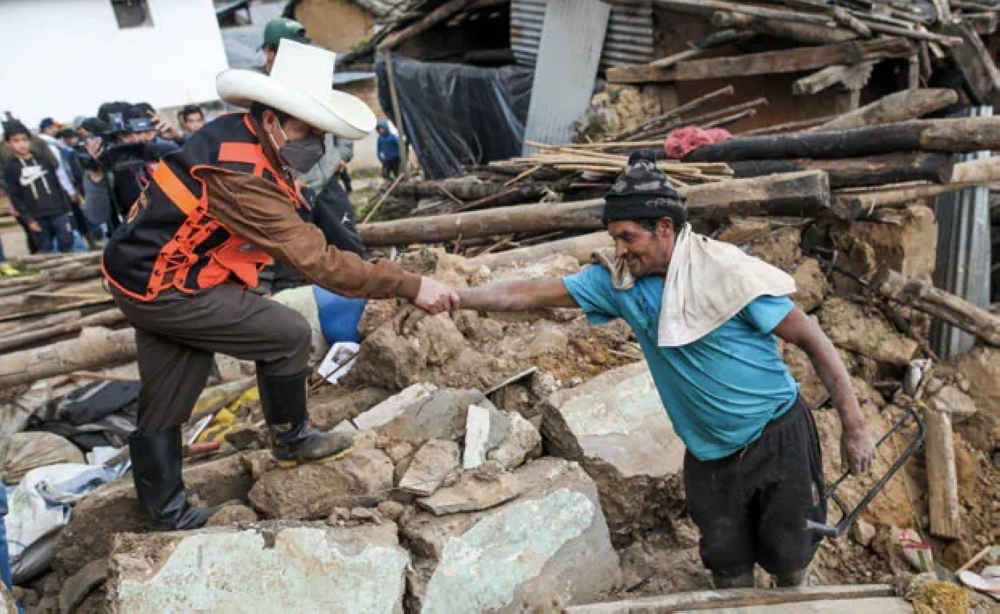
Authorities in Peru announced on Sunday that a magnitude 6 earthquake struck the Ancash region north of the capital, Lima, injuring at least 25 people and causing material damage to infrastructure, including hospitals and schools.
According to official reports, the earthquake struck on Saturday evening at 9:51 PM local time (Sunday at 2:51 AM GMT), with its epicenter located off the coast of the port city of Chimbote. The tremor caused panic among residents who rushed into the streets fearing building collapses or strong aftershocks.
Details of injuries and material damage
The Peruvian Ministry of Health stated in an official statement that the initial count of injured was 25 people, with 12 requiring hospitalization for further treatment, while 13 others received first aid and were discharged. In Chimbote, a city of approximately half a million inhabitants, the main hospital suffered structural damage and cracks, further complicating rescue efforts.
Videos and photos circulated by local media and social media platforms showed cracked buildings, collapsed supermarket shelves, and damage to a number of schools and residential homes in the area surrounding the epicenter.
Peru and the Ring of Fire: A Geological Context
These events are particularly significant given Peru's geographical and geological location; the country, with a population of approximately 34 million, lies within the Pacific Ring of Fire. This region is one of the most seismically and volcanically active in the world, experiencing about 90% of the world's earthquakes.
The primary cause of this intense seismic activity is tectonic plate movement, specifically the subduction of the oceanic Nazca Plate beneath the continental South American Plate. This ongoing geological process generates immense pressure, which is periodically released in the form of earthquakes of varying intensity, resulting in Peru experiencing an average of 100 perceptible earthquakes annually.
Memories of the 1970 disaster in Ankash
This earthquake brought back painful memories for the residents of the Ancash region in particular, which was the scene of one of the deadliest earthquakes in Latin American history. In 1970, a devastating 7.9 magnitude earthquake struck the same area, triggering a massive avalanche from Mount Huascarán.
That historic disaster buried the city of Yeongai completely under ice and rock, killing approximately 67,000 people and displacing hundreds of thousands. This historical context makes any seismic activity in the Ankash region a source of great concern, both for local residents and for disaster management authorities, who are constantly updating emergency protocols to prevent a recurrence of past tragedies.