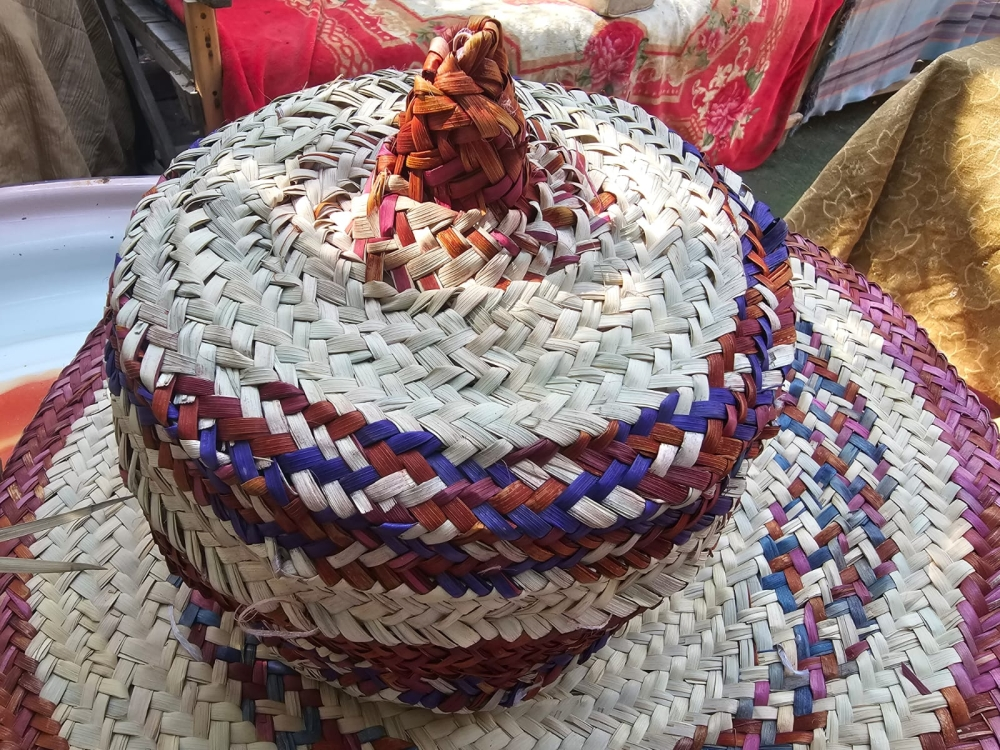
The Qatif Governorate in the Eastern Province is witnessing a vibrant cultural and heritage movement, spearheaded by a select group of seasoned artisans who have taken it upon themselves to protect the "palm frond" craft from extinction. These efforts involve passing down the secrets of this intricate craft, known locally as "palm frond engineering," from generation to generation, ensuring the sustainability of the region's rich heritage and bolstering the creative economy based on traditional handicrafts.
Historical depth and palm civilization
This craft cannot be separated from the historical and geographical context of the Eastern Province, which has long been known as home to some of the world's largest palm oases. Before the discovery of oil, the date palm was the lifeblood of the inhabitants of Qatif and Al-Ahsa, not only as a source of food but also as a primary source of building materials, furniture, and household items. The palm frond weaving industry formed an integral part of the traditional local economy, with ancestors skillfully adapting palm fronds to serve their daily needs. This craft stands as a testament to humanity's ability to adapt to its environment and utilize its natural resources intelligently and sustainably.
Pioneers of the craft and documentation of memory
Within this movement, the craftsman Ali Hassan Al-Rabeh stands out, emphasizing that his adherence to this craft is an extension of his father, Haj Hassan Al-Rabeh's, legacy. Through his tireless work, Al-Rabeh aims to document and vividly transmit this traditional way of life to new generations. He possesses years of experience transforming palm fronds into functional and aesthetic products, including baskets, mats, and woven baskets, as well as traditional cooling tools such as hand fans, and tableware and hospitality items like mats and rugs.
Secrets of manual engineering
For his part, palm frond craftsman Abdulrab Al-Matar recounts his journey, which began at the age of nine when he learned the fundamentals of the craft from his mother. Al-Matar mastered the basic "weaving" technique, from which all other artistic forms branch out. His production relies on complex, innate engineering skills, starting with six frond heads before adding the "seventh head," which veteran craftsmen call "the father," the essential support upon which the final product's integrity is built.
Al-Matar points out that crafting a single "saffa" requires meticulous precision and immense patience, as it necessitates preparing thirty "saffas," each three and a half cubits long, which are then intricately woven together using a finely crafted technique. The technical terms vary depending on the number of branches, such as "takhmisa" (two branches), "samt" (four branches), and so on up to "ushr.".
Cultural and economic importance
These efforts are of paramount importance at present, aligning with national initiatives to revive intangible heritage and promote cultural tourism. Preserving the palm frond weaving craft is not merely a matter of sentiment; it also contributes to the local economy through participation in heritage festivals and traditional markets that attract visitors and tourists. The artisans emphasize that their primary motivation is not financial gain, but rather the preservation of historical memory. Some even refuse to sell their rare pieces, preferring them to remain as testaments to a bygone era and the region's authentic heritage.