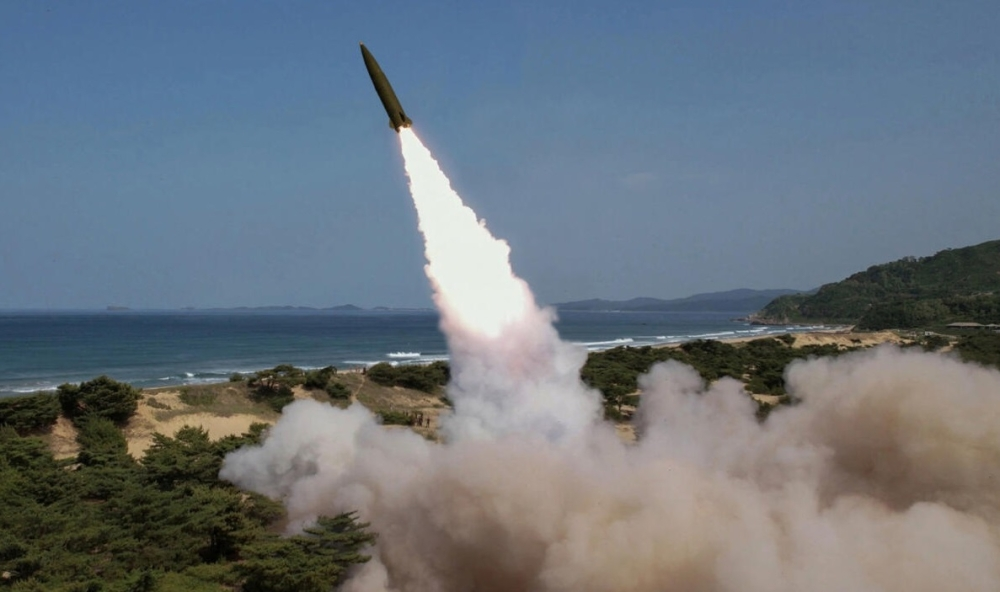
In a new escalation that further heightens tensions on the Korean Peninsula, Pyongyang announced a series of advanced military operations. North Korea’s latest missile tests highlight its multiple rocket launcher system, which the Korean Central News Agency described as its “most advanced.” This announcement came just one day after Seoul confirmed detecting the launch of approximately ten short-range ballistic missiles from the Pyongyang area toward the Sea of Japan, raising serious questions about the future of stability in the region.
The historical context of North Korea's missile testing development
This move was not a spur-of-the-moment decision, but rather the culmination of decades of relentless efforts by Pyongyang to bolster its military arsenal. Historically, North Korea began its missile program in the late 1970s and 1980s by replicating Soviet Scud missiles, gradually evolving into the production of intercontinental ballistic missiles capable of carrying nuclear warheads. Despite a series of harsh sanctions imposed by the UN Security Council since 2006 aimed at curbing this program, Pyongyang has continued to defy the international community, maintaining that developing its military capabilities is the only guarantee of the regime's survival in the face of what it describes as persistent American threats.
Details of the deadly weapon and its superior destructive power
North Korean leader Kim Jong Un personally oversaw the military test, which involved the use of 12 "high-precision 600mm multiple rocket launchers" and two artillery batteries. According to official statements, the system is considered by the North Korean leadership to be "a very lethal but attractive weapon.".
Kim Jong Un asserted that the test was intended to instill "concern" in enemies within a 420-kilometer strike range, placing large swaths of South Korean territory and US military bases there within range. The Korean Central News Agency (KCNA) reported that the missiles struck their targets in the East Sea (Sea of Japan) at a distance of 364.4 kilometers with 100% accuracy, demonstrating the system's high destructive power and strategic military value, and reinforcing a deeper understanding of the destructive force of tactical nuclear weapons.
Regional and international repercussions of the recent escalation
These tests have far-reaching implications and effects that extend beyond local borders to encompass the regional and international arenas. Regionally, these weapons pose a direct threat to the national security of South Korea and Japan. The South Korean Joint Chiefs of Staff quickly issued a statement confirming the detection of unidentified ballistic missile launches from the Sunan area toward the East Sea.
The South Korean presidency strongly condemned the launches, describing them as a “blatant provocation that violates UN Security Council resolutions,” and demanded that Pyongyang immediately cease these hostile acts. Internationally, this escalation is seen as a clear message of defiance to the United States and its allies, especially since the test comes just days after South Korean and US forces began their joint spring military exercises. North Korea views these maneuvers as a rehearsal for invasion, prompting it to respond by showcasing its missile and nuclear capabilities, which threatens an arms race that could complicate diplomatic efforts to achieve peace and denuclearization of the Korean Peninsula.