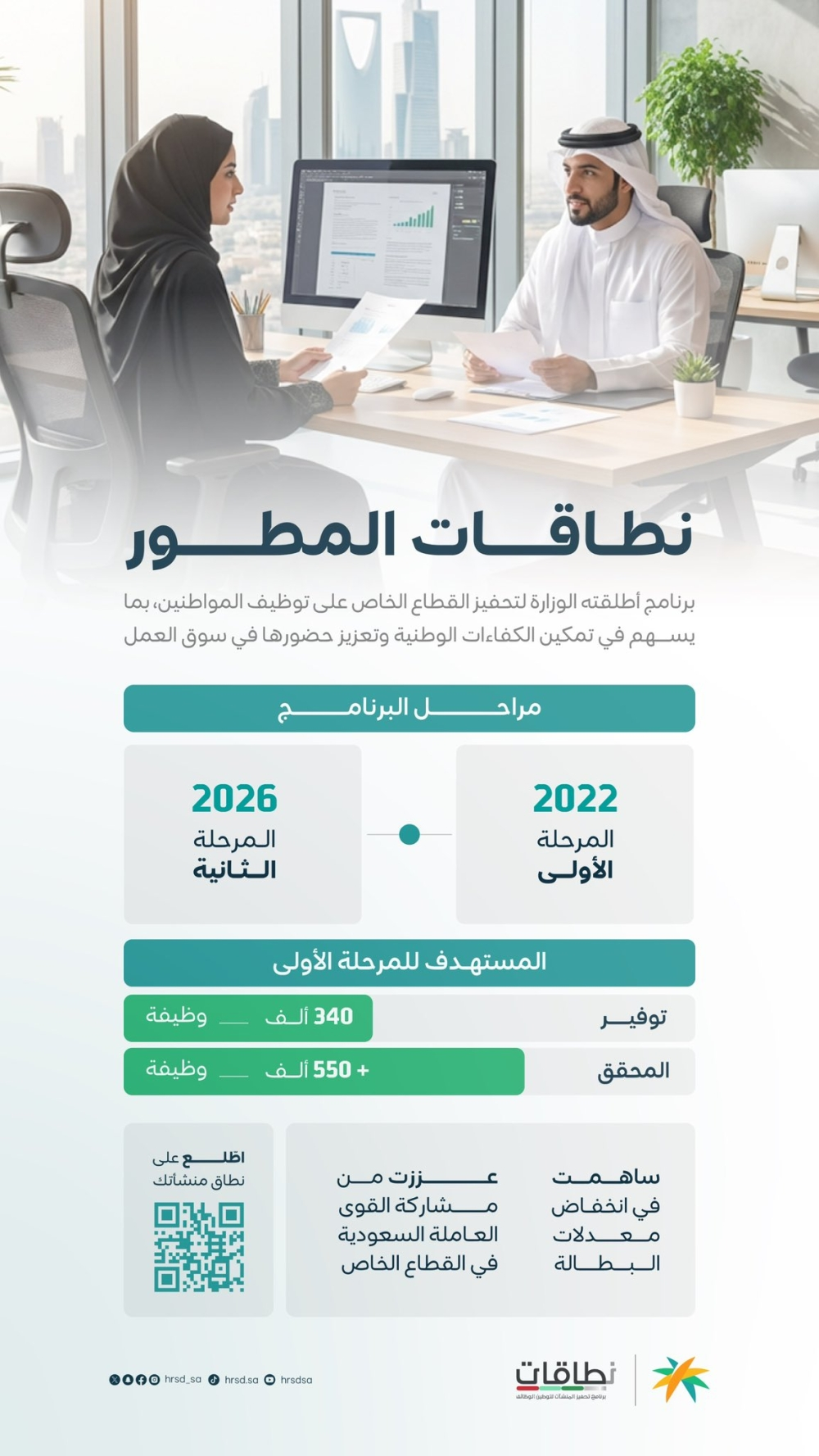
Introduction: A strategic update to the labor market
The Ministry of Human Resources and Social Development in the Kingdom of Saudi Arabia announced the adoption of the updated procedural guide for the “Developerated Nitaqat” program, whose plans are scheduled to be fully implemented by 2026. This update represents a strategic step aimed at enhancing the efficiency of the labor market and raising the rates of Saudization in private sector establishments, in direct line with the ambitious goals of the Kingdom’s Vision 2030, which seeks to build a sustainable economy based on empowering national talent and raising its productivity.
Historical context of the Nitaqat program
The “Developer Nitaqat” program did not emerge in a vacuum; rather, it is an extension and development of the “Nitaqat” program, which was first launched in 2011. The program's primary objective from its inception was to address the challenges of unemployment among Saudi citizens by obligating private sector establishments to achieve specific Saudization quotas. Over time, the program evolved to become more dynamic and flexible, moving from simply imposing fixed percentages to a sophisticated system that classifies establishments based on their actual Saudization performance compared to their counterparts in the same economic activity and size—a model embodied in today's “Developer Nitaqat.”.
Explanation of the colors of the five ranges and their effect
The program classifies establishments into five color-coded zones, each representing the establishment's level of commitment to achieving the required Saudization ratios, and is linked to a package of services, facilities, or restrictions. These zones are:
- Platinum scope: Represents the highest level of commitment, and establishments within it enjoy full facilities and priority in services, such as immediate visa access, changing professions, and transferring services without restrictions, which enhances their ability to grow and expand.
- High Green Zone: Indicates a very high level of commitment, and its facilities receive significant benefits similar to the Platinum Zone, with high flexibility in managing its human resources.
- The medium green range: This is considered a safe and acceptable level, where establishments benefit from most of the basic services that enable them to continue their work effectively, while motivating them to move up to higher ranges.
- The low green zone represents the minimum level of compliance required to avoid strict restrictions. Establishments in this zone face certain limitations, such as a halt to accepting new visa applications, as a sign that they need to improve their Saudization performance.
- The red zone is the lowest category, and establishments in this category are subject to the strictest restrictions. Most ministry services are suspended for these establishments, including work permit renewals, new visa issuance, and transfers of sponsorship. The aim is to compel these establishments to rectify their situations urgently.
The importance and expected impact of the program
The updated “Developer Nitaqat” program is of paramount importance on several levels. Locally , the program contributes to creating genuine and sustainable job opportunities for Saudi citizens and enhances job quality by incentivizing companies to invest in training and development. It also fosters a competitive and equitable work environment, rewarding companies committed to Saudization, thus supporting their stability and growth. Regionally and internationally , the program sends a clear message to foreign investors and global companies that developing national human capital is an integral part of the Kingdom’s investment environment. Furthermore, it impacts the dynamics of the labor market in the region, as Saudization policies reshape the demand for expatriate labor, potentially affecting remittances to labor-exporting countries and encouraging the redirection of expatriate workers towards specialized professions where they are still needed.
Calculation and transparency mechanism
The ministry affirmed that the updated procedural guide provides complete transparency for establishments, detailing the mechanism for calculating the required Saudization percentages for each activity and establishment size. This is done through a mathematical formula that considers the total number of employees, applying fixed values that vary according to the economic activity, thus ensuring fair classification and its ability to adapt to market changes. This clarity enables companies to strategically plan their human resources and efficiently achieve their Saudization targets.