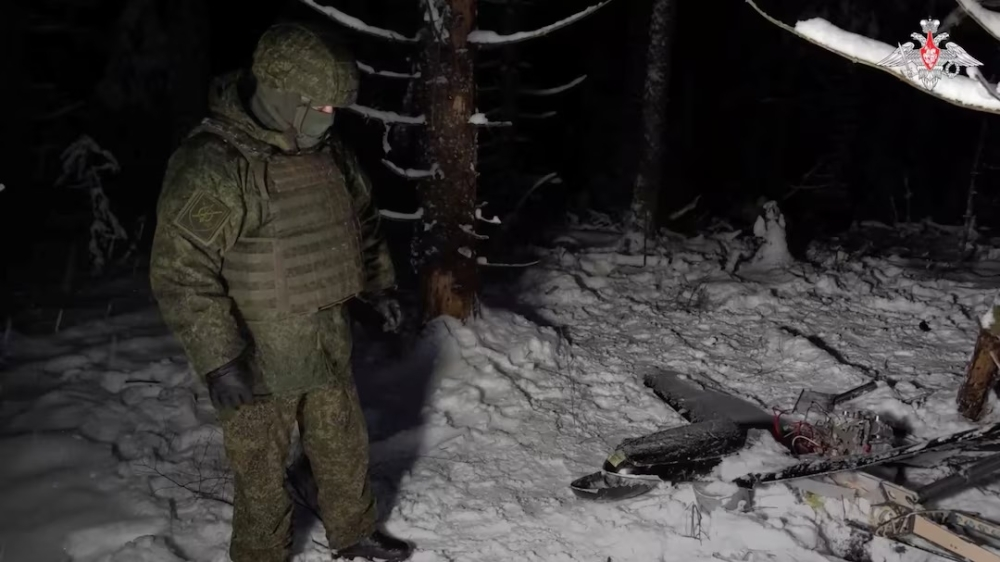
In a significant development in the Russian-Ukrainian conflict, the Russian Defense Ministry released a video on Wednesday showing what it claimed was the wreckage of a downed drone, accusing Ukraine of using it in an attempt to target President Vladimir Putin's residence in northwestern Russia. This announcement further complicates the political and military landscape, especially given Kyiv's categorical denial of the accusations, which it described as "fabricated lies.".
Details of the Russian novel and the published video
A video circulating online overnight showed a damaged drone lying in the snow in a remote wooded area. According to a statement from the Russian Ministry of Defense, the alleged attack was not random but rather "precisely planned and executed," carried out in multiple stages to ensure the target was hit.
Moscow specified the timing of the attack as the night of December 28-29, targeting President Putin's residence in the Valdai region of Novgorod Oblast. Valdai is a heavily guarded area between Moscow and St. Petersburg, known for housing one of the most important presidential residences. The Russian military released a map purporting to show the flight paths of 91 drones involved in the extensive attack, while simultaneously asserting that the residence sustained no damage. It was not disclosed whether the president was present at the time of the incident.
Context of drone warfare and historical background
This is not the first such accusation in the context of the ongoing conflict; since the outbreak of war, drones have become a strategic weapon in the battle. This incident brings to mind previous accusations, most notably the drone attack on the Kremlin in May 2023, which Moscow considered an assassination attempt against the president. Kyiv employs a strategy of targeting the Russian interior in retaliation for the ongoing shelling of its territory, but it rarely officially claims responsibility for attacks directly targeting political figures, making the current accusation a highly controversial point.
International skepticism and lack of independent evidence
The Russian account was met with widespread skepticism from Western parties and independent observers. The American Institute for the Study of War (ISW), which documents the conflict, pointed out the absence of any independent visual evidence or amateur or local media images documenting the explosions or air defenses that night, which is unusual for attacks deep inside Russia that would typically flood platforms like Telegram immediately after they occur.
For its part, the European Union believes that Moscow is trying, through these "baseless allegations," to create a pretext to undermine the diplomatic progress recently made at the behest of Ukraine and its allies.
The impact of the incident on peace negotiations
This event gains particular significance from its sensitive timing; it comes amid reports of little progress in the diplomatic negotiations that began last November with the aim of ending the deadliest conflict in Europe since World War II. Moscow has explicitly warned that this attack, which it has described as "terrorist" and a personal assault, will lead it to significantly harden its negotiating position.
Analysts believe that such incidents, whether real or fabricated, could be used as political leverage to raise the bar for demands or to justify a future military escalation, putting international de-escalation efforts to a difficult test that could send things back to square one.