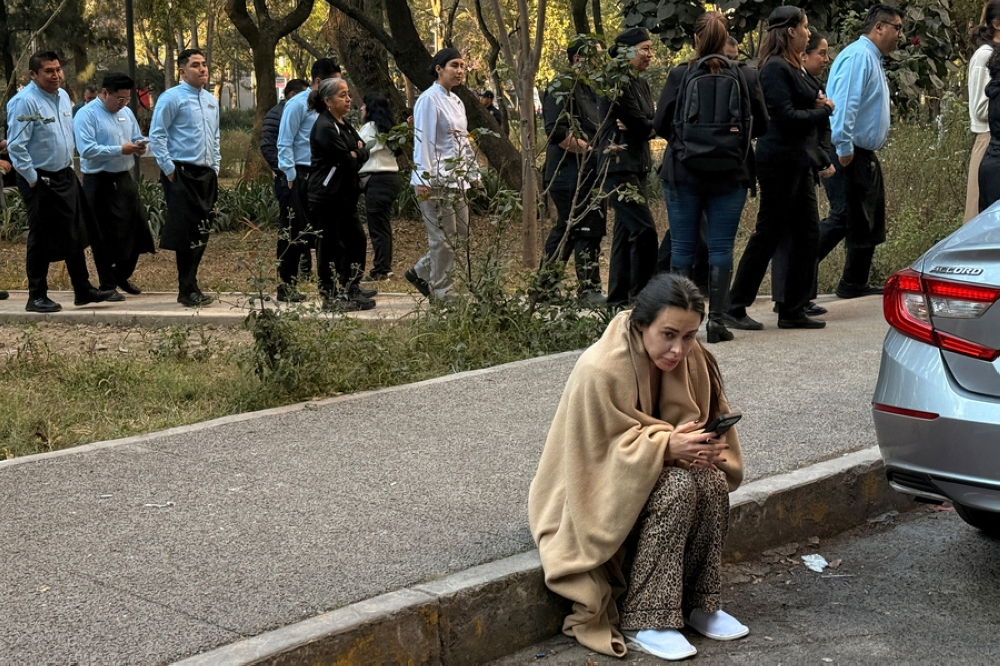
Mexico City experienced moments of tension and anticipation on Friday after a powerful earthquake measuring 6.5 on the Richter scale, according to the National Seismological Service. The geological event triggered emergency protocols at the highest levels, forcing Mexican President Claudia Sheinbaum to cut short her usual morning press conference and immediately evacuate the presidential palace in response to the sounding sirens.
Details of the incident and evacuation of the presidential palace
While speaking to reporters at the National Palace, the earthquake sirens sounded, prompting President Sheinbaum to calmly but firmly leave, following established safety procedures. After a few minutes of anticipation, she returned to continue the press conference, assuring reporters and those present that the situation was under control. Sheinbaum explained that initial reports indicated no major damage in either Mexico City or the state of Guerrero, where the earthquake's epicenter was located.
According to official data, the epicenter was located 15 kilometers from the town of San Marcos in the southern state of Guerrero, about 230 kilometers from the capital. The U.S. Geological Survey recorded the earthquake at 13:58 GMT (07:58 local time), which is the peak of morning activity in the country.
Why is Mexico considered an active earthquake hotspot?
To understand the context of this event, one must consider the complex geological nature of Mexico. The country lies above a seismically active region known as the Pacific Ring of Fire, an area of constant interaction between tectonic plates. Specifically, Mexico sits atop the North American Plate and is subjected to constant pressure from the subducting Cocos Plate, generating immense energy that is released in the form of earthquakes, often centered off the coast of Guerrero state.
What exacerbates the situation in Mexico City is the nature of its soil; the city is built on the bed of an ancient lake that has dried up, making its ground clayey and soft. This geological characteristic acts as an amplifier for seismic waves, making earthquakes seem stronger and more destructive compared to areas with solid rocky soil, which explains why tremors are felt so strongly even if their epicenters are hundreds of kilometers away.
A painful historical memory and preventive measures
Mexicans have a painful collective memory of earthquakes, which explains their rapid response to the sound of sirens. On September 19, 1985, a devastating 8.1 magnitude earthquake struck the capital, causing widespread destruction and killing nearly 13,000 people, according to official figures, forever altering the face of the city. The tragedy was repeated on subsequent dates, prompting the Mexican government to invest heavily in early warning systems (SASMEX), which give residents precious seconds to evacuate before the arrival of destructive seismic waves.
This latest earthquake serves as a constant reminder of the natural challenges facing Mexico, and of the importance of strict adherence to earthquake-resistant building standards and evacuation protocols that have proven effective in protecting lives, as demonstrated today by the safe evacuation of the presidential palace.