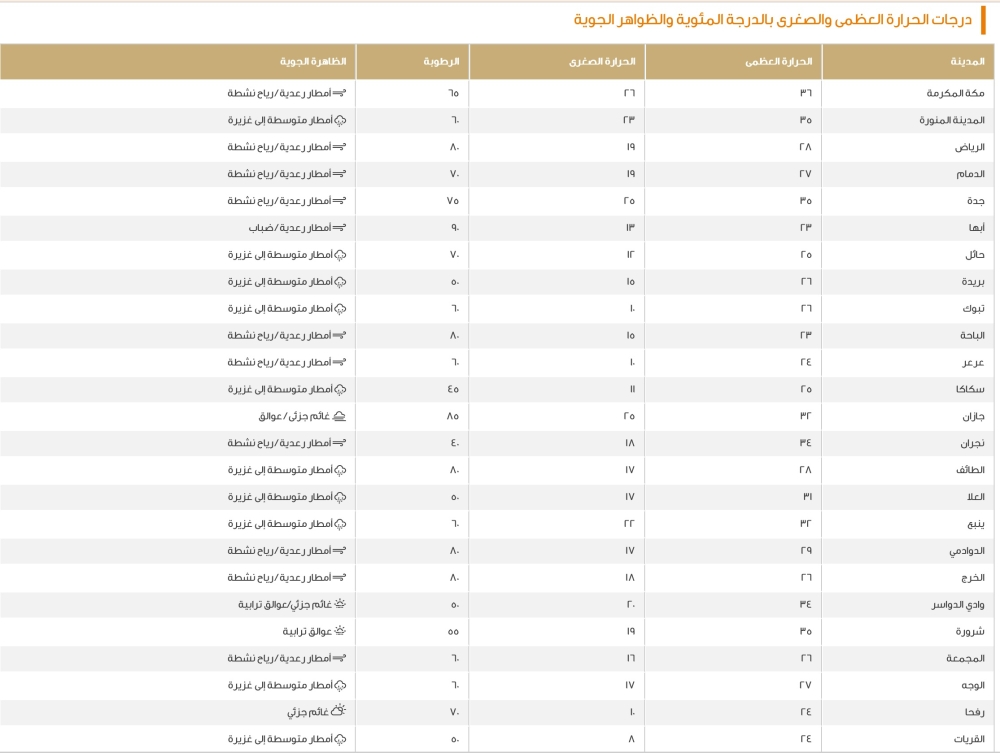
The National Center for Meteorology issued its detailed daily report on Wednesday, which included maximum temperatures in various cities and regions of the Kingdom of Saudi Arabia. The report showed a noticeable variation reflecting the weather patterns during this period, with Dammam recording 27 degrees Celsius, while Mecca topped the list with the highest recorded temperature at 36 degrees Celsius. This necessitates that citizens and residents adjust their daily activities accordingly.
List of recorded temperatures in the cities of the Kingdom
The details of the temperatures recorded by the monitoring stations of the National Center for Meteorology are as follows:
- Dammam: 27 degrees Celsius.
- Mecca: 36 degrees Celsius.
- Medina: 35 degrees Celsius.
- Riyadh: 28 degrees Celsius.
- Jeddah: 35 degrees Celsius.
- Abha: 23 degrees Celsius.
- Hail: 25 degrees Celsius.
- Buraidah: 26 degrees Celsius.
- Tabuk: 26 degrees Celsius.
- The courtyard: 23 degrees Celsius.
- Arar: 24 degrees Celsius.
- Sakaka: 25 degrees Celsius.
- Jazan: 32 degrees Celsius.
- Najran: 34 degrees Celsius.
- Taif: 28 degrees Celsius.
- Al-Ula: 31 degrees Celsius.
- Yanbu: 32 degrees Celsius.
- Al-Dawadmi: 29 degrees Celsius.
- Al-Kharj: 26 degrees Celsius.
- Wadi Al-Dawasir: 34 degrees Celsius.
- Sharurah: 35 degrees Celsius.
- Combined: 26 degrees Celsius.
- Face: 27 degrees Celsius.
- Rafha: 24 degrees Celsius.
- Al Qurayyat: 24 degrees Celsius.
- Tarif: 23 degrees Celsius.
- Al Qunfudhah: 32 degrees Celsius.
- Al-Ahsa: 28 degrees Celsius.
- Hafar Al-Batin: 22 degrees Celsius.
- Bisha: 33 degrees Celsius.
- Al-Sawda: 19 degrees Celsius.
- Rawdat Al-Tanhat: 26 degrees Celsius.
- Al-Dahna desert: 25 degrees Celsius.
- Al-Saman: 27 degrees Celsius.
Climatic and geographical diversity in Saudi Arabia
The Kingdom of Saudi Arabia is characterized by a unique geographical and climatic diversity, which explains the significant variations in daily temperature readings. Historically, the Arabian Peninsula was known for its arid desert climate, but the Kingdom's vast area and varied topography create a range of local climates. The high mountainous regions in the southwest, such as Abha and the Asir Mountains, enjoy a mild, cool climate, with Asir recording the lowest temperature in the report at only 19 degrees Celsius. In contrast, coastal and desert areas, such as Mecca and Sharurah, experience significantly higher temperatures. This geographical diversity is not a recent phenomenon; rather, it is a historical characteristic that has made the Kingdom a rich environment of diverse climates and environments.
The importance of monitoring maximum temperatures and their effects
Close monitoring of weather data and maximum temperatures a vital role in daily and strategic planning. Locally, these readings directly impact critical sectors such as agriculture, where irrigation and harvesting schedules depend on stable weather. Energy consumption rates, particularly for cooling and air conditioning systems, are also linked to temperature fluctuations, necessitating careful planning of electrical loads by relevant authorities.
At the regional and international levels, the National Center of Meteorology's reports contribute to strengthening the climate database for the Arabian Peninsula, aiding researchers in studying climate change and its impact on the region. The Kingdom's commitment to providing accurate and transparent climate data aligns with global efforts to monitor global warming and underscores Saudi Arabia's leading role in supporting environmental initiatives, such as the "Saudi Green Initiative," which aims to increase vegetation cover and improve quality of life to address future climate challenges.