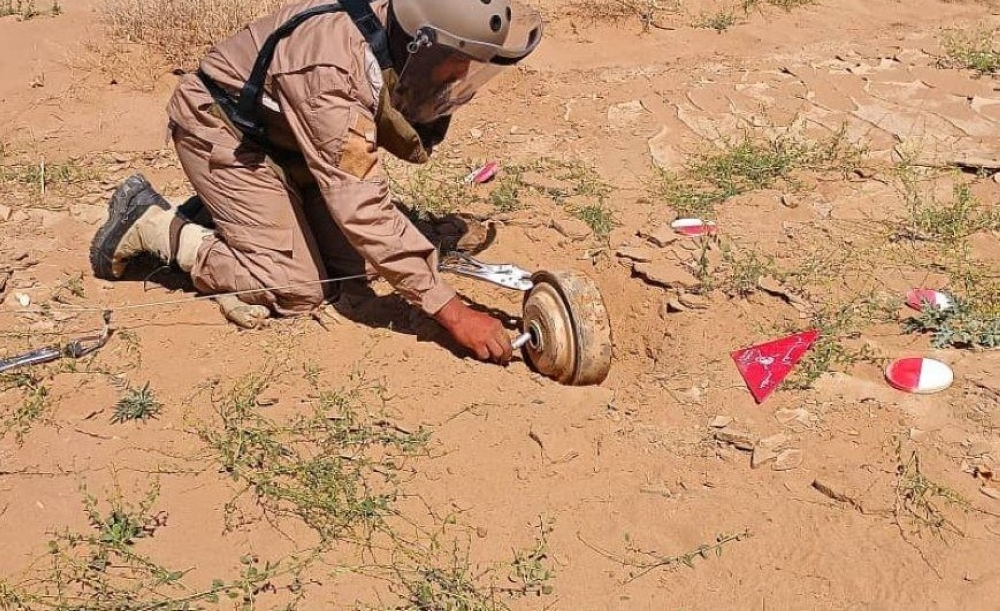
The Masam Project for clearing Yemeni lands of mines, affiliated with the King Salman Humanitarian Aid and Relief Center, announced a new milestone in its ongoing humanitarian efforts. During the fourth week of January 2024, the project's field teams successfully removed a total of 2,108 mines and unexploded ordnance in several Yemeni governorates, representing a significant step towards securing civilian lives and restoring hope to affected areas.
Details of recent demining operations
The demining operations targeted various types of explosives that pose a direct threat to the lives of Yemenis, including 31 anti-personnel mines, 75 anti-tank mines, 2,000 pieces of unexploded ordnance, and two improvised explosive devices. These efforts were carried out across several governorates as follows:
- Aden Governorate: 243 unexploded ordnance were removed in the districts of Khor Maksar and Aden City.
- Al Hudaydah Governorate: 601 unexploded ordnance were cleared in Hays District, and an anti-tank mine and 6 unexploded ordnance were cleared in Al Khawkhah.
- Hadhramaut Governorate: Al- Mukalla District witnessed the removal of 20 anti-personnel mines, 23 anti-tank mines, and 1,057 unexploded ordnance.
- Hajjah Governorate: In Midi District, the team was able to remove 9 anti-personnel mines, 46 anti-tank mines, 58 unexploded ordnance, and 2 improvised explosive devices.
- Other governorates: The operations also included Al-Mudharabah district in Lahj, Ragwan district in Ma'rib, and Dhubab and Saluh districts in Taiz.
The general context of the landmine crisis in Yemen
These efforts come amid a complex humanitarian crisis that has gripped Yemen for years. The ongoing conflict has led to the indiscriminate planting of hundreds of thousands of landmines in residential areas, farmland, and roads, turning vast swathes of the country into death traps that continue to threaten the population even after the fighting has ceased. Landmines and improvised explosive devices (IEDs) are among the most dangerous remnants of war, killing and maiming civilians, impeding the delivery of humanitarian aid, preventing displaced people from returning home, and crippling essential economic activities such as agriculture and livestock farming.
The importance of the “Masam” project and its humanitarian impact
The Masam Project, launched in 2018 with funding from the Kingdom of Saudi Arabia, stands out as one of the most important humanitarian interventions to address this catastrophe. The project's significance extends beyond mere statistics; it encompasses the profound impact on the lives of individuals and communities. Every mine removed represents an opportunity to save the life of a child, woman, or elderly person, and is a step towards rehabilitating agricultural lands, opening roads for aid, and enabling communities to resume their normal lives. With these achievements, the total number of mines and unexploded ordnance removed since the project's inception has reached 534,813, reflecting the scale of the challenge and the Kingdom's immense humanitarian commitment, through its humanitarian arm, the King Salman Humanitarian Aid and Relief Centre, to support the people of Yemen and enable them to live in a safe and stable environment.