Makkah Towers reset the clock for breaking the fast... 3 minutes to protect the fast of pilgrims

12.03.2026
1 min read
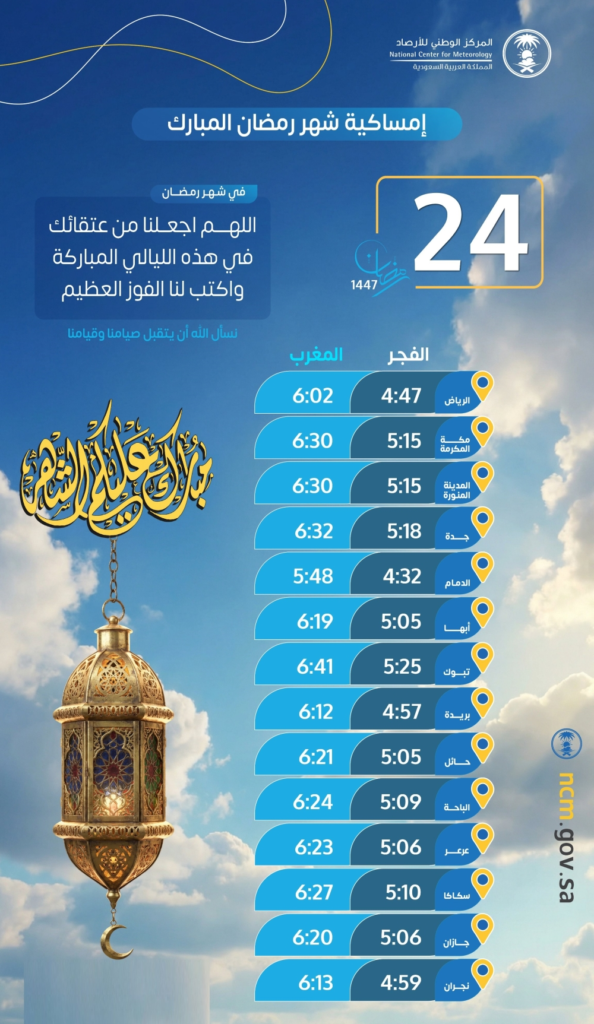
Professor Abdullah Al-Musnad, a former faculty member at Qassim University and Vice President of the Saudi Society for Weather and Climate, proposed delaying the Maghrib (sunset) prayer call in Mecca by three minutes during Ramadan. This would ensure the validity of the Iftar (breaking of the fast) for residents of high-rise buildings on the upper floors, who see the sun after it has set on the ground floors. Dr. Al-Musnad attributed this issue to the reliance on sea-level coordinates for calculating prayer times, a factor that has no effect in flat areas. He explained that the width of the visible horizon increases proportionally with altitude, keeping the sun visible for a longer period on upper floors compared to those on lower floors. This time difference..
faculty member at Qassim University and Vice President of the Saudi Society for Weather and Climate, proposed delaying the Maghrib (sunset) prayer call in Mecca by three minutes during Ramadan to ensure the proper breaking of the fast for residents of high- rise buildings who see the sun after it has set on the ground floors..

Dr. Al-Musnad attributed this problem to the reliance on location coordinates at sea level in calculating prayer times, a factor that does not appear to have an effect in flat areas.President of the Saudi Society for Weather and Climate, Professor Dr. Abdullah Al-Musnad

He explained that the width of the visible horizon increases proportionally with altitude above the Earth's surface, which keeps the sun's disk visible for a longer time on upper floors compared to those on lower floors.

Time difference

Dr. Al-Musnad pointed out that the time difference is clearly evident in cities with vertical urban expansion, taking Mecca and the Clock Tower, which reaches a height of 601 meters, as a living example of the difference in sunset time by several minutes.

He proposed a practical solution, which consisted of delaying the call to prayer according to the official calendar of the Holy City, thus achieving the ultimate goal of jurisprudential precaution in worship, given the difficulty of setting an independent timing for each floor.

Time differences

He emphasized that the temporary nature of the visitors to these towers, including pilgrims performing Hajj and Umrah, makes it difficult to raise awareness about time differences, thus making a unified solution an urgent necessity to keep pace with urban development in major cities like Riyadh and Jeddah.

Leave a comment

Your email address will not be published.

Go up