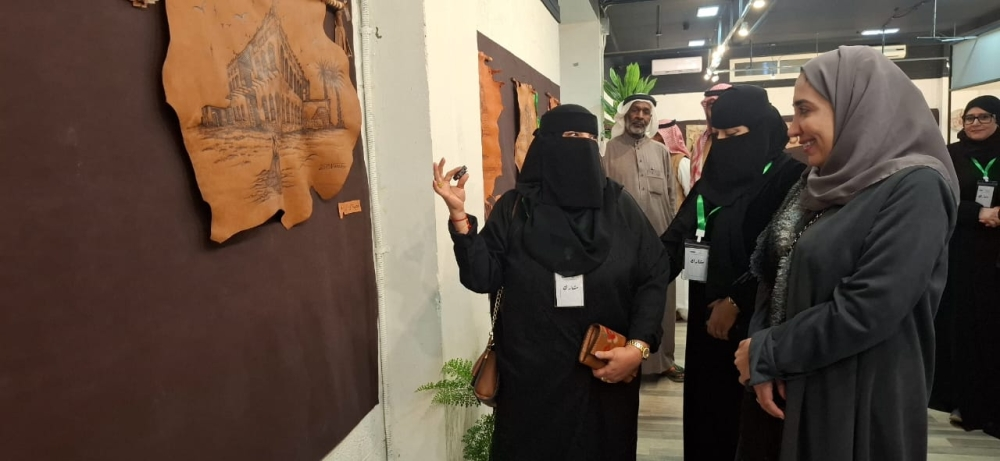
In a move reflecting the richness of the art scene in Saudi Arabia, the Sandal Gallery for Visual Arts in Al-Ahsa hosted an exhibition showcasing the work of 22 Saudi female artists who excelled in painting and pyrography on natural leather. The exhibition was attended by Dr. Fatima Al-Mulla, Vice President of the Al-Ahsa Girls Association, Mr. Yousef Al-Khamis, Director of the Al-Ahsa Culture and Arts Association, and a number of those interested in cultural activities.
Al-Ahsa: A global hub for arts and crafts
This artistic movement didn't emerge from a vacuum. Al-Ahsa Governorate possesses a deep historical and cultural heritage, being the first Gulf city to join UNESCO's Creative Cities Network in the field of crafts and folk arts. Workshops and exhibitions like these are a natural extension of this global recognition, as cultural associations strive to integrate traditional crafts, such as leather tanning and working with natural materials, with contemporary visual arts. This results in artworks that are authentically rooted in heritage yet possess a modern vision, aligning with the aspirations of the Kingdom's Vision 2030 to promote national culture.
Innovative technologies and environmental sustainability
Youssef Al-Khamis, director of the Culture and Arts Association in Al-Ahsa, explained that the exhibition represents the culmination of the success of the "Second Art Journey" program, which the association is implementing in four major regions of the Kingdom. He noted that the program focused on developing the visual arts and opening new horizons for participation.
For her part, visual artist Salma Al-Sheikh, coordinator of the Fine Arts Committee, revealed that the workshop focused on the "burning technique on natural leather" using vegetable-tanned leather from the Swakni region. This approach carries an important environmental message aimed at promoting a culture of sustainability and recycling, as the leather scraps were transformed into artistic pieces that reflect the identity of Al-Ahsa, with the palm tree symbol prominently featured in most of the works, thus closely linking art to the local environment.
Female artists' experiences: from paintings to leather
The workshop presented a new artistic challenge for the participants, who were accustomed to painting on canvas or glass. In this context, artist Atab Al-Bahri mentioned that she transferred her expertise from metalwork to painting on leather, emphasizing that the challenge lay in adapting the material, but the results were impressive and achieved in record time.
Artist Iman Saeed Al-Khashram employed this technique to depict the folk heritage of the Al-Ahsa bride, documenting traditional adornments such as the "Tula" (a type of perfume bottle), the "Mirsh" (a type of perfume bottle), and dowry chests, thus presenting a visual record of the region's social heritage. Meanwhile, artist Iman Al-Mubrazi focused on documenting historical architecture by painting the "Al-Amiriya School" (the first formal school in Al-Ahsa) on a large piece of leather, blending historical elements with modern burning techniques.
Cultural and future impact
This exhibition is a significant step towards empowering Saudi female artists with unconventional artistic tools, opening new doors for them in the creative labor market and the evolving crafts industry. The association's management confirmed that these works will continue to be showcased at future events, emphasizing the role of art in preserving identity and transmitting it to future generations through innovative methods that ensure the heritage remains vibrant and dynamic.