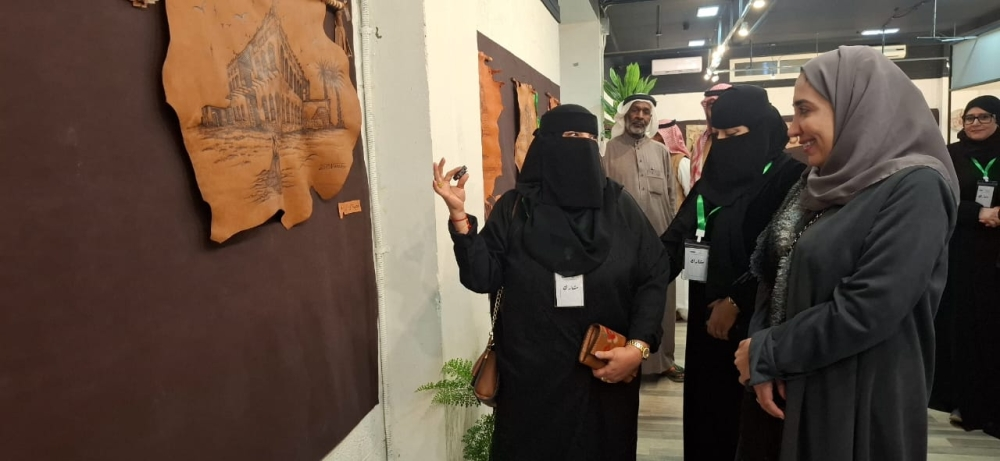
In a move that reflects the richness of the cultural scene in the Kingdom of Saudi Arabia, specifically in Al-Ahsa Governorate, which is registered on the UNESCO list of creative cities in the field of crafts and folk arts, the Al-Ahsa Culture and Arts Association organized a distinguished art exhibition to showcase the results of the “Art Training Journey” specializing in drawing and burning on natural leather.
The Sandal Gallery for Visual Arts hosted this art event, which was inaugurated by Dr. Fatima Al-Mulla, Vice President of the Al-Ahsa Girls Association, in the presence of Youssef Al-Khamis, Director of the Al-Ahsa Culture and Arts Association, and a number of those interested in the visual arts movement. The exhibition featured the work of 22 female artists from the province, who presented creative pieces that blended traditional craftsmanship with contemporary visual art.
Al-Ahsa: A cradle of creativity and arts
This exhibition comes within the context of enhancing the cultural standing of Al-Ahsa, a region historically known as an oasis of palm trees and arts. The aim of these events is not limited to artistic display alone, but extends to preserving and reinterpreting folk heritage in innovative ways that resonate with the spirit of the times, thus contributing to the development of the creative economy and empowering Saudi women in the fields of visual arts and crafts.
In this regard, Yousef Al-Khamis, Director of the Culture and Arts Association in Al-Ahsa, affirmed that the "Second Art Journey" exhibition, which the association is implementing in four regions (Medina, Hail, Al-Baha, and Al-Ahsa), has achieved remarkable success in developing various artistic styles. He pointed out that the high demand for registration through official platforms reflects the female artists' passion for discovering new techniques, such as painting on leather, which opens up broad horizons for artistic experimentation.
Sustainable technologies and the use of heritage
Visual artist Salma Al-Sheikh, coordinator of the Fine Arts Committee, explained that the workshop lasted five days and focused on using "Suwakni" leather treated with vegetable tanning. This choice carries significant environmental weight, as vegetable tanning promotes the concept of sustainability and is considered a safe and environmentally friendly alternative, thus giving the artworks added value that transcends visual aesthetics to touch upon environmental awareness.
The exhibited works were distinguished by a strong presence of elements of Al-Ahsa identity; the palm tree, folk decorations, and heritage tools were strongly present in the artistic hangings that were executed with 100% natural materials.
Artists' experiences... from metals to leather
The participants spoke about their experience in transitioning to a new artistic medium. Artist Atab Al-Bahri pointed out that her previous experience in shaping metals and copper helped her in dealing with leather, stressing that "drawing knows no obstacles," and that she was able to emulate and skillfully apply camel-drawing techniques.
For her part, artist Iman Saeed Al-Khashram focused her work on depicting the rituals of a bride from Al-Ahsa, documenting traditional adornment tools such as henna, the tola (a type of perfume), and the mirsh (a type of perfume), in a painting that evokes the scent of the past. Meanwhile, artist Iman Al-Mubrazi took on the challenge of painting the "Amiriya School" (the first formal school in Al-Ahsa) on a large piece of leather, describing the experience as a personal achievement that combined historical documentation with modern technology.
This exhibition is tangible proof of the Saudi artist’s ability to adapt environmental materials to serve art, and to transform local heritage into a world-class visual product, thus enhancing the presence of Saudi arts in cultural forums.