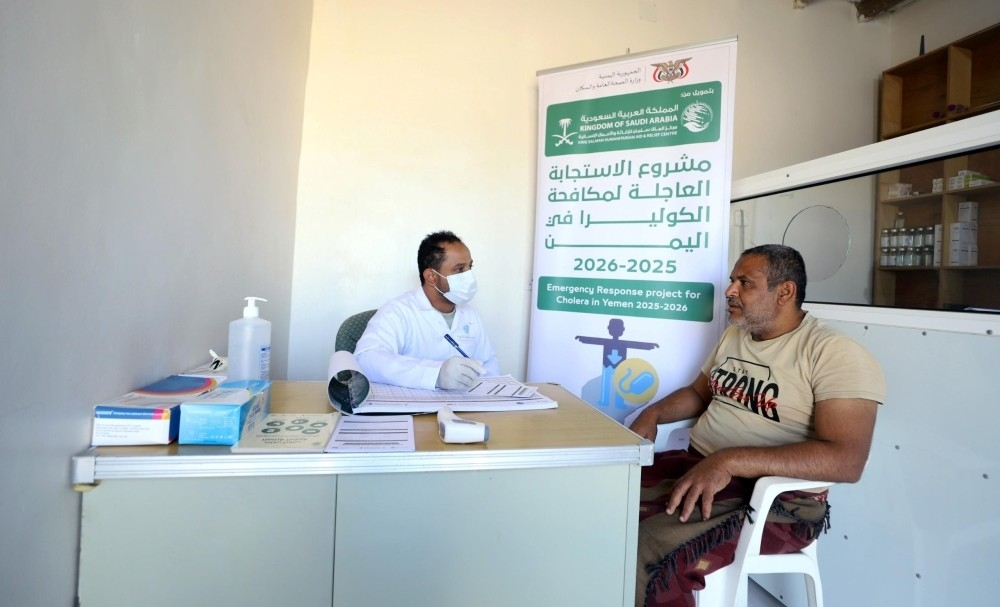
As part of ongoing humanitarian efforts to support the health sector in Yemen, the Yemen Cholera Response Project continued to provide intensive medical and preventative services. This project, directly supported and funded by the King Salman Humanitarian Aid and Relief Center , served 130 individuals between January 7 and 13, 2026, reaffirming the Kingdom of Saudi Arabia's commitment to protecting the Yemeni people from epidemics and infectious diseases.
Details of services provided at ports and airports
The project's activities during the designated week included conducting thorough and comprehensive screenings to detect suspected cases of cholera. These efforts focused on key strategic locations, including the airports of Aden, Al-Rayyan, and Seiyun, as well as land border crossings such as Al-Wadi'ah, Al-Hafiyah, and Razih. These measures covered extensive areas in coastal and inland Hadramawt, Aden, Hajjah, and Sa'dah. Field reports confirmed that no suspected or confirmed cases of cholera were recorded during this period, reflecting the effectiveness of the monitoring and surveillance procedures.
In addition to medical examinations, the project paid great attention to the awareness aspect, as 278 educational and awareness sessions were provided, benefiting 5,123 individuals, with the aim of raising community awareness about ways to prevent the disease and the importance of personal and public hygiene.
Context of the health crisis and cholera challenges in Yemen
These efforts are of paramount importance given the complex health context Yemen has been experiencing for years. Over the past decade, Yemen has suffered repeated cholera outbreaks, classified by international organizations as among the worst epidemics in modern history, due to the damage to water and sanitation infrastructure and the decline in the efficiency of the health system caused by the conflict. Therefore, the continuation of emergency response projects is essential to preventing a resurgence of the epidemic and protecting the most vulnerable groups, especially children and the elderly.
A comprehensive strategy to limit the spread of the epidemic
The project primarily targets the areas most affected and vulnerable to the spread of the epidemic, relying on an integrated prevention and treatment strategy. This strategy includes establishing and supporting specialized medical teams working around the clock to screen and monitor travelers at air and land entry points. Support also extends to strengthening the capacities of health facilities by providing them with essential medical supplies for cholera treatment, including intravenous and oral rehydration solutions, specific antibiotics, protective equipment, and sterilization materials, as well as expanding the bed capacity in isolation and treatment centers to accommodate any potential increase in cases.
The Kingdom's leading role in humanitarian work
These initiatives are an extension of the leading humanitarian and relief role played by the Kingdom of Saudi Arabia, represented by the King Salman Humanitarian Aid and Relief Center, in supporting its brothers and sisters in Yemen. Through these programs, the Kingdom seeks to enhance regional health security, reduce the spread of cross-border epidemics, and alleviate the suffering of the Yemeni people by ensuring the continuity of essential health services with high quality and efficiency.