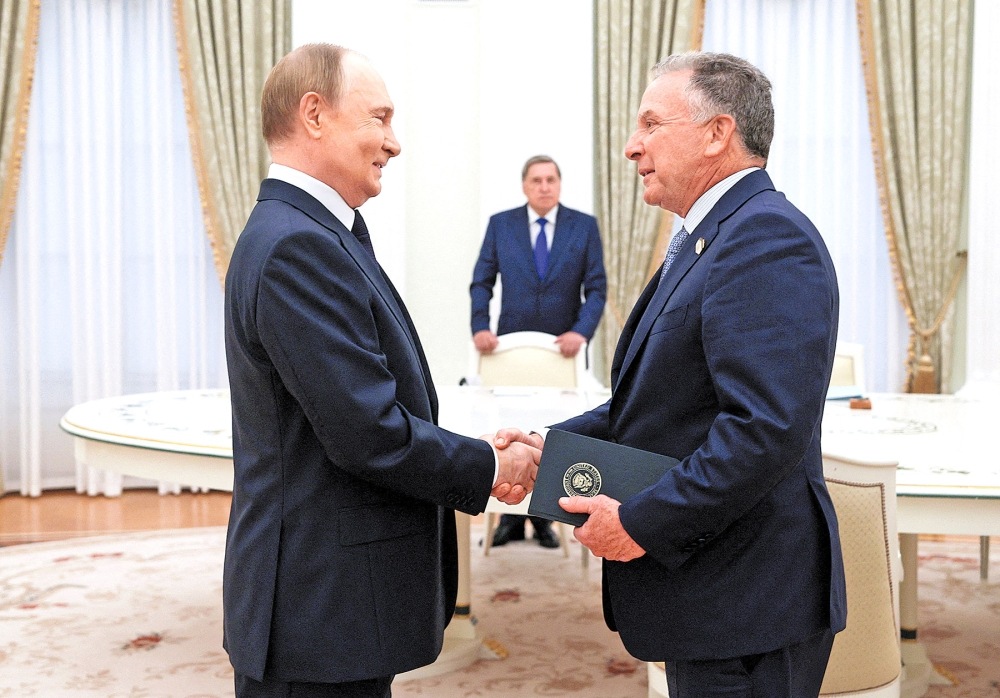
The Kremlin confirmed that Ukraine's aspirations to join NATO were a key and contentious issue during recent talks in Moscow between Russian President Vladimir Putin and US envoy Steve Witkopf. This announcement underscores the deep divide between Moscow and Kyiv and their Western allies, as Russia views NATO's eastward expansion as an existential threat to its national security.
Details of the Russian-American talks
In a press briefing, Yuri Ushakov, diplomatic advisor to the Russian presidency, explained that the issue of Ukraine's NATO membership was prominently featured in the discussions, describing it as "one of the fundamental issues." While he did not elaborate on the details of the closed-door meetings, his remarks indicate that Moscow remains steadfast in its categorical rejection of any scenario involving Kyiv's accession to NATO, a condition the Russian leadership has repeatedly cited as one of the reasons for the outbreak of the conflict.
The historical context and security roots of the crisis
To understand Russia’s resolve, one must return to the historical roots of the crisis. Since the collapse of the Soviet Union, Moscow has viewed successive waves of NATO expansion toward its borders with suspicion. Russian military doctrine holds that Ukraine’s accession to the alliance would mean Russia losing its strategic depth and bringing Western military infrastructure within minutes of Moscow’s decision-making centers. Russia’s demand in December 2021 for written security guarantees preventing such accession was the last diplomatic attempt before the start of military operations in February 2022.
The Western position and the proposed alternatives
In contrast, Western positions on this dilemma have varied. While Kyiv sees membership as the only guarantee of its survival, US President-elect Donald Trump has previously ruled out Ukraine's imminent accession, reflecting a new American approach that may lean toward political realism to end the war. For his part, NATO Secretary General Mark Rutte indicated the search for alternative formulas, saying, "We are discussing how Ukraine, in the absence of membership, can ensure its own protection with the support of other countries," hinting at the possibility of proposing a "security guarantees" model as an alternative to full membership.
The impact of the situation on the ground on the negotiation process
The diplomatic track cannot be separated from military developments on the ground. The Kremlin has made it clear that the recent battlefield successes of the Russian army in eastern Ukraine have strengthened its negotiating position. Ushakov asserted that the "achievements of Russian soldiers" have prompted foreign partners to adopt more realistic and appropriate assessments of the paths to a peaceful settlement. Analysts suggest that Russia's increasing territorial control gives it significant leverage, making it difficult for the West to impose preconditions and pushing toward a settlement that may require painful concessions from the Ukrainian side in exchange for a ceasefire.
Expected regional and international repercussions
The outcome of these negotiations will not only shape Ukraine's future but will also reshape the entire European security architecture. Reaching an agreement that excludes Ukraine from NATO membership could establish a new security system that addresses Russian concerns, but it could also alarm other Eastern European countries. Conversely, the failure of the talks and the continuation of the war carry the risk of regional escalation that could draw in other international actors, making the current dialogue between Moscow and Washington a pivotal moment in the history of modern international relations.