In a global cultural and scientific event hosted by the Saudi capital, Riyadh, and in the presence of His Royal Highness Prince Turki bin Faisal, Chairman of the Board of Directors of the King Faisal Center for Research and Islamic Studies, the General Secretariat of the King Faisal Prize revealed the names of the winners of its 2026 cycle. The Secretary-General of the Prize, Dr. Abdulaziz Al-Sabil, announced the names during an official ceremony held in the Prince Sultan Grand Hall at the Al-Faisaliah Center, amidst the presence of a select group of intellectuals and media professionals.
The award's prestige and global impact
The King Faisal Prize, established in 1977 and first awarded in 1979, is one of the world's most prestigious prizes, recognizing scientists and thinkers who have made outstanding contributions to humanity. Distinguished by its rigorous selection and judging criteria, the prize has garnered significant attention within the international academic community. Winners in the fields of medicine and science are often considered potential Nobel Prize candidates, reflecting the prize's considerable scientific weight on the global stage.
Winners in Islamic Studies and Community Service
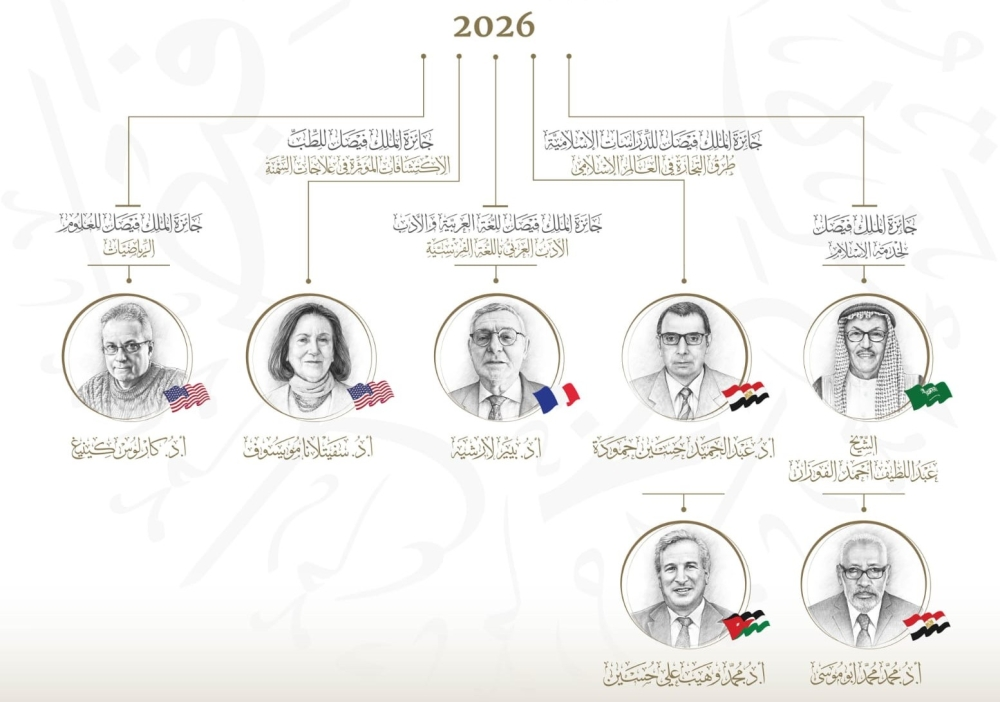
In the field of Islamic studies and related charitable work, the selection committee decided to award the prize for 2026 jointly to Sheikh Abdul Latif bin Ahmed Al-Fawzan, Chairman of the Board of Directors of Al-Fawzan Company, and Dr. Muhammad Muhammad Abu Musa from Egypt.
Sheikh Abdul Latif Al-Fawzan 's win came in recognition of his exceptional efforts in institutionalizing charitable work. He adopted a distinctive methodology focused on sustainability and supporting impactful initiatives that address the actual developmental needs of society. His efforts culminated in the establishment of the "Ajwad Endowment," which represents a sophisticated community arm for creating and developing humanitarian initiatives.
Dr. Muhammad Abu Musa , a professor at Al-Azhar University, was awarded the prize for enriching the Arabic library with more than thirty books, focusing particularly on rhetoric and the miraculous nature of the Holy Quran. He was also distinguished by his efforts to strengthen cultural identity among young people through his membership in the Council of Senior Scholars and his holding of hundreds of scholarly gatherings at Al-Azhar Mosque.
Trade routes in the Islamic world
In the field of “Trade Routes in the Islamic World,” the prize was jointly awarded to Dr. Abdul Hamid Hussein Hammouda (Fayoum University) and Dr. Muhammad Wahib Hussein (Hashemite University). Dr. Hammouda’s work was distinguished by its comprehensive coverage of land and sea trade networks in the Islamic East and Africa, while Dr. Wahib Hussein made a significant contribution through his meticulous archaeological field surveys and documentation of the Meccan trade route, linking Quranic texts with geographical data.
Arabic language and literature: Bridges of cultural communication
In the field of Arabic Language and Literature, specifically in the category of "Arabic Literature in French," Professor Pierre Larcher from Aix-Marseille University in France was awarded the prize. This honor recognizes his rigorous critical project in translating the Mu'allaqat and pre-Islamic poetry, where he successfully presented Arabic literature to the French reader in a style that combines scholarly precision with literary beauty, thus fostering intercultural dialogue and communication.
Medicine: A revolution in the treatment of obesity and diabetes
In one of the most impactful fields of global public health, Professor Svetlana Moiseyova (Rockefeller University, USA) won the Nobel Prize in Medicine for her groundbreaking work in obesity treatment. She is credited with the discovery of glucagon-like peptide-1 (GLP-1), a discovery that revolutionized medicine and laid the foundation for a new generation of effective drugs for treating diabetes and obesity, thus improving the quality of life for millions of patients worldwide.
Science: New Horizons in Mathematics
The announcements concluded with the Science Prize in Mathematics, awarded to Professor Carlos Koenig (University of Chicago). His pioneering research in mathematical analysis and nonlinear partial differential equations has opened up broad application possibilities, including vital fields such as medical imaging, fiber optics, and fluid mechanics.
At the conclusion of the announcement, the General Secretariat of the Award expressed its gratitude to the judging committees, universities, and international scientific centers that contributed to the nomination and selection of these scientific figures, affirming the continuation of the Award’s mission to honor science and scientists.