In a grand scientific and cultural ceremony held in the Saudi capital, Riyadh, the General Secretariat of the King Faisal Prize announced the winners of its 2026 cycle. The announcement was made in the presence of His Royal Highness Prince Turki bin Faisal, Chairman of the Board of Directors of the King Faisal Center for Research and Islamic Studies. The ceremony, held in the Prince Sultan Grand Hall at the Al Faisaliah Center, reaffirmed the prize's continued commitment to its noble mission of honoring science and scholars and serving humanity.
The award's prestige and global impact
The King Faisal Prize is one of the world's most prestigious awards, given to scholars and thinkers who have made outstanding contributions to Islam and Islamic studies, Arabic language, medicine, and science. Since its inception, the prize has served as a bridge for cultural exchange and a platform for recognizing achievements that benefit humanity. Many of its winners in the fields of science and medicine have subsequently gone on to receive Nobel Prizes, reflecting the rigor of its scientific standards and the expertise of its judging panels, which comprise a select group of international experts.
Winners in Islamic Studies and Philanthropy
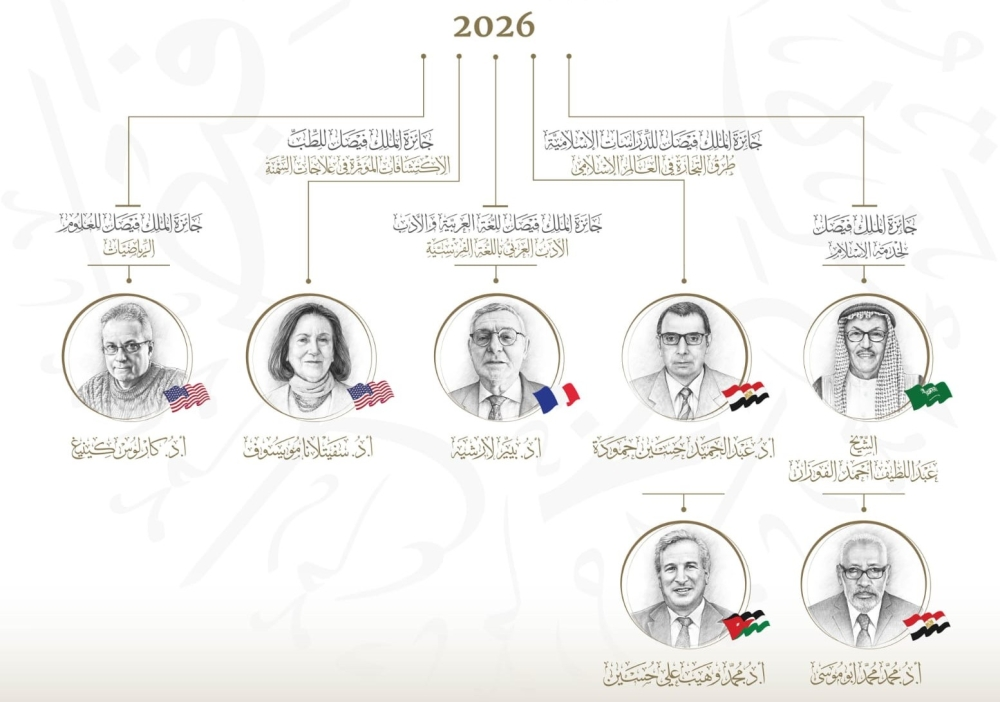
In the field of Islamic Studies, the selection committee decided to award the prize for 2026 jointly to two prominent figures who combined philanthropy with scholarly contributions. Sheikh Abdul Latif bin Ahmed Al-Fawzan, Chairman of the Board of Directors of Al-Fawzan Company, was awarded the prize in recognition of his distinguished approach to institutionalizing charitable work and his establishment of the “Ajwad Endowment,” which serves as a model for community development initiatives. He was joined by His Eminence Dr. Muhammad Muhammad Abu Musa, Professor at Al-Azhar University and member of the Council of Senior Scholars, for his extensive scholarly efforts, which include more than thirty books on rhetoric and the miraculous nature of the Quran, and his pivotal role in consolidating cultural identity through hundreds of scholarly gatherings at Al-Azhar Mosque.
In the same category, the award recognized researchers' efforts in uncovering the civilizational aspects of Islamic trade, specifically in the area of "Trade Routes in the Islamic World." Dr. Abdul Hamid Hussein Hammouda from Fayoum University in Egypt won for his comprehensive studies on land and sea trade networks in the Islamic East and Africa. Dr. Muhammad Wahib Hussein from the Hashemite University in Jordan also won for his distinguished use of modern technologies and archaeological surveys supported by GPS to document ancient trade routes and link them to Quranic and geographical texts.
Excellence in Arabic language, medicine, and science
In the field of Arabic language and literature, dedicated to the theme of “Arabic Literature in French,” the prize was awarded to Professor Pierre Larcher of Aix-Marseille University in France. Larcher earned this honor for his rigorous critical project and his exquisite translations of the Mu'allaqat and pre-Islamic poetry, which have contributed to presenting the Arabic heritage to the French reader in a style that combines scholarly precision with literary beauty.
In the field of medicine, the award addressed global health challenges by being presented to Professor Svetlana Moiseyova of Rockefeller University in the United States, for her groundbreaking work in obesity treatment. This recognition recognizes her pioneering work in discovering the peptide GLP-1, which revolutionized the understanding of insulin secretion and paved the way for the development of a new generation of effective medications for treating diabetes and obesity, conditions affecting millions worldwide.
The prize announcements concluded with the Science category, specifically in Mathematics, where Professor Carlos Kennig of the University of Chicago was awarded for his fundamental contributions to mathematical analysis and nonlinear partial differential equations. Kennig's work is significant due to its wide-ranging applications in vital fields such as medical imaging, fluid mechanics, and fiber optics, underscoring the close connection between pure mathematics and practical applications that serve society.