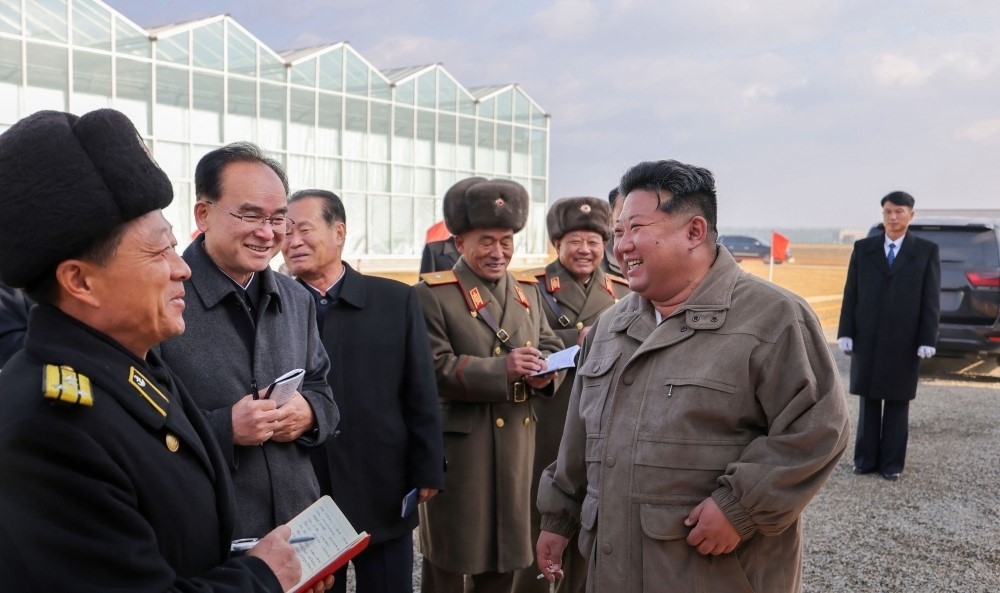
In a move reflecting the continued military escalation on the Korean Peninsula, North Korean leader Kim Jong Un announced plans to equip his country's air force with "new strategic military assets," according to Pyongyang's state media on Sunday. The significant announcement came during a ceremony marking the 80th anniversary of the air force's founding, which Kim attended alongside his daughter Kim Ju Ae, who is increasingly seen as his likely successor, adding a political dimension to the military event.
A historical background of ongoing tension
This pledge comes within a complex historical context of hostility between the two Koreas, dating back to the Korean War (1950-1953), which ended with an armistice, not a peace treaty, meaning the two countries technically remain at war. Over the past decades, North Korea has invested heavily in developing its missile and nuclear programs, often at the expense of modernizing its conventional forces, such as its air force, which relies heavily on aging Soviet-era aircraft. Therefore, the announcement of providing the air force with “strategic assets” represents a potential shift in Pyongyang’s military strategy, aimed at addressing a clear weakness in its defensive and offensive capabilities.
The importance of "strategic assets" and their potential impact
Although Kim Jong Un did not specify the nature of these new assets, the term “strategic” typically refers to weapons capable of having a significant impact, often linked to nuclear capabilities. This could include the development of new fighter jets capable of carrying tactical nuclear warheads, advanced reconnaissance and attack drones, or modernized air defense systems. In his speech, Kim stated, “The air force must resolutely repel and control all kinds of enemy espionage and potential military provocations,” emphasizing the need to be prepared for any confrontation.
Regional and international repercussions
This announcement is causing considerable concern both regionally and internationally. In Seoul, the move is seen as a further escalation that increases the risk of accidental conflict, especially given the severing of all military communication lines between the two sides. South Korean President Lee Jae-myung recently warned that the situation had become “grave,” citing Pyongyang’s extreme measures at the border, such as the installation of three layers of barbed wire. Internationally, this development presents a new challenge to efforts to denuclearize the Korean Peninsula and places additional pressure on the United States and its allies in the region, such as Japan, to strengthen their defense and deterrence capabilities. This move comes at a time when Pyongyang is ignoring calls for dialogue from its southern neighbor, deepening the diplomatic stalemate and increasing the likelihood of military miscalculation.