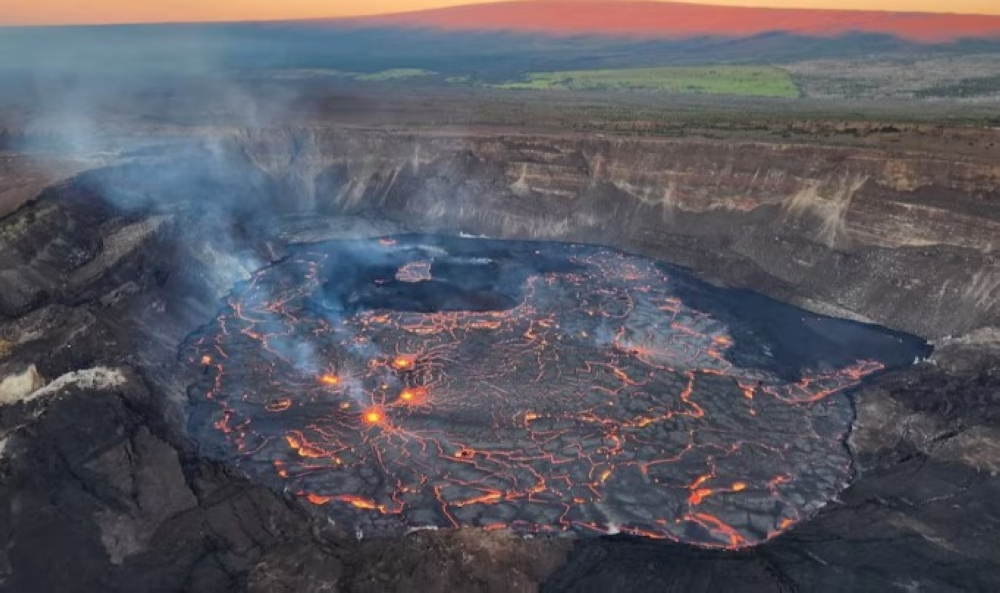
Kilauea has once again captured attention in Hawaii, USA, as it resumed erupting and unleashed spectacular natural fire displays that captivated tourists and onlookers. Lava fountains flowed, illuminating the night sky with a deep red hue, in a spectacle that embodies both the power and beauty of nature, according to the US Geological Survey.
Details of the current eruption and the visual scene
The volcano on Hawaii's Big Island has resumed intermittent activity, with scientists observing lava fountains ranging from 15 to 30 meters in height. These fountains are erupting from vents in the volcano's northern cone, creating a glow visible from a distance. Despite the dramatic eruption, authorities have confirmed that the activity remains safely contained within the boundaries of Hawaii Volcanoes National Park and poses no immediate threat to nearby residential areas.
A history rich in geological activity
This event is not unusual for Kilauea, a volcano with a rich geological history that makes it a magnet for scientists and researchers. Classified as a shield volcano, Kilauea has been almost continuously active since 1983, making it one of the most active volcanoes on Earth. Historically, the volcano has been associated with major eruptions, most notably the 2018 eruption that destroyed hundreds of homes and reshaped the region's landscape. However, the current eruption is less intense and confined to the summit, making it more of a tourist attraction than a catastrophic event.
Tourist and economic importance
Kilauea volcano plays a pivotal role in Hawaii's tourism sector, attracting millions of visitors annually eager to witness "the Earth in motion." During periods of safe eruption, helicopter tourism flourishes, offering tourists a rare panoramic view of the volcano's crater and glowing lava lakes. This influx of tourists contributes significantly to the island's local economy, with the national park being one of the region's most important economic drivers.
Geographic location and continuous monitoring
Kilauea is located on the southeastern slope of Mauna Loa, the world's largest active volcano by mass and volume. Although smaller in size, Kilauea surpasses Mauna Loa in its activity and eruption frequency. The U.S. Geological Survey (USGS) continues to closely monitor seismic activity and gas emissions to ensure the safety of visitors and residents, confirming that the current situation is stable and allows for safe viewing from designated areas within the park.