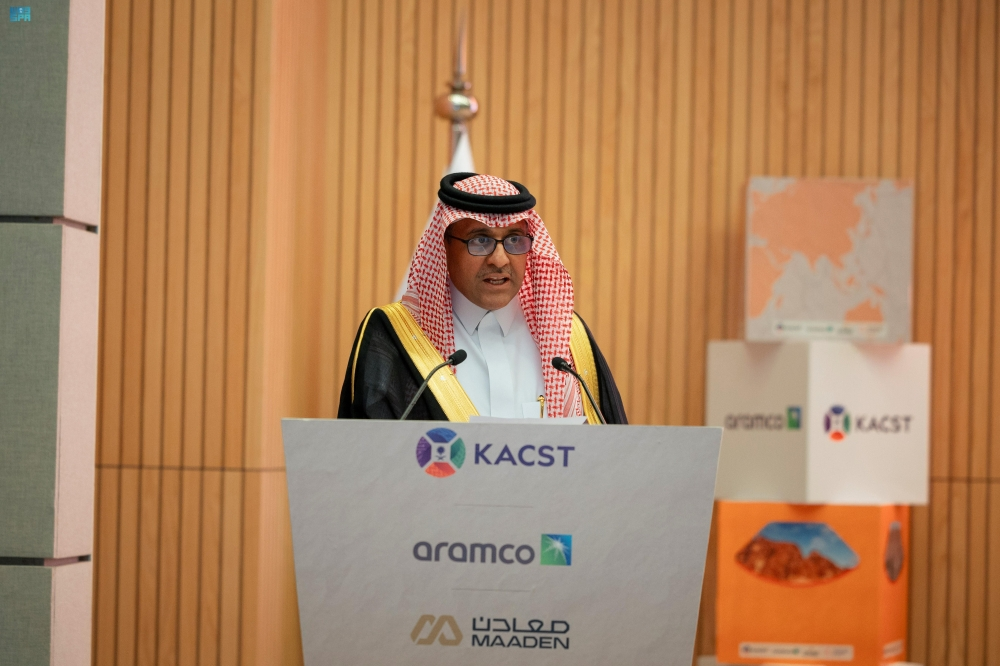
In a strategic move reflecting the Kingdom of Saudi Arabia’s commitment to developing the mining sector as a third pillar of national industry, the President of King Abdulaziz City for Science and Technology (KACST), Dr. Munir bin Mahmoud Al-Dasouqi, inaugurated the “Advanced Knowledge Laboratory for Mineral Resources.” This laboratory aims to bring about a qualitative leap in geological innovation mechanisms and support advanced exploration operations, in line with the objectives of the Kingdom’s Vision 2030.
This important announcement was made during the 19th International Lithosphere Programme Conference, organized by KAUST in collaboration with the United Nations International Lithosphere Programme (ILP). The event was attended by His Excellency the Deputy Minister of Industry and Mineral Resources for Mining Affairs, Engineer Khalid bin Saleh Al-Mudaifer, along with a distinguished group of scientists and researchers specializing in earth sciences from around the world.
Strengthening the national economy and exploiting latent resources
The launch of this laboratory comes at a time when the Kingdom is witnessing unprecedented economic activity aimed at diversifying its sources of income away from oil. The Kingdom's mineral wealth, estimated at around 5 trillion riyals (approximately $1.3 trillion), is a crucial element in this economic equation. The new laboratory will serve as a technological and research arm, enabling companies and stakeholders to access these resources with greater accuracy and efficiency, thus enhancing the sector's attractiveness to both foreign and domestic investment.
Modern technologies for exploring the Arabian Shield
The laboratory focuses primarily on localizing advanced geophysical modeling techniques, which are essential for improving the efficiency of mineral exploration and reducing the financial risks associated with haphazard drilling operations. By enabling a more accurate understanding of the Earth's subsurface, the laboratory contributes to supporting the Kingdom's ambitious geological survey initiatives, which have so far covered more than 700,000 square kilometers of the Arabian Shield, a region rich in precious and base metals.
In this context, Engineer Khalid Al-Mudaifer stressed that the Kingdom has placed geology at the heart of its mining strategy, noting that accurate data is the key to transforming the Kingdom into a reliable partner in global mineral supply chains, especially in light of the global acceleration in demand for minerals.
Mining and the transition to clean energy
For his part, Dr. Talal bin Ahmed Al-Sudairy, Senior Vice President of Research and Development at KACST, explained the geopolitical and economic importance of the Kingdom, given its possession of one of the world's most significant mineral regions. He pointed out that the global shift towards clean energy technologies, such as electric vehicles and renewable energy, is dramatically increasing demand for specific minerals like copper, lithium, and rare earth elements.
Al-Sudairi added that investing in lithospheric sciences is no longer a scientific luxury, but a strategic necessity to ensure resource security. KAUST is leading this trend through its scientific innovation ecosystem, serving as a national laboratory and incubator for the Innovation Oasis, connecting centers of excellence and facilitating the exchange of expertise in artificial intelligence and numerical modeling.
A scientific platform for exchanging experiences
The international forum included in-depth dialogue sessions that discussed the nature of the lithosphere of the Arab region and the mineral system of the Arabian and Nubian Shield. The importance of geological heritage and its role in supporting sustainable tourism were also addressed, along with a review of the latest developments in remote sensing and artificial intelligence technologies for exploring hydrocarbon and mineral resources, thus underscoring the Kingdom's leading role in driving scientific research in the region.