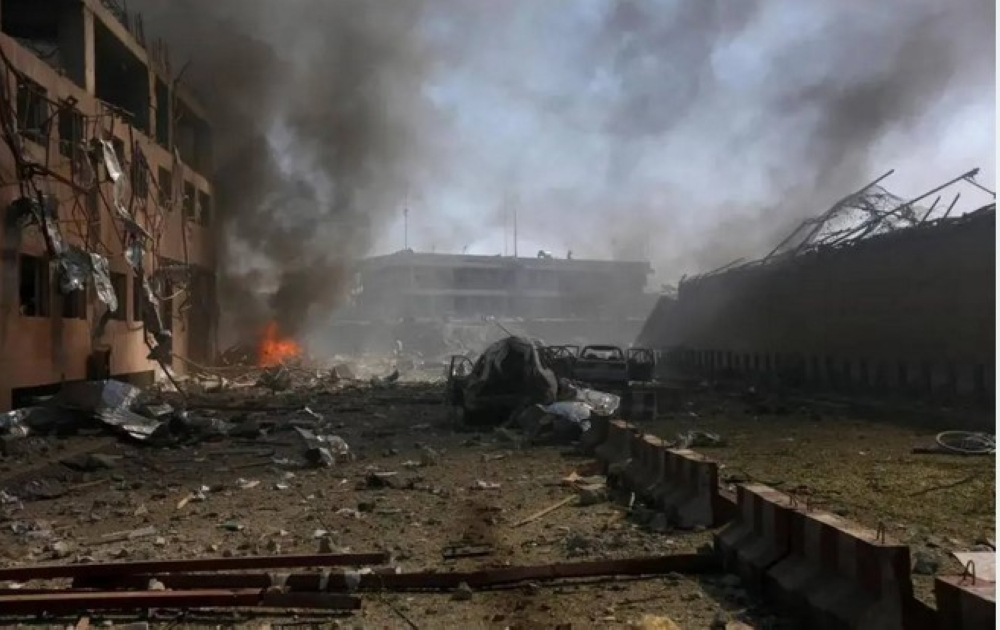
On Monday, the Afghan capital, Kabul, witnessed a horrific security incident: a powerful explosion targeted a hotel in a busy area of the city center, resulting in numerous casualties. The Italian NGO Emergency, which operates a specialized surgical center for war victims in the capital, confirmed that at least seven people were killed in the attack.
Casualty figures and details of the incident
The organization explained in an official statement that its hospital received twenty people transferred from the site of the explosion in the busy Shahr-e-Naw commercial district. Tragically, seven of these victims died before receiving treatment. Dejan Panic, the organization's country director in Afghanistan, noted that among the thirteen injured currently receiving treatment are four women and a child, reflecting the indiscriminate and tragic nature of the explosion that targeted civilians.
In a related development, eyewitnesses at the scene provided horrifying details about the moment of the explosion. A local flower shop owner, who preferred to remain anonymous, stated that the explosion occurred around 3:30 PM local time (11:00 GMT), describing the sound as a "loud bang" that caused panic among passersby and residents. He personally witnessed at least five people being injured amidst the chaos.
The official narrative and the security dimension
For his part, Kabul police spokesman Khalid Zadran confirmed that an explosion occurred inside a hotel on Golfaroshi Street in the 4th security district, indicating that there were casualties but without disclosing the exact nature of the explosives used. Security forces have significantly increased their presence in the area, which contains numerous restaurants and vital facilities. Police vehicles were seen cordoning off the area, while the facades of nearby buildings and vehicles were damaged.
General context and security challenges in Afghanistan
This attack casts a heavy shadow over the security situation in Afghanistan, where the current authorities, since assuming power in August 2021, have been striving to establish security and end decades of war. Although the overall level of violence has decreased compared to previous years, the capital, Kabul, and other cities continue to experience sporadic attacks, often claimed by the Islamic State-Khorasan Province (ISIS-K), which poses a major security challenge to the ruling authorities.
These attacks, especially those that take place in diplomatic or commercial areas such as Shahr-e-Naw, carry implications that go beyond direct human losses, as they aim to undermine confidence in the current government’s security capabilities and demonstrate the continued existence of vulnerabilities that can be exploited by opposing groups.
International dimensions and targeting of foreign interests
Adding to the sensitivity of this incident are reports indicating the presence of foreign nationals at the site. China's official Xinhua news agency, citing a local source, reported that two Chinese citizens were seriously injured and an Afghan security guard was killed. This is a significant factor given that China is one of the few countries that has maintained active diplomatic and trade relations with Kabul and is seeking to boost investment in infrastructure and mining.
Targeting the residences of foreign nationals and investors could negatively impact Afghan efforts to attract foreign investment needed to revive the ailing economy, placing a double responsibility on security authorities to protect foreign missions and companies to ensure continued regional economic cooperation.