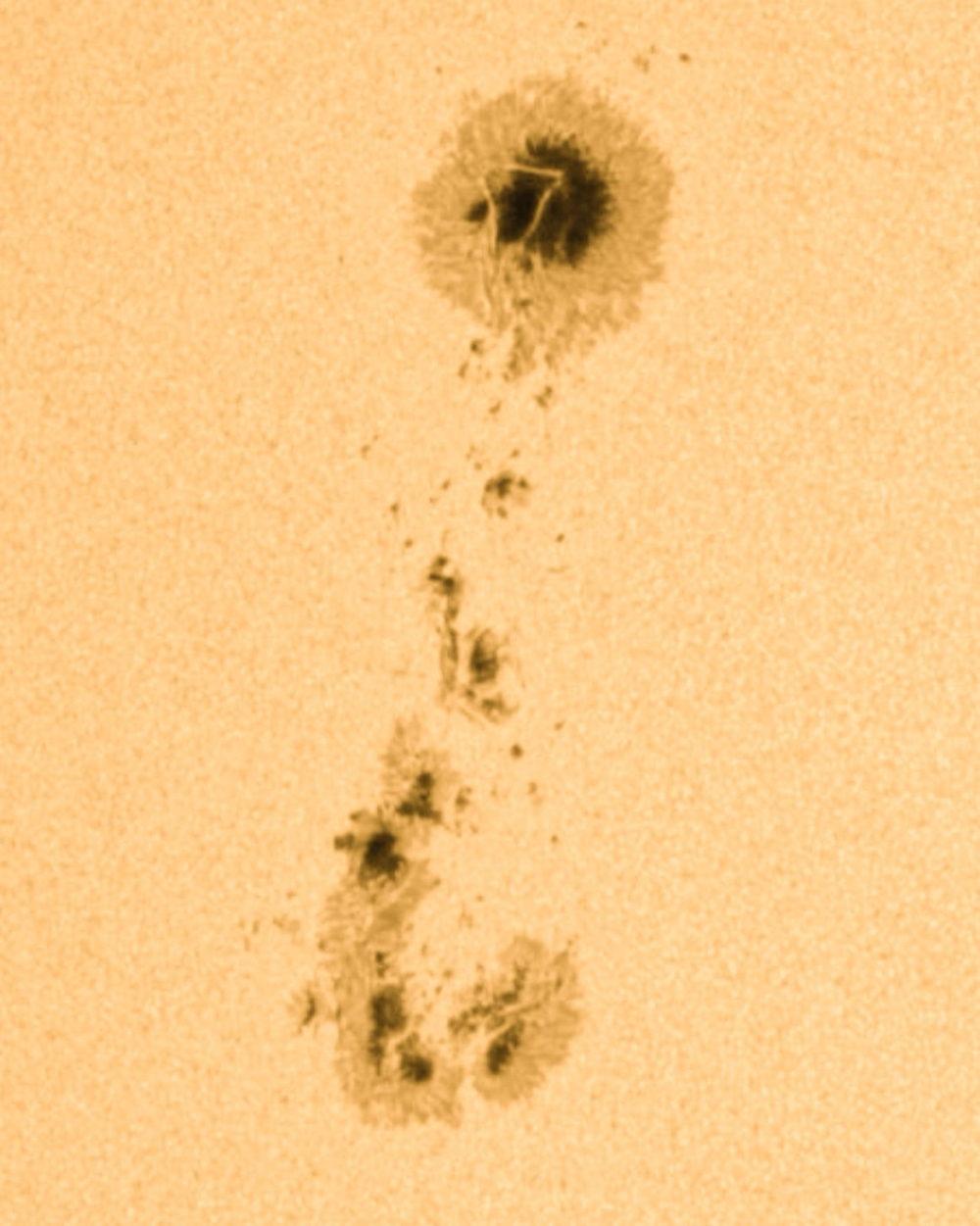
The Jeddah Astronomical Society announced that it is continuing to monitor the giant sunspot, designated AR3664, which is one of the most magnetically active and complex regions of the current 25th solar cycle. Its size and intense activity have attracted the attention of astronomical observatories worldwide, raising scientific awareness of its potential effects on Earth in the coming days.
Scientific background: Sunspots and the solar cycle 25
Sunspots are temporary areas on the Sun's surface (photosphere) that appear darker than the surrounding areas. They are regions of low temperature resulting from high concentrations of magnetic flux, which inhibits convection. The appearance of these spots follows a natural cycle known as the solar cycle, which lasts approximately 11 years, during which the Sun transitions from a period of relative calm (solar minimum) to a period of intense activity (solar maximum). We are currently approaching the peak of solar cycle 25, which explains the appearance of giant, active sunspots like AR3664. Historically, Earth has experienced the effects of powerful solar storms, the most famous being the Carrington Event of 1859, which caused widespread disruptions to the then-nascent telegraph systems.
Description of the giant spot and its remarkable activity
The head of the Jeddah Astronomical Society, Engineer Majid Abu Zahra, explained that this sunspot represents a rare example of the complexity of magnetic fields on the Sun's surface. Scientists have described it as an "archipelago of magnetic islands," consisting of a massive central spot several times the diameter of Earth, surrounded by dozens of secondary spots that reflect a highly complex magnetic structure. This region has witnessed remarkable activity, releasing dozens of solar flares, including several X-class flares, the highest category on the flare intensity scale. These powerful explosions are capable of releasing enormous amounts of energy and radiation into space.
Expected impacts on Earth: from technology to the aurora borealis
Because the active region AR3664 is currently in a position facing Earth, the possibility of coronal mass ejections (CMEs) reaching our planet remains. These ejections, which are massive clouds of plasma and magnetic field, can, when interacting with Earth's magnetic field, cause geomagnetic disturbances ranging from mild to strong.
Abu Zahra emphasized that this solar activity is not expected to have a direct impact on daily life in Saudi Arabia or other Arab countries. The potential effects are limited to technical aspects only, such as:
- Wireless communications: Strong flares may cause temporary interruptions to high-frequency radio communications, which are used by aircraft, ships, and radio amateurs.
- Satellites: Geomagnetic storms can affect the operation of satellites in orbit, including global navigation systems (GPS) and communications satellites.
- Power grids: In severe cases, strong storms can induce electrical currents in underground power grids, which can cause disruptions.
On the other hand, one of the most prominent phenomena accompanying these storms is the expansion of the visibility of the aurora borealis, as it may become possible to see it in areas at lower latitudes than usual, providing a magnificent celestial spectacle.
Scientific importance and an opportunity for observation
Abu Zahra emphasized that weather and human health are unaffected by these phenomena, as the Earth's atmosphere and magnetic field form a natural shield that deflects most solar radiation and particles. He affirmed that these events are of great scientific and observational importance, providing scientists with a unique opportunity to study the dynamics of the sun during its peak activity and to better understand space weather. He concluded by stressing that solar activity will continue to be monitored in the coming days, making this phenomenon a subject of close attention and observation by scientific institutions worldwide.