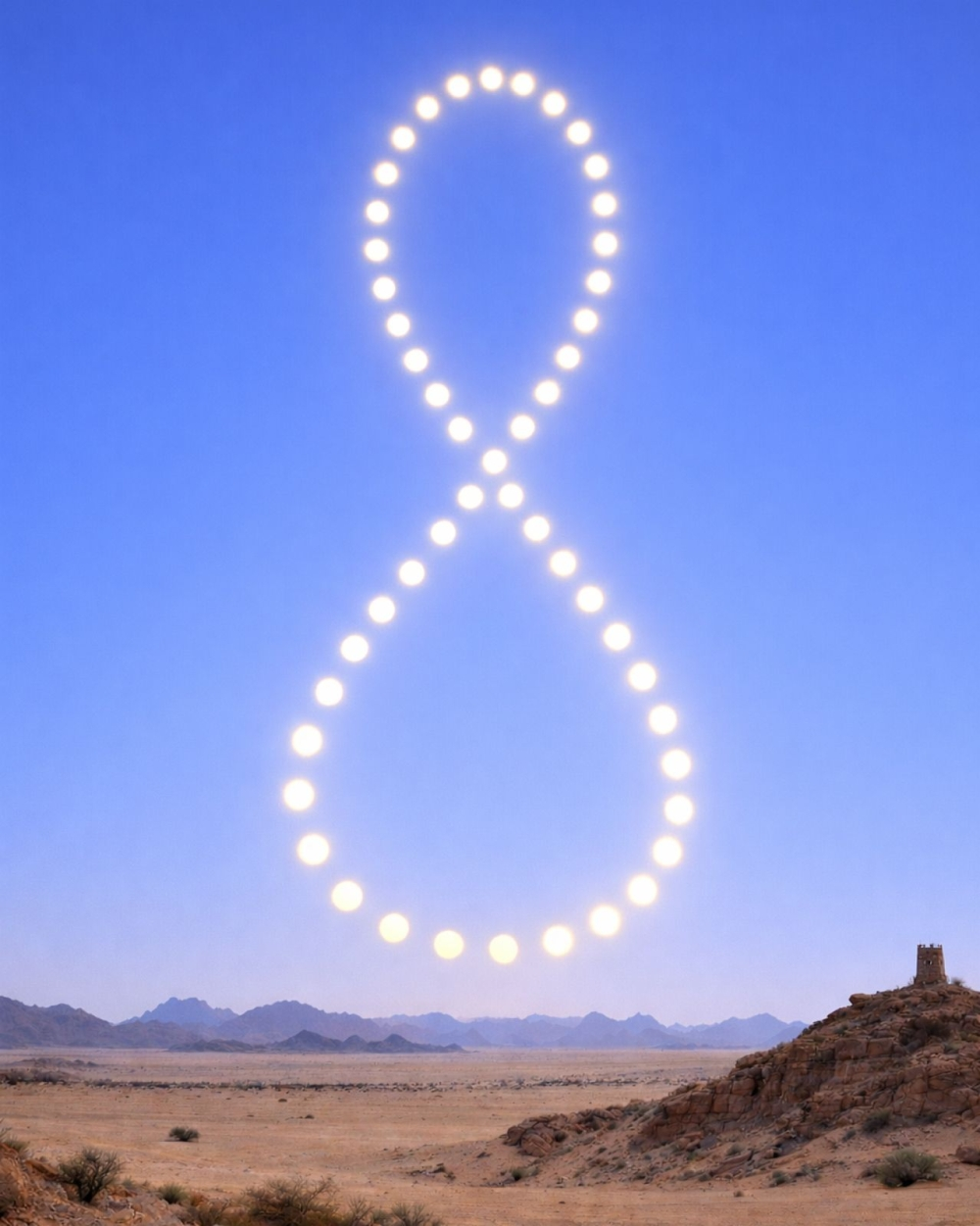
Engineer Majed Abu Zahra, head of the Jeddah Astronomical Society, revealed details of a unique astronomical phenomenon known as the analemma. This is a beautiful optical phenomenon in which the sun appears to trace an imaginary path across the sky resembling the number "8." This phenomenon occurs when the sun's position is observed and photographed from the exact same location and time, daily or weekly, throughout a year, reflecting a complex cosmic interaction between the Earth's and the sun's movements.
The scientific and historical roots of the phenomenon
The analema is a practical application of what is known in astronomy as the "equation of time," which is the difference between the time indicated by sundials and the time indicated by modern mechanical clocks. Historically, ancient astronomers observed that the sun does not return to the same point in the sky at the same time every day, which affected the accuracy of sundials. This temporal and spatial variation is what creates this distinctive geometric shape, where the sun advances or lags behind its average time by about 16 minutes at different times of the year.
Physical factors behind the octagonal shape
Abu Zahra explained that the formation of this number in the sky results from the combination of two main factors that govern our planet's movement: the first is the tilt of the Earth's axis of rotation at an angle of approximately 23.5 degrees, and the second is the Earth's orbit around the sun in an elliptical (oval) path, not a perfectly circular one. This combination causes the apparent position of the sun to vary, rising and setting, as well as to the right and left, relative to a stationary observer on Earth, thus forming the sides of the number "8".
Guide to Astronomical Photography and Observation
The head of the Jeddah Astronomical Society pointed out that documenting this phenomenon requires patience and precision. A digital camera securely mounted on a tripod can be used to ensure a stable angle throughout the year. He advised using a solar filter to protect the camera sensor and the observer's eye, and setting the camera to a short exposure speed (between 1/1000 and 1/8000 of a second), a narrow aperture (f/7.1 to f/11), and a low ISO (ISO 100-200). He confirmed that combining the captured images clearly shows that the upper part of the shape represents the summer solstice (the longest day of the year), while the lower part represents the winter solstice (the shortest day of the year).
The shape varies according to geography
Geographically, the analema's appearance varies depending on the observer's location. In Saudi Arabia, it appears higher above the horizon and less horizontally extended, giving it a pronounced vertical elongation. In contrast, in countries like Egypt, Lebanon, and Morocco, it appears more tilted towards the horizon and wider, while in southern regions like Yemen, it appears narrower and higher. This variation makes the phenomenon an excellent educational tool for understanding how latitude affects our perception of the celestial sphere.
Scientific and educational importance
The importance of the analemma lies not only in its artistic beauty as a photograph, but also in its tangible and visual evidence proving the Earth's spherical shape and its rotation around the sun. It offers a live scientific experience for students and astronomy enthusiasts, allowing them to grasp concepts such as the four seasons, the solstices, and the dynamics of Earth's orbital motion, moving beyond theoretical illustrations in textbooks. This makes it one of the finest educational tools for astronomical observation.