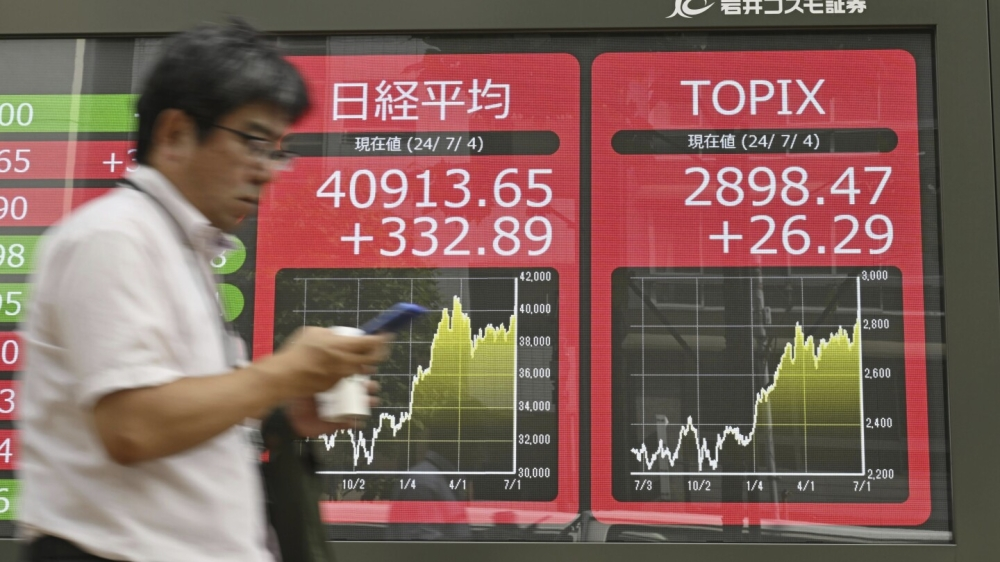
Japanese stock markets witnessed a historic performance on Monday, with major indices surging to unprecedented highs. At the start of trading, the Nikkei 225 index surged past the 56,000 mark for the first time ever, reflecting growing confidence in the Japanese economy. The index closed up 3.4% at 56,083 points, while the broader Topix index gained 2.5% to reach 3,792.05 points, amid a positive investor reaction to a series of encouraging economic data and ongoing structural reforms.
Historical background: The end of the “lost decades”
This surge is particularly significant given the long history of the Japanese stock market. This achievement marks the end of a prolonged period of stagnation known as the “lost decades,” which began after the collapse of the asset bubble in late 1989. At that time, the Nikkei index reached its previous all-time high of 38,915 points, a figure that had remained a distant dream for over three decades. During this period, the Japanese economy suffered from deflation and weak growth, making the market's return to these levels a landmark event symbolizing a profound economic recovery and renewed confidence in Japan's future.
What factors are driving the rise of Japanese stocks?
This strong rally can be attributed to a combination of factors that have boosted the appeal of Japanese stocks to both domestic and foreign investors. Chief among these are the structural reforms in corporate governance encouraged by the Tokyo Stock Exchange, which have prompted companies to focus on increasing shareholder value, dividend payouts, and share buybacks. Additionally, the weak yen a pivotal role, enhancing the competitiveness of Japanese exports and increasing the profits of large companies when their foreign earnings are converted into yen. The strong performance of technology and semiconductor stocks, in line with global trends, has also contributed to driving the index higher.
Expected impacts locally and internationally
Domestically, this surge is seen as a positive sign that could help break the cycle of consumer and business stagnation, potentially stimulating domestic spending and investment. Internationally, this remarkable performance puts Japan back on the global investment map as a major destination, especially given the growing interest of leading global investors, such as Warren Buffett, in Japanese companies with strong fundamentals and attractive valuations. The influx of foreign capital indicates a shift in the global perception of the world's third-largest economy, from a stagnant market to one with promising growth potential. In conclusion, the Nikkei's surpassing these record highs represents more than just a number; it reflects a fundamental transformation in the Japanese economy and investor expectations, though the challenge remains in sustaining this momentum.