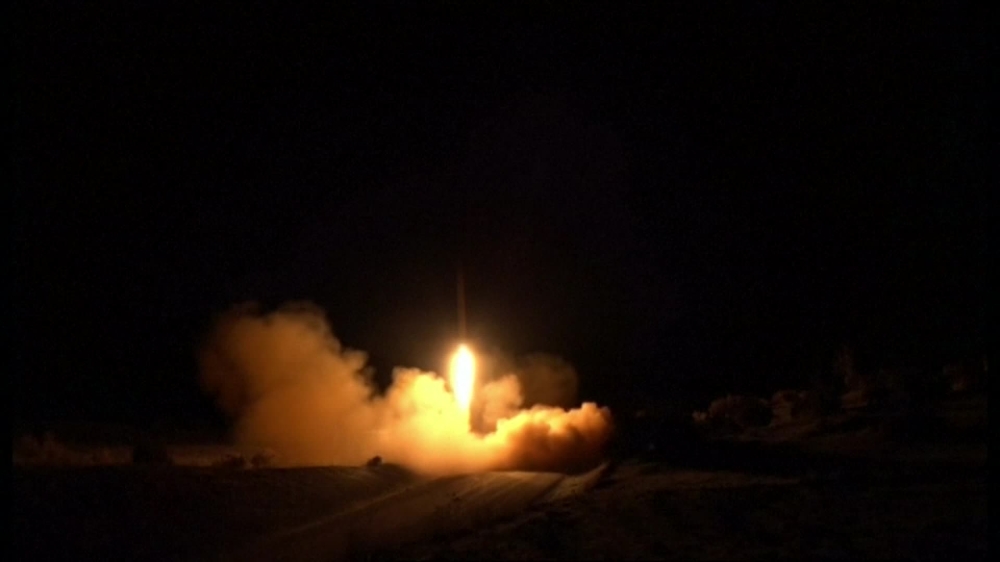
In a significant security and military development, recent reports revealed that Iran launched ballistic missiles toward the joint US-UK military base on Diego Garcia in the Indian Ocean. According to the Wall Street Journal, citing US officials, this incident represents a notable escalation in the ongoing tensions in the region. Although neither missile struck its target, a strategic location approximately 4,000 kilometers from Iranian territory, the launch itself carries serious military implications and reveals that Tehran possesses missile capabilities with a much longer range than previously estimated by Western intelligence.
The American newspaper detailed the targeting in its report, noting that one of the missiles suffered a technical malfunction and failed in flight, while the other was successfully intercepted by a missile launched from a US warship stationed in the area. Diego Garcia, located in the Chagos Islands archipelago, is considered one of the most important strategic bases and is one of two bases that Britain has allowed the United States to use for "defensive" operations to counter growing threats.
The historical context of the development of Iranian ballistic missiles
Iranian ballistic missiles was not a sudden occurrence, but rather the culmination of decades of military and technological investment. Historically, Tehran began building its missile arsenal during the Iran-Iraq War in the 1980s, when the Iranian leadership recognized the urgent need for a strategic deterrent to compensate for the shortcomings of its air force. Over the years, Iran sought foreign expertise to develop and domestically modify Scud missiles, producing new generations such as the Shahab, Sejjil, and Khorramshahr missiles. This continuous development has made the Iranian missile program one of the largest and most diverse in the Middle East, a constant source of concern for the international community, especially as Tehran continues to increase the range and accuracy of these missiles to reach distant strategic targets beyond regional borders.
The strategic importance of the Diego Garcia base
Diego Garcia plays a pivotal role in US and British military calculations. Established in the 1970s during the Cold War, the base has evolved into a key launching point for military operations in the Middle East and Asia. Its isolated location in the middle of the Indian Ocean provides a safe haven for strategic bombers, nuclear submarines, and logistical support facilities. Targeting this base, even if unsuccessful, represents an attempt to breach the geographical security that Western forces have long relied upon to conduct their military operations beyond the range of direct fire.
Regional and international repercussions of this escalation
This event has far-reaching implications on multiple levels. Domestically and regionally, the missile launches send a reassuring message to the Iranian public and Tehran's allies in the region about its ability to retaliate and strike vital Western interests. This could escalate the arms race in the Middle East and prompt neighboring countries to strengthen their air defense systems. Internationally, demonstrating Iran's ability to reach targets 4,000 kilometers away alters the strategic calculations of the United States and its European allies. This development may lead Washington to reassess its military deployments and bolster its naval and defense presence in the Indian Ocean and the Arabian Gulf. It may also result in the imposition of new rounds of economic and military sanctions on Tehran to curb its accelerating missile program, which now threatens international navigation and global security.