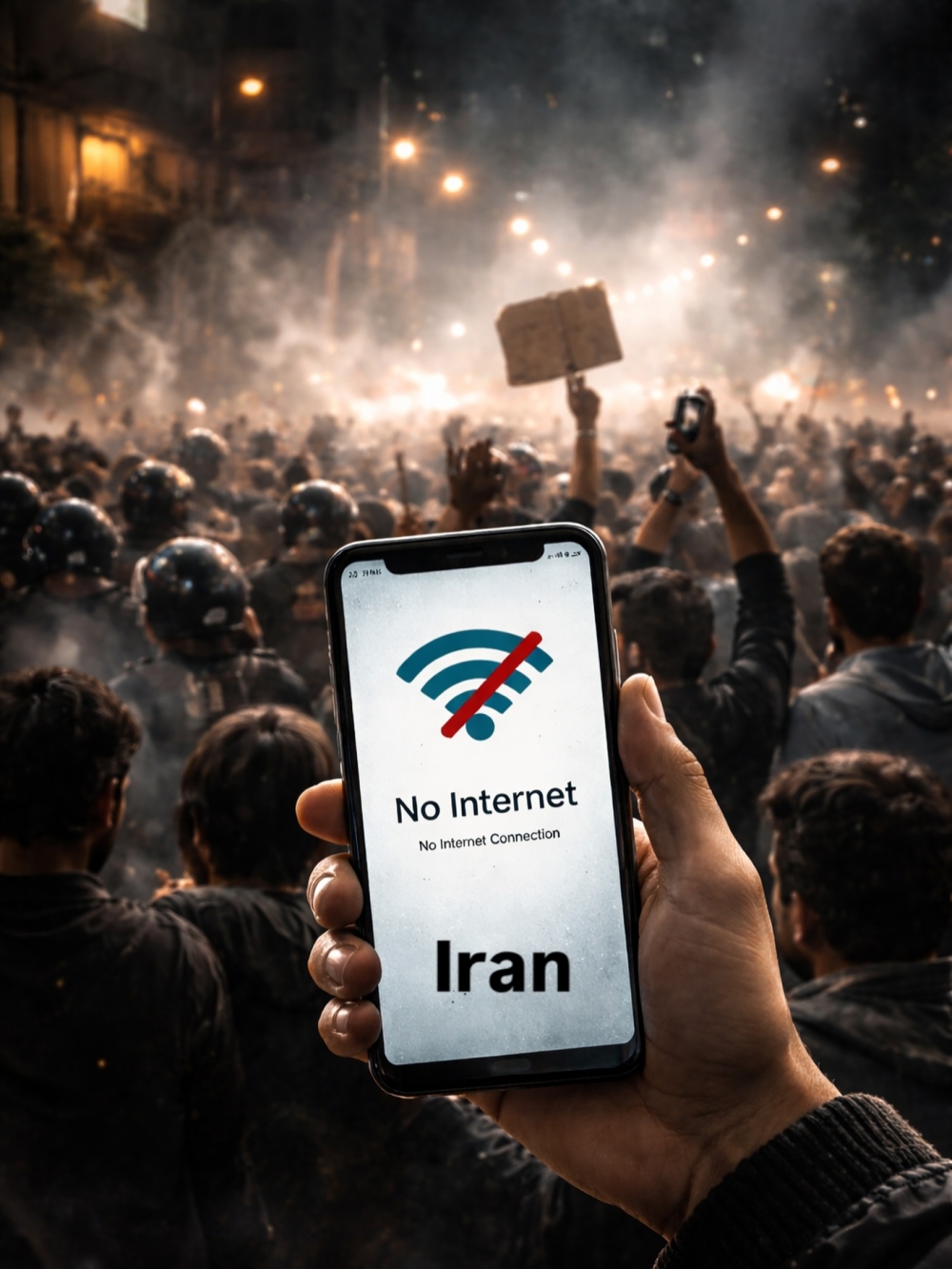
Nearly 86 million Iranians have been living in near-total isolation from the outside world for several days following the authorities' decision to shut down internet services extensively. This measure has paralyzed the country's digital infrastructure, with email, text messaging, and global applications unavailable, while telephone communications are severely disrupted, creating a new and difficult reality for the population as the protest movement continues.
Life behind the digital wall
This move comes as part of a strategy employed by Tehran to control the flow of information during crises. On January 8th, Iranians found themselves unable to share what was happening inside their country with the outside world. Protests that began over economic and living conditions quickly transformed into a political movement raising anti-regime slogans, prompting authorities to activate what is known as a "kill switch" to the international internet.
Speaking to AFP, an employee at a private company expressed his deep frustration, saying, "We come to the office, but without internet. I can't even communicate with my clients." This statement reflects the extent of the economic damage being inflicted on the private sector, where companies rely entirely on digital communication.
National network and local alternatives
Despite blocking popular global platforms like YouTube, Instagram, and Telegram, authorities have maintained access to the National Information Network (the domestic internet). This system allows local applications such as taxi services, delivery apps, and banking services to continue operating, though all content on this network is subject to strict censorship and filtering. While international phone calls from Iran were restored on Tuesday, they continue to suffer from frequent outages and poor quality, and calls from abroad to Iran remain unavailable.
Tehran Diaries: Between Chaos and Cautious Calm
The streets of Tehran present a contrasting picture; during the day, life appears outwardly normal. Cafe terraces are crowded with patrons, shops are open, and the main roads experience their usual traffic congestion. However, the scene changes completely as the sun sets.
As evening falls, and despite the absence of an official curfew, economic activity slows noticeably. Restaurants and shopping centers close early, and a waiter at a café says, "There are lots of customers when people come to meet up, but we have to start closing around 6:00 PM." A relative decrease in the number of security forces at major intersections has also been observed compared to the peak of the protests last weekend.
The official narrative and the exchange of accusations
Meanwhile, state media and some conservative newspapers, such as Kayhan, are promoting the government's narrative, describing the events as a "historic humiliation" for the United States and Israel, which Tehran accuses of orchestrating the unrest. Banners displaying images of burning vehicles and slogans like "These are not demonstrations" are ubiquitous in the capital, attempting to discredit the protests as peaceful.
In front of Tehran University, a burned-out ambulance and fire truck were displayed as evidence of the riots, along with a banner accusing "agents of the Zionist entity" of targeting them. For his part, Iranian Foreign Minister Abbas Araqchi told foreign ambassadors that the losses included the burning of 200 shops, 180 ambulances, and 53 mosques, in addition to public buses, thus reinforcing the government's narrative of foreign-backed "terrorism" targeting the country's stability.