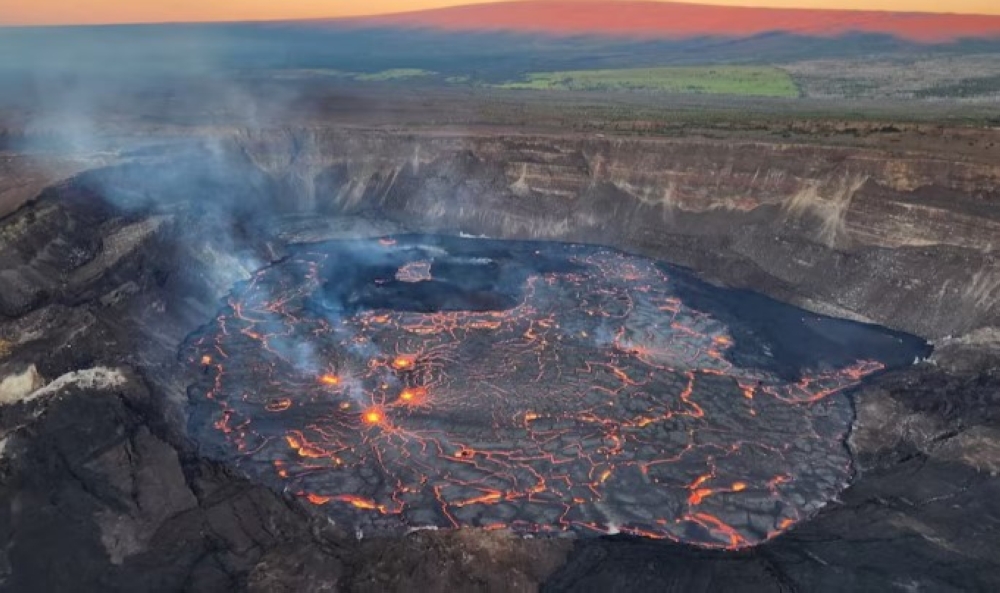
Indonesian authorities have officially raised the alert level for Mount Por Ne Tilong volcano, located in Aceh province in the far west of the country, to level two, following the detection of a worrying series of increased activity and volcanic earthquakes that indicate geological movements beneath the surface.
Details of observed seismic activity
In a press statement, Lana Sariya, acting head of the Geological Agency at the Ministry of Energy and Mineral Resources, explained the current situation of the 2,624-meter-high stratovolcano located in the Pinner Merja region. She noted that monitoring equipment recorded at least seven tremors on Tuesday evening, tremors strong enough to be felt by residents in neighboring areas up to five kilometers from the volcano's center.
The technical data recorded by the seismometers added that there were seven surface volcanic tremors, in addition to 14 deep tremors and two tremors in the Earth's crust, which prompted immediate intervention to raise the alert level from level three to level two.
Significance of ground movements
Sariya confirmed that the aftershocks that followed the disturbances in the Earth's crust clearly indicate the ease with which lava activity (magma) can be stimulated, as the continuous increase in seismic activity since last July, which has intensified and become closer to the surface during the past two months, is a strong indicator of the rising internal pressure of the volcano.
Based on visual and mechanical monitoring, the agency warned of the possibility of an eruption, which could include underground explosions and the emission of dangerous volcanic gases, especially near areas containing vents that emit vapors, although no heavy smoke has been detected emanating from the main vent so far.
Indonesia and the Ring of Fire: A complex geological context
To understand the nature of this event, one must consider the geographical and geological context of Indonesia. The archipelago nation lies directly on the Pacific Ring of Fire, a horseshoe-shaped zone stretching 40,000 kilometers, characterized by intense tectonic activity resulting from the collision of continental plates.
Indonesia is home to more than 120 active volcanoes, making it one of the most volcanically and seismically active countries in the world. Local communities in these areas live in a constant state of alert, and authorities have developed sophisticated early warning systems to deal with these natural threats.
Potential risks and safety measures
Raising the alert level in such cases is usually accompanied by precautionary measures, including prohibiting climbing or approaching the crater area within specified distances. The danger of stratovolcanoes like Bur Nee Telong lies in their ability to release pyroclastic flows and toxic gases that may not be visible to the naked eye but are still deadly.
The situation remains under close monitoring by geologists to determine whether the activity will escalate towards a full-blown eruption or return to stability, while residents and tourists are advised to follow the instructions of local authorities strictly to ensure their safety.