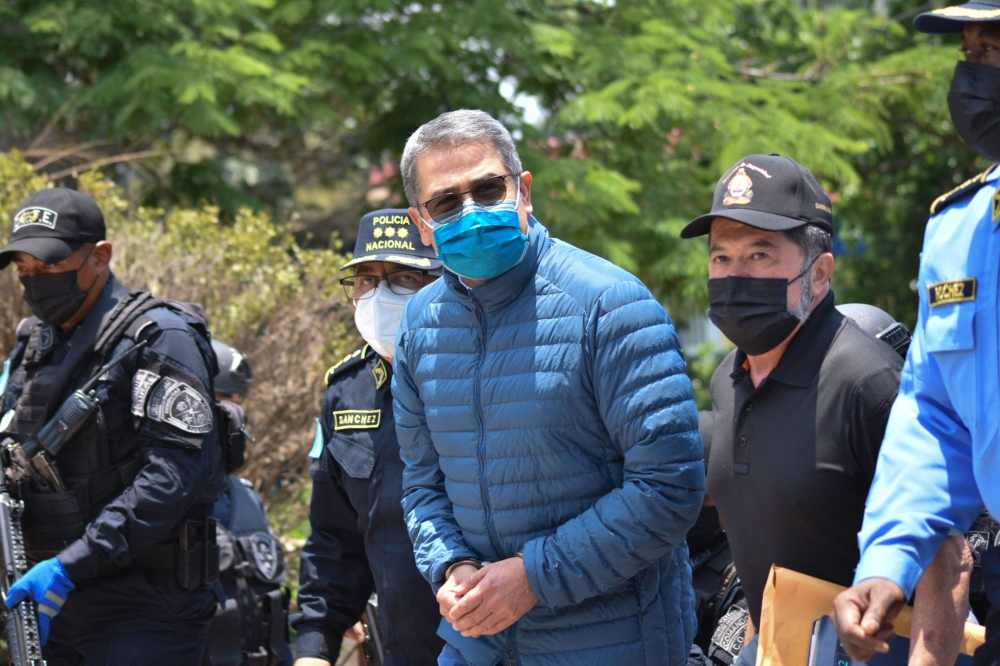
In a dramatic legal development, a jury in a New York federal court convicted former Honduran President Juan Orlando Hernández of conspiring to smuggle hundreds of tons of cocaine into the United States. This verdict marks a dramatic end to the long political career of a man once considered a key ally of Washington in its war on drugs in Central America, revealing instead his role as a patron of a narco-state.
Hernández, who ruled Honduras for two presidential terms from 2014 to 2022, was convicted on three serious charges: conspiracy to import cocaine, possession of machine guns and destructive devices, and conspiracy to possess those weapons. The former president now faces a mandatory minimum sentence of 40 years in prison, and a potential life sentence.
General context: From the presidency to the dock
Juan Orlando Hernández rose to power promising an “iron fist” policy against organized crime and drug cartels plaguing his country. During his presidency, he cooperated closely with successive US administrations, including that of President Donald Trump, and extradited dozens of Honduran drug traffickers to the United States. However, US prosecutors revealed during his trial that this cooperation was merely a facade to conceal his deep involvement in criminal networks.
According to prosecutors, Hernandez used drug proceeds to finance his political rise and protected major drug traffickers, including his brother Tony Hernandez, who was convicted on the same charges in 2019, in exchange for millions of dollars in bribes. He was also accused of using the military and national police to secure cocaine shipments as they transited Honduras en route north.
The importance of the event and its expected impact
Hernandez's conviction is a watershed moment on several levels. Domestically in Honduras, it confirms long-held suspicions of rampant corruption at the highest levels of power and could pave the way for the prosecution of other implicated officials. It also places immense pressure on the country's political and judicial systems to implement genuine reforms.
Regionally, the case sends a powerful message to corrupt political elites across Latin America that no one is above the law and that U.S. justice can reach them even after they leave office. Internationally, the case raises serious questions about U.S. foreign policy and its choice of allies in the war on drugs, given that Washington supported Hernandez for years despite growing warnings about his ties to organized crime.