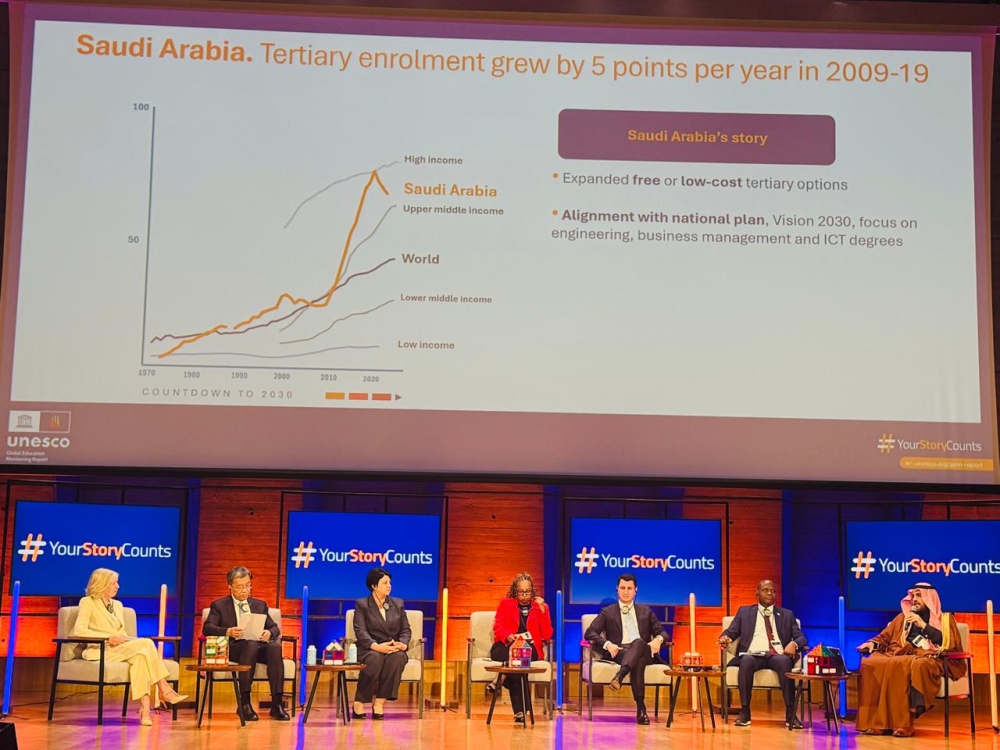
In a new historical achievement reflecting the scale of efforts to develop the knowledge sector, the United Nations Educational, Scientific and Cultural Organization (UNESCO) highlighted in Paris the exceptional leap achieved by the higher education sector in Saudi Arabia . The Kingdom recorded unprecedented enrollment rates in post-secondary education, reaching 83.88%, on the sidelines of the Saudi Ministry of Education's participation in the launch of the "Global Education Monitoring Report 2026," which focuses on issues of accessibility and equality of educational opportunities.
The historical roots and comprehensive renaissance of higher education in Saudi Arabia
This qualitative leap was not a sudden occurrence, but rather the culmination of long-term strategic policies adopted by the Kingdom of Saudi Arabia decades ago. The Saudi leadership has consistently prioritized human development as a cornerstone of progress, expanding the establishment of public and private universities to cover all regions of the Kingdom and launching massive scholarship programs that have contributed to the transfer and localization of knowledge. This accumulation of knowledge and substantial financial investment in educational infrastructure has paved the way for achieving the advanced global indicators we witness today, making the Kingdom a model to be emulated in rapid and sustainable educational transformation.
Record numbers and gender equality
The UNESCO international report revealed positive indicators reflecting the maturity of the education system, with the Kingdom achieving remarkable gender parity in enrollment rates of 1.01, confirming the success of policies aimed at empowering Saudi women in the education and scientific research sectors. Furthermore, enrollment in technical and vocational education saw a significant increase, exceeding 30% by 2024, which aligns with global trends toward enhancing technical and vocational skills that meet the needs of the modern era.
Ranking of Saudi universities and their regional and international influence
During the ministerial session, the Deputy Minister of Education for Planning, Engineer Saad Al-Ghamdi, outlined the ongoing efforts to enhance the quality of educational outcomes. These efforts have resulted in King Fahd University of Petroleum and Minerals achieving a global ranking of 67th in the prestigious QS World University Rankings. He also noted that several Saudi universities have entered the list of the top 100 universities globally in patent registrations for 2025. This tangible progress not only has a local impact but also strengthens the Kingdom's position as a leading regional hub for scientific research and innovation, contributing to raising the international competitiveness indicators for the entire region in the knowledge economy.
Attracting talent and internationalizing the academic system
In a related context, the Undersecretary highlighted the success of the Strategic Scholarship Program, which currently includes more than 56,000 students studying at top international academic institutions. Regarding attracting talent, the number of beneficiaries of the "Study in Saudi Arabia" platform has reached over 200,000 international students. Efforts are ongoing to grant licenses to prestigious international universities to open branches within the Kingdom, which will contribute to diversifying educational options and enhancing competitiveness, positioning Saudi Arabia as a globally attractive destination for students and researchers.
Aligning educational outputs with the labor market within the framework of Vision 2030
Engineer Al-Ghamdi affirmed that the experience of aligning educational outcomes with the evolving needs of the labor market represents an inspiring model internationally. These strategic steps aim to transform economic challenges into sustainable development opportunities, thus achieving the objectives of Saudi Vision 2030. At the conclusion of their participation, the Ministry's delegation held bilateral meetings with UNESCO leaders to discuss future cooperation opportunities, follow up on joint projects, and exchange educational policies, thereby solidifying Saudi Arabia's active and influential presence on the international educational stage.