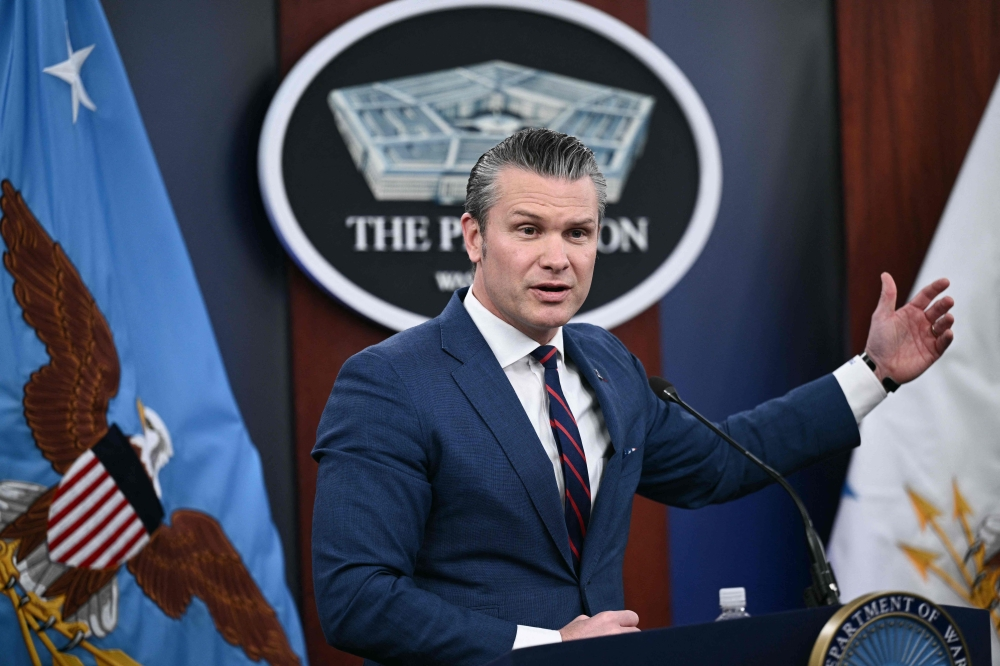
US Defense Secretary Pete Hegseth asserted on Monday that the war with Iran , which his country is waging in cooperation with Israel, is by no means aimed at "establishing democracy" or regime change through nation-building, but rather focuses on achieving specific and decisive military objectives. These remarks clarify the Pentagon's new combat doctrine for dealing with regional threats, dispelling speculation about long-term political agendas.
Washington's new strategy: Victory without nation-building
In his first press conference since the outbreak of hostilities, Higseth drew clear red lines for his country's military policy, stating firmly: "No more stupid rules of engagement, no more nation-building quagmires, no more democracy-building operations. No more politically correct wars. We fight to win, not to waste time or lives." This statement reflects a radical shift in American strategy, moving away from the approach of previous interventions that drained American resources in the Middle East for decades.
Higseth categorically stated that Washington had not sent any ground troops into Iranian territory as part of the joint attack with Israel, but he simultaneously emphasized the readiness to go "as far as necessary" in this battle to neutralize the threats. In response to a journalist's question about the presence of American soldiers inside Iran, he replied, "No, but we're not going to say what we will or will not do," adding, in a somewhat ambiguous statement, "We will go as far as necessary.".
Historical context and chronic tension
conflict with Iran cannot be separated from decades of escalating tensions between Tehran and the West. Since 1979, US-Iranian relations have been marked by a series of crises, from the hostage crisis to disputes over the nuclear program and crippling economic sanctions. While the region has long been a stage for proxy wars and indirect escalation, the current shift toward direct confrontation represents a dangerous turning point in the history of the conflict, as the United States seeks to curtail Tehran's regional influence without becoming embroiled in a costly military occupation.
The repercussions of a war with Iran on regional stability
This escalation is raising widespread concerns at both the regional and international levels. Economically, the Gulf region is a vital artery for global energy supplies, and any expansion of the conflict could threaten the security of navigation in the Strait of Hormuz, leading to dramatic increases in oil and gas prices. Politically, this confrontation presents the countries of the region with complex security challenges, amid fears that the situation could spiral into a full-blown war that would redraw the geopolitical map of the Middle East and affect existing international alliances.
Larijani: Defending Civilization and Destiny
In response, Tehran issued a swift and sharp rebuttal. Ali Larijani, Secretary of Iran's Supreme National Security Council, asserted that his country would not stand idly by. In remarks on Monday, Larijani stated that Iran would defend itself against the American-Israeli attack "whatever the cost.".
On the “X” platform, Larijani posted a message reflecting his country’s fighting spirit and adherence to its historical heritage, stating: “We will continue to fiercely defend ourselves and our six-thousand-year-old civilization, whatever the cost, and we will make our enemies regret their miscalculations.” These statements indicate that Tehran views the current conflict as an existential one, drawing on its historical depth and defensive capabilities to counter increasing military pressure.