A new strategy for managing Hajj: Early planning for the 1447 AH season
In a proactive move reflecting a strategic shift in Hajj management, the Saudi Ministry of Hajj and Umrah has unveiled the comprehensive timeline for the operations of Hajj affairs offices for the 1447 AH (2026 CE) Hajj season. The Ministry announced that the issuance of Hajj visas will commence on 1 Sha'ban 1447 AH, corresponding to February 8, 2026 CE, emphasizing its proactive planning approach aimed at enhancing the readiness of all sectors and improving the quality of services provided to millions of Muslims arriving from around the world.
This early announcement, which has become a hallmark of recent years, falls within the framework of the Kingdom’s Vision 2030 objectives, specifically the “Guests of God Service Program.” This approach aims to shift from reactive seasonal management to proactive planning, giving countries, Hajj affairs offices, and service providers ample time to finalize contracts, arrange logistics, and educate pilgrims, thus ensuring a smoother and more convenient spiritual journey.
Historical context and importance of the event
Hajj, one of the five pillars of Islam, represents the largest annual human gathering in the world, placing an enormous logistical and organizational responsibility on the Kingdom of Saudi Arabia. Over the decades, the Kingdom has continuously developed its Hajj management system to accommodate the increasing number of pilgrims and the challenges that come with it. Announcing the Hajj schedule more than a year and a half before the season begins marks a significant step forward in this development, providing all stakeholders, from governments to service providers, with an unprecedented opportunity for meticulous planning and avoiding the challenges they faced in the past due to time constraints.
Internationally, this approach reinforces the Kingdom's position as a global leader in crowd management and large gatherings, and provides a model for strategic planning. Domestically, it stimulates the local economy by enabling the housing, transportation, and hospitality sectors to better prepare, and supports the digital transformation being undertaken by all government entities.
Details of the Hajj season schedule for 1447 AH
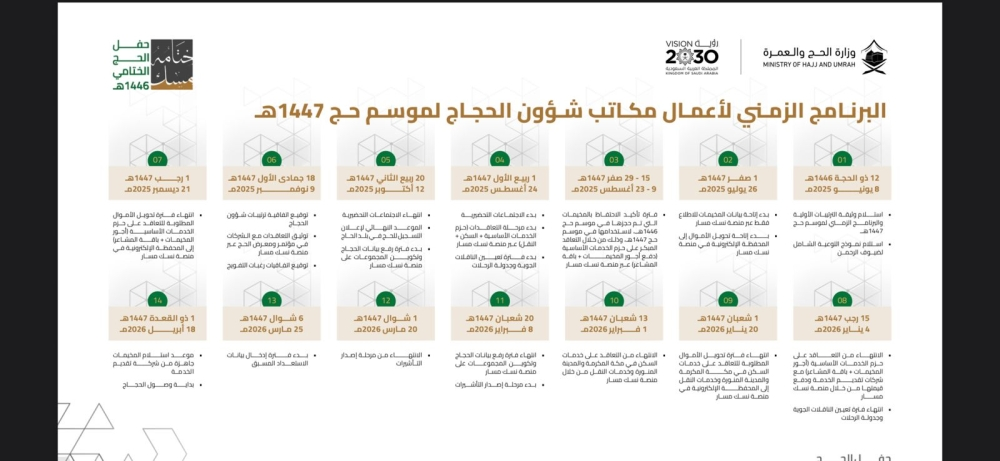
The ministry clarified that actual preparations for the season began the day after the end of the 1446 AH Hajj season, with the initial arrangements document being submitted on 12 Dhu al-Hijjah 1446 AH (June 8, 2025). The main stages will follow according to the following schedule:
- 1 Rabi’ al-Awwal 1447 AH: The preparatory contracting phase for basic services such as housing and accommodation begins.
- 20 Rabi’ al-Thani 1447 AH (October 12, 2025): Deadline for concluding preparatory meetings and completing the necessary operational data.
- Jumada al-Ula 1447 AH: Signing of the main agreements and launch of the Hajj and Umrah Services Exhibition, which brings together service providers with the relevant authorities.
- January 2026: Completion of all housing contracts in Makkah and Madinah, in addition to services for the holy sites and transportation.
- 1 Sha’ban 1447 AH (8 February 2026 AD): The official issuance of Hajj visas begins.
- 1 Dhu al-Qi'dah 1447 AH (18 April 2026 AD): The first groups of pilgrims begin arriving in the Kingdom.
Digital transformation and its role in facilitating procedures
The Ministry emphasized the pivotal role of digital platforms, particularly the “Nusk Masar” platform, in ensuring the success of this timeline. The platform allows for the electronic completion of all contractual and financial transactions, enhancing transparency, expediting procedures, and eliminating haphazard bookings. The Ministry urged all Hajj affairs offices to fully adhere to the specified deadlines to guarantee a successful and safe Hajj season, embodying the slogan “Nusk and Tranquility.”.