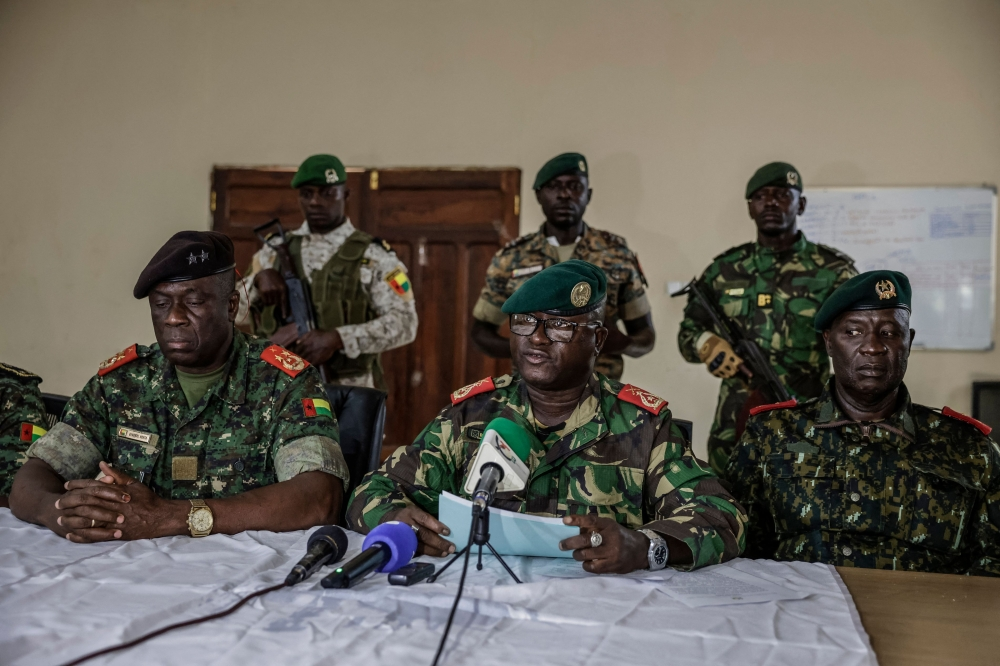
The army's control over key state institutions in Guinea-Bissau
In a dramatic turn of events in Guinea-Bissau, the military announced it had taken full control of the country, confirming the arrest of outgoing President Umaro Sissoco Embaló, along with the army chief of staff and the interior minister. This sudden move, coming on the heels of presidential and legislative elections whose results the West African nation was anxiously awaiting, has deepened political uncertainty and brought the democratic process to a complete halt. A military officer told AFP that President Embaló was being held at the army headquarters and was being “treated well,” while troops were deployed throughout the capital, Bissau, particularly around key government buildings and the presidential palace, near which heavy gunfire was heard.
A history marked by coups and political upheavals
This coup is not an isolated event in the modern history of Guinea-Bissau. Since gaining independence from Portugal in 1974, the country has suffered from chronic political instability, experiencing more than a dozen military coups and failed coup attempts. The military has consistently played a pivotal role in politics, often intervening directly in governance and exploiting political divisions and fragile state institutions. This vicious cycle of instability has severely hampered economic and social development, leaving the country one of the poorest in the world.
The situation was exacerbated by Guinea-Bissau's transformation into a major transit point for drug trafficking from Latin America to Europe, leading to the infiltration of organized crime networks into the state apparatus, including the political and military institutions. Analysts have sometimes referred to the country as a "narco-state," as the proceeds from this illicit trade are believed to fuel corruption and contribute to the financing of power struggles.
The importance and expected effects of the crisis
Domestically, this coup represents a serious setback to hopes for a peaceful and sustainable democratic transition. The suspension of the electoral process closes the door on the popular will and opens the door to a prolonged period of unconstitutional military rule, which could lead to the suppression of freedoms and a deterioration of the humanitarian situation. Regionally, this event adds to concerns about the wave of coups that has swept across the Sahel and West Africa in recent years, in what has become known as the “coup belt.” The Economic Community of West African States (ECOWAS) and the African Union are expected to strongly condemn this power grab and may impose tough economic and diplomatic sanctions on the ruling military junta in an effort to pressure it to return to the constitutional path.
Internationally, the new regime is likely to face widespread isolation. Condemnations are expected from the United Nations, the European Union, the United States, and Portugal, the country's long-standing partner. International concern will focus on preventing Guinea-Bissau from becoming a new hotbed of instability in an already fragile region, averting a worsening humanitarian crisis, and combating organized crime networks that could exploit the power vacuum to expand their influence.