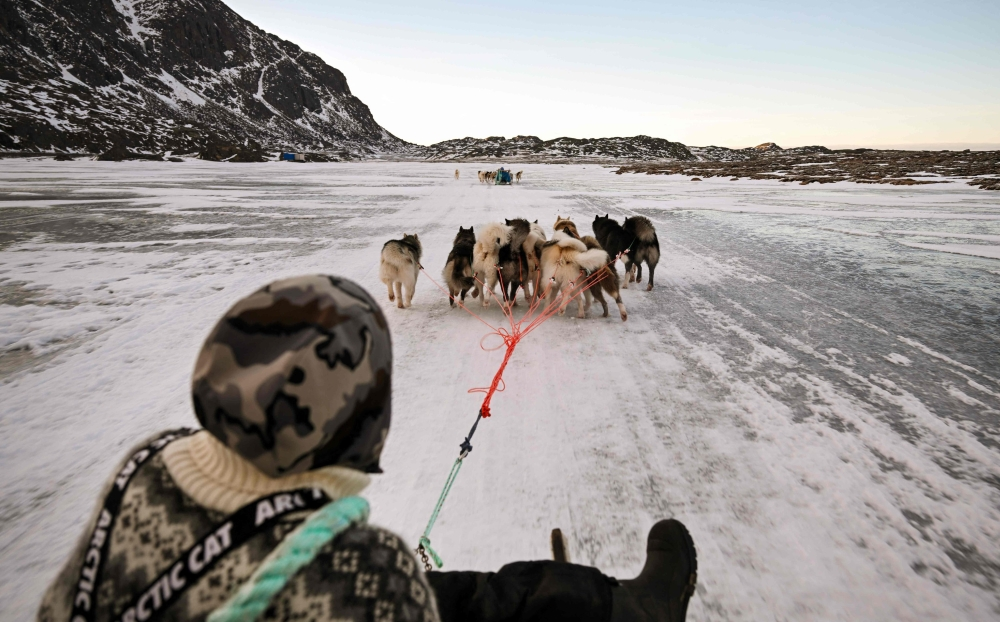
A historic record in the Arctic
In a worrying sign of accelerating climate change, Greenland's west coast recorded its warmest January on record, breaking a record that had stood for over a century. According to data from the Danish Meteorological Institute, the capital, Nuuk, experienced exceptional temperatures, surpassing the previous record set 109 years ago, further highlighting the increasing vulnerability of polar regions.
The average temperature in Nuuk during January was 0.1°C, which is 7.8 degrees higher than the average temperature for the same month over the past three decades. This not only broke the previous record set in 1917 but surpassed it by a significant margin of 1.4°C. On some days, the temperature reached 11.3°C, an unprecedented warmth in the heart of the Arctic winter.
A widespread phenomenon with worrying effects
This warm spell wasn't confined to the capital, Nuuk, but extended along the west coast for over 2,000 kilometers. In Ilulissat, a city on Disko Bay famous for its massive icebergs, the average temperature reached -1.6 degrees Celsius, a full 11 degrees above the usual average and breaking the previous record set in 1929. Martin Olssen, a climate researcher at the Danish Institute, confirmed that the persistence of this warm spell over such a vast area and for such a long period is a "clear indication of profound climate change.".
Scientific context: Polar amplification and its global dimensions
This phenomenon is a prime example of what is known as “Arctic Amplification,” a scientific fact confirming that the Arctic region is warming at a much faster rate than the rest of the world. Recent studies indicate that this warming is about four times the global average. The primary cause is the melting of sea ice, which exposes dark ocean waters that absorb the sun’s heat instead of reflecting it as white ice does, creating a vicious cycle of accelerated warming.
The importance of Greenland and its impact on the future of the planet
These record-breaking figures have implications far beyond Greenland. The massive ice sheet covering the island is the second largest ice mass in the world after Antarctica. The rapid melting of this ice sheet is releasing enormous quantities of fresh water into the ocean, directly contributing to global sea-level rise. This rise directly threatens coastal communities and major cities worldwide, from Miami to Alexandria. Locally, this warming impacts the traditional livelihoods of Inuit communities who rely on hunting and gathering in a stable, icy environment, and it also threatens infrastructure built on permafrost.
Olsen concluded his statement by saying: “We know and clearly see that climate warming is continuing, which is leading, as expected, to more record-breaking warm temperatures and a gradual decrease in cold temperatures.”.