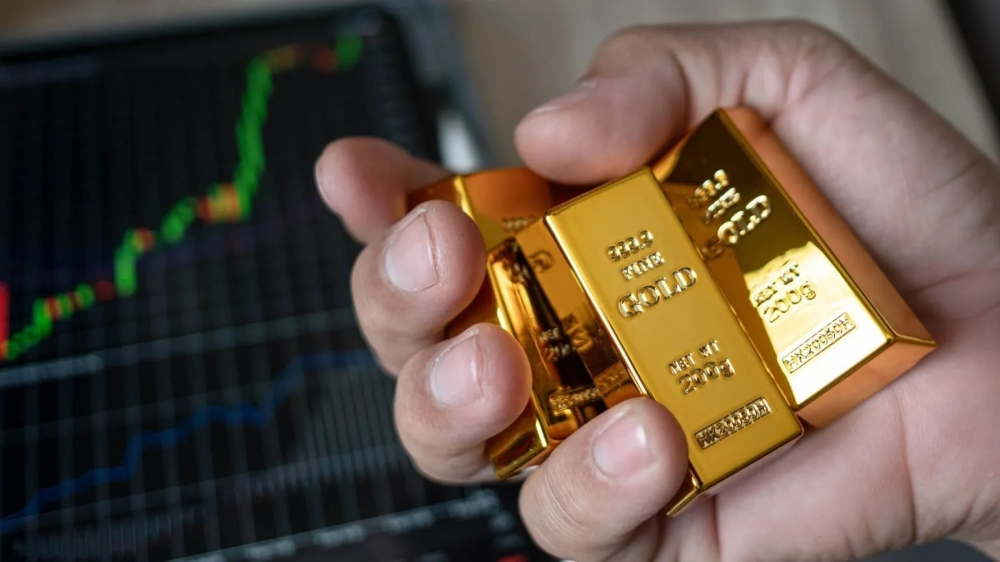
Global financial markets witnessed a historic shift on Friday, with gold prices to unprecedented record highs, shattering all expectations and previous psychological barriers. This dramatic surge reinforces the precious metal's status as a safe haven amidst global economic volatility, with the price per ounce surpassing $4,900 for the first time in trading history.
Details of the record rise in gold
According to spot market data, gold surged to a peak of $4,904.66 per ounce by 5:50 PM GMT. The rise wasn't limited to spot trading; futures contracts also saw gains, with US gold futures (February delivery) rising 1.2% to close at $4,896.2 per ounce.
Strong performance for other precious metals
Gold was not alone in this collective rise of precious metals; it was accompanied by sharp increases in the prices of other metals, indicating a broad investment trend towards tangible assets:
- Silver: It achieved a significant jump in spot transactions by 3.5%, reaching an amazing level of $96.45.
- Platinum: It recorded an increase of about 4% in spot transactions, bringing its price to $2,580.1 per ounce.
- Palladium: rose by 2.9% to reach $1892.55.
Economic context and safe haven
Historically, gold has been considered a true gauge of investor anxiety and a key barometer of the global economy's health. Prices reaching astronomical levels typically reflect investors seeking to protect their wealth against major economic challenges, such as high inflation or currency market volatility. Gold is consistently viewed as a store of value that does not depreciate over time, and its appeal increases as the global economic outlook becomes more uncertain.
Expected impacts locally and globally
This record high is expected to have repercussions on both local and global markets. Globally, this price could prompt central banks to reassess their gold reserves. Locally, for consumers, the price of an ounce exceeding $4,900 will undoubtedly lead to a significant increase in the prices of gold jewelry and investment bars, potentially altering individual purchasing patterns and leading them to invest in smaller amounts or hedge against the trend through gold-backed exchange-traded funds (ETFs).