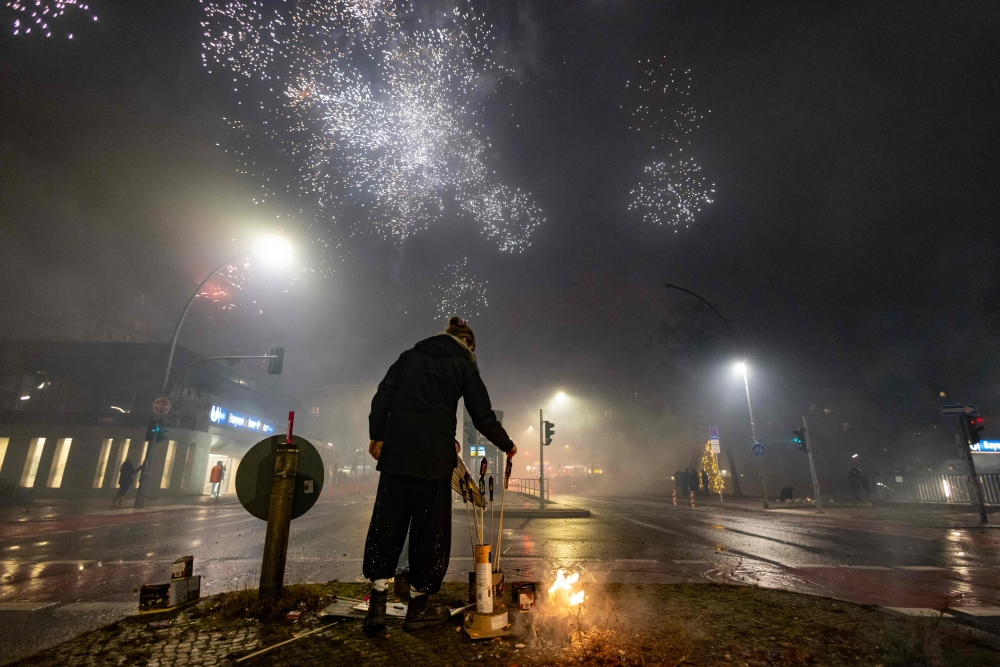
Germany witnessed tragic events and widespread security disturbances on New Year's Eve, turning celebrations in several cities into scenes of confrontation. Two people died, dozens were injured, and hundreds were arrested. The night was marked by the excessive use of fireworks, not only for celebrations but also as weapons to attack security forces and rescue teams.
Heavy toll in Berlin and Hamburg
In Berlin, the epicenter of the unrest, police endured a tense night despite deploying some 3,200 additional officers, a measure based on experience from previous years with similar incidents. Police sources confirmed the arrest of approximately 430 suspects following a series of coordinated and random attacks targeting officers, which resulted in injuries to 35 police personnel.
Hamburg was not immune to this chaos, as an additional thousand officers were deployed to control the situation. However, the city witnessed sporadic incidents that resulted in injuries to 10 police officers, and an unspecified number of people being investigated or detained.
The tragedy of firecrackers
In another tragic turn of events, grief gripped the city of Bielefeld in western Germany, where two 18-year-old boys were killed by homemade fireworks. Local police reported that the two suffered fatal facial injuries after the fireworks were set off indiscriminately, highlighting the dangers of using unlicensed explosives, which are prevalent at such celebrations.
In the medical context, Berlin's accident hospital received more than 30 people with serious injuries. Hospital spokeswoman Angela Kievsky confirmed that medical teams had to perform amputations of fingers or parts of the hands for some of the injured, as well as treat severe burns and injuries to the face and eyes.
The context of violence and targeting the state
These events have reignited the heated debate in Germany surrounding the tradition of setting off fireworks on New Year's Eve, a custom deeply rooted in German culture but which has become an increasing security challenge in recent years. In some neighborhoods, these celebrations have transformed into a means of expressing anger and targeting symbols of the state, with fireworks being deliberately aimed at police and ambulance vehicles, hindering rescue operations and endangering the lives of first responders.
In North Rhine-Westphalia, police recorded 30 attacks on their officers during 4,000 security operations, while Leipzig witnessed mass attacks by vandal groups using stones and paint-filled bottles.
Calls for accountability
These attacks sparked a wave of official and union condemnation, with the police union describing them as “serious attacks on the rule of law.” Andreas Roskov, a union representative, demanded that those responsible be brought to justice swiftly as a deterrent, amid expectations that these events will lead to stricter laws regarding the sale and use of fireworks in the future, and perhaps even the expansion of firework-free zones in major cities to protect lives and public property.