A joint statement issued following an extraordinary meeting of the foreign ministers of the Gulf Cooperation Council (GCC) and the United Kingdom strongly condemned any Iranian threats to close the Strait of Hormuz or disrupt international shipping through it. This important meeting was convened to discuss the rapidly escalating developments in the Middle East, including the dangerous attacks launched by Iran and its regional proxies against GCC member states and the Hashemite Kingdom of Jordan.
Strategic importance and history of tensions in the region
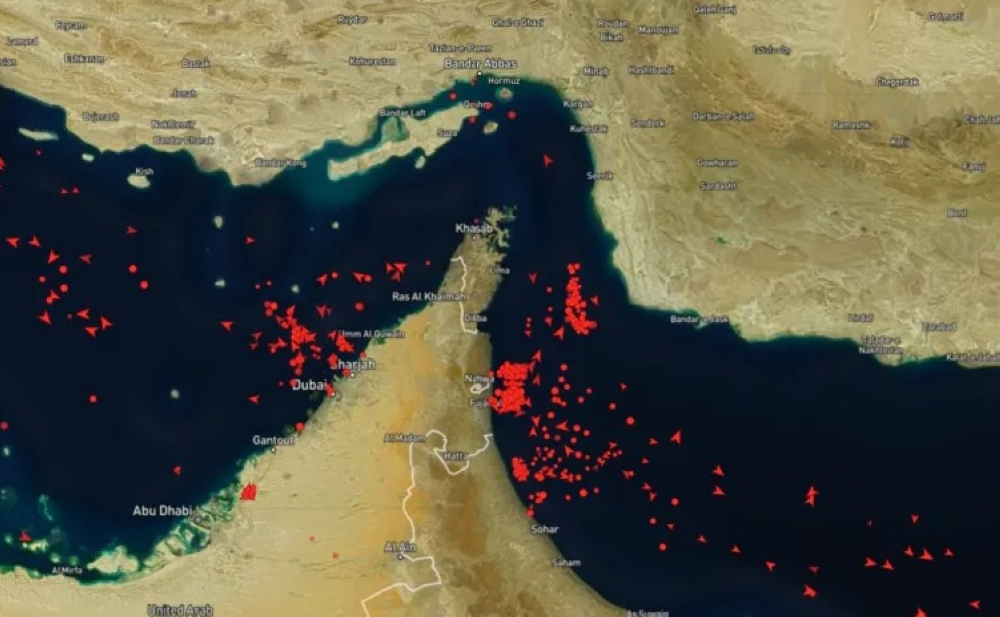
The Strait of Hormuz is one of the world's most important waterways, connecting the Persian Gulf, the Gulf of Oman, and the Arabian Sea. Historically, this strait has been a vital artery for the global economy, with approximately one-fifth of the world's daily oil consumption passing through it, in addition to vast quantities of liquefied natural gas. Over the decades, this sensitive region has witnessed recurring tensions, as the threat of closing the strait has long been used as a tool of political and military pressure in regional conflicts, prompting the international community to continuously strengthen its naval presence to ensure freedom of navigation and secure global energy supplies.
The expected effects of any Iranian threats to close the Strait of Hormuz
Any Iranian threats to close the Strait of Hormuz would have repercussions far beyond the local and regional levels, striking at the very heart of the global economy. Regionally, it would destabilize security and increase military spending by countries in the region to protect their territorial waters. Internationally, any disruption to navigation would immediately lead to sharp increases in global oil prices, threatening to raise inflation rates and slow economic growth in major industrialized nations. Therefore, the international community considers the security of this strait a red line that cannot be compromised.
Gulf-British strategic partnership
The GCC delegation was headed by the Minister of Foreign Affairs of the Kingdom of Bahrain, Dr. Abdullatif bin Rashid Al Zayani, in his capacity as Chair of the current session of the Ministerial Council, while the UK delegation was headed by the Secretary of State for Foreign, Commonwealth and Development Affairs, Yvette Cooper. Also participating were Their Excellencies the Foreign Ministers of the GCC member states and His Excellency the Secretary-General of the GCC, Jassim Mohammed Al-Budaiwi. The Ministers emphasized the great importance of the existing strategic partnership between the two sides, which was announced at the 2016 Summit in the Kingdom of Bahrain, and welcomed the progress made in the negotiations for the Free Trade Agreement, expressing their anticipation of its conclusion as soon as possible.
International condemnation and protection of civilians
The ministers welcomed the adoption of Security Council Resolution 2817 (2026), which condemned in the strongest terms the attacks targeting the territories of the GCC states and Jordan, considering them a flagrant violation of international law and a threat to international peace and security. They noted the resolution's condemnation of the targeting of residential areas and civilian infrastructure, including oil and service facilities, which resulted in civilian casualties and damage. The Ministerial Council commended the unprecedented international solidarity demonstrated by the support of 136 countries for the Security Council resolution, and stressed the demand that Iran immediately cease all attacks and refrain from any provocative actions or the use of proxies to destabilize the region.
Commitment to dialogue and diplomacy
The ministers reaffirmed their unwavering commitment to dialogue and diplomacy as the means to resolve crises, commending the constructive role played by the Sultanate of Oman in this regard. They reiterated their continued urging of Iran to curb its nuclear, ballistic missile, and drone programs. They also affirmed the inherent right of the GCC states, in accordance with Article 51 of the UN Charter, to individual and collective self-defense against armed attacks. They agreed to continue joint diplomatic efforts to reach a sustainable solution that ensures Iran does not acquire nuclear weapons and protects regional airspace and maritime routes.
Security and stability of the Gulf region
The ministers stressed that the security and stability of the Gulf region are fundamental pillars of global economic stability and are closely linked to the security of the United Kingdom and international security. They noted Britain's significant contributions to supporting the region's security and expressed their appreciation for its recent decision to enhance its defense capabilities, including the participation of Royal Air Force Typhoon aircraft in defense operations. For its part, the United Kingdom expressed its gratitude to the GCC states for their hospitality and assistance to British citizens residing in their territories.