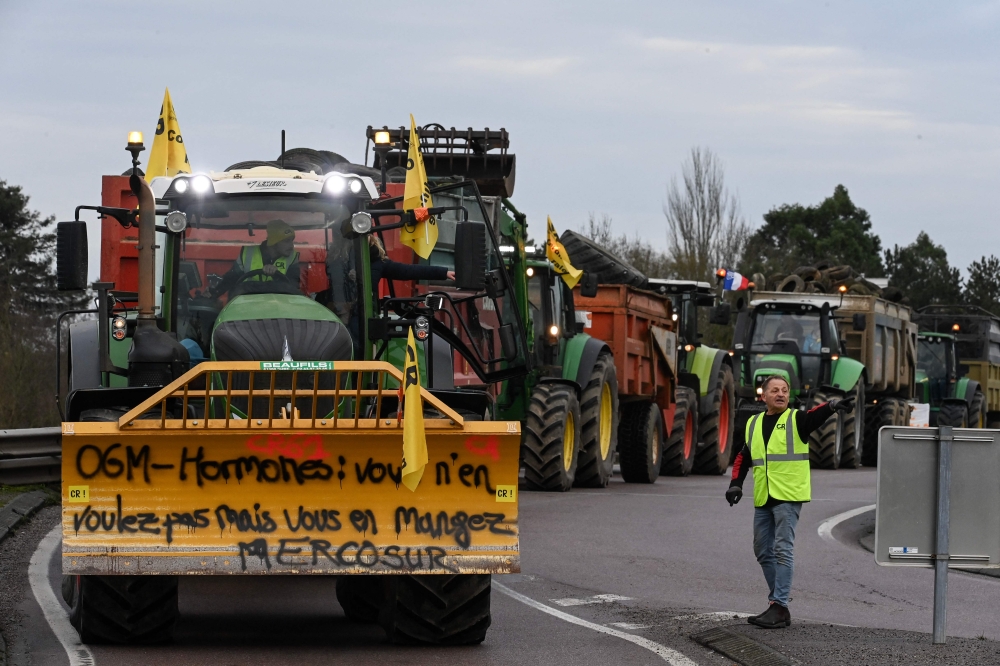
French farmers continued their protests in the southwest of the country, defying the French government's calls for a "truce" during the Christmas period. Saturday saw the continued blocking of vital and strategic roads, an escalation that reflects the deep divide between agricultural unions and government officials over current health and economic policies.
Health policy crisis and the outbreak of epidemics
This new wave of anger stems from the authorities' handling of the outbreak of contagious lumpy skin disease in livestock. Reflecting the protesters' resolve, Sarah Melki, spokesperson for the farmers' union in the Aveyron region, told AFP that the mobilization would continue. "As long as there is no radical change in health policy, and as long as the government continues its approach of systematically and completely culling the herd as soon as a single case appears on a farm, we will not stop," she said. The farmers believe this policy is destroying their livelihoods and wiping out years of hard work without offering fair and timely alternatives or compensation.
Traffic gridlock in the southwest
On the ground, the farmers' union, which is affiliated with the leftist movement, erected new roadblocks, leading to traffic paralysis on main roads:
- Motorway A75: the link between Clermont-Ferrand and Montpellier, which was closed in the southbound direction before being partially reopened in the afternoon.
- The A64 motorway, linking Toulouse and Bayonne, remained closed for a distance of over 180 kilometers, causing major disruption to traffic.
- The A63 motorway: a vital artery linking Bordeaux to the Spanish border, where the closure continued near the Sestas area.
According to data from the French Interior Ministry, 50 protest actions were recorded on Saturday with the participation of about 1,619 people, a slight decrease compared to Friday, which saw 93 actions with the participation of 4,000 people, but the quality of the protests and their impact on the main roads remain high.
Context of the crisis: Accumulation of agricultural anger in Europe
These protests cannot be separated from the general context in which French and European agriculture has been living since the beginning of 2024. The agricultural sector in France, which is the largest agricultural producer in the European Union, is suffering from increasing pressures including rising production costs (energy and fertilizers), fierce competition from imported products from outside the European Union that are not subject to the same strict standards, as well as complex bureaucracy.
European environmental policies, known as the "Green Deal," represent an additional burden that farmers see as threatening the economic sustainability of their farms. These accumulated issues have fueled periodic protests, with farmers feeling that the government is not responding to their fundamental demands but rather offering temporary, stopgap solutions.
Economic and political repercussions
The continued road closures, particularly those leading to Spain (such as the A63), have tangible economic repercussions, disrupting supply chains and overland freight traffic between southern European countries and France, especially during the peak holiday season. Politically, this escalation puts the French government in a difficult position, as it seeks to calm social unrest and avoid scenes of chaos, while farmers attempt to capitalize on the media attention to push for a comprehensive review of preventative slaughter policies and financial support.