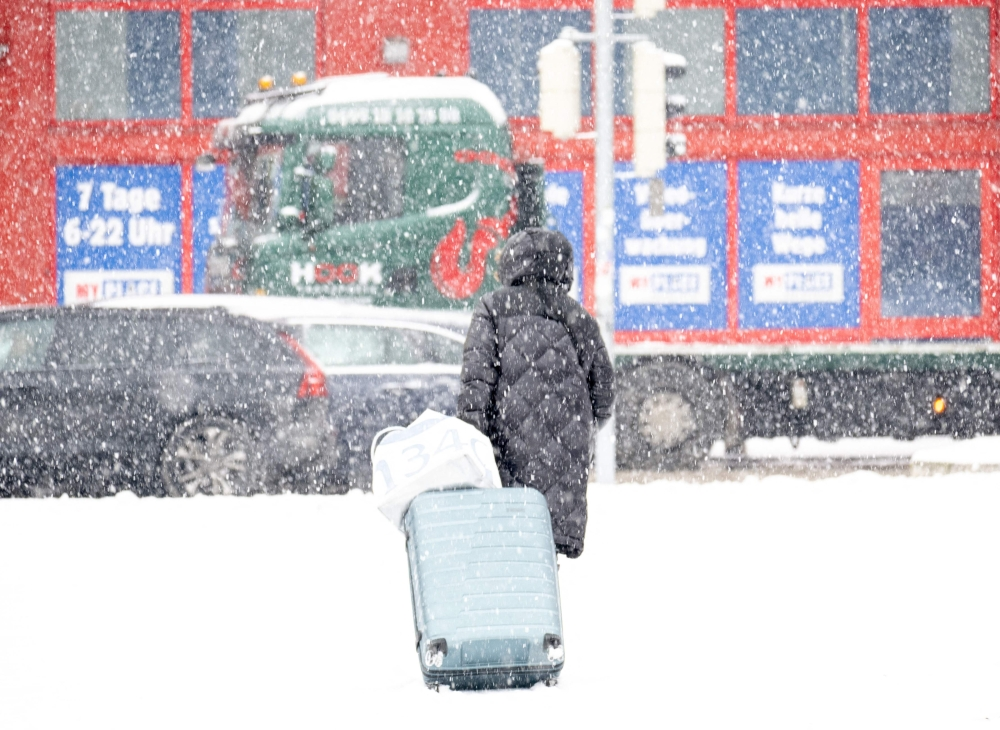
On Tuesday morning, Central Europe experienced a complete paralysis in the air and land transport sectors, as a result of a heavy wave of freezing rain that hit several countries, causing the suspension of flights and the cancellation of train services, which caused widespread chaos in travel schedules.
Vienna Airport halted and routes diverted
In Austria, authorities at Vienna International Airport were forced to temporarily suspend flights after freezing rain created thick layers of ice on the runways, making takeoffs and landings unsafe. As a result, many incoming flights were diverted to alternative airports in neighboring countries, including Munich, Frankfurt, and Cologne in Germany, as well as Venice in Italy.
In a press statement to the Austrian Press Agency, Peter Kleiman, spokesman for Vienna Airport, explained that the situation necessitated the mobilization of technical teams to deal with the ice, expecting the disruptions to continue for several hours until visibility improves and the runways are clear.
Widespread regional impacts
The crisis was not limited to Austria alone, but extended to neighboring countries. In Slovakia, Bratislava Airport announced its closure to air traffic until midday, while Slovak police issued urgent warnings via social media platforms urging citizens to avoid road travel in the west of the country due to the risk of landslides.
In the Czech Republic, Prague Airport experienced a near-total shutdown as fire and safety crews worked to clear ice from the runways and aircraft. The rail and highway networks were also severely affected, causing widespread traffic disruptions. Similarly, the Hungarian Meteorological Service issued warnings of severe winter conditions that negatively impacted train and flight schedules.
Air navigation challenges in the European winter
Freezing rain is one of the most serious challenges facing the aviation sector in Europe during winter. Unlike regular snowfall, this phenomenon occurs when rain falls as a liquid and freezes upon contact with cold surfaces, forming a hard, glassy layer that is difficult to remove quickly. This necessitates strict safety protocols at airports, including de-icing operations for aircraft fuselages and wings to ensure smooth airflow—processes that are time-consuming and inevitably lead to schedule delays.
Economic and logistical repercussions
These disruptions are particularly significant given Central Europe's position as a vital transport hub connecting the continent's east and west. The closure of key airports like Vienna and Prague has a domino effect on global air traffic, causing missed connecting flights for international passengers and delays in air cargo shipments. Austrian Railways has also urged passengers to postpone non-essential travel, a move reflecting the strain on transport infrastructure and underscoring the priority of public safety over temporary economic considerations in such exceptional weather conditions.