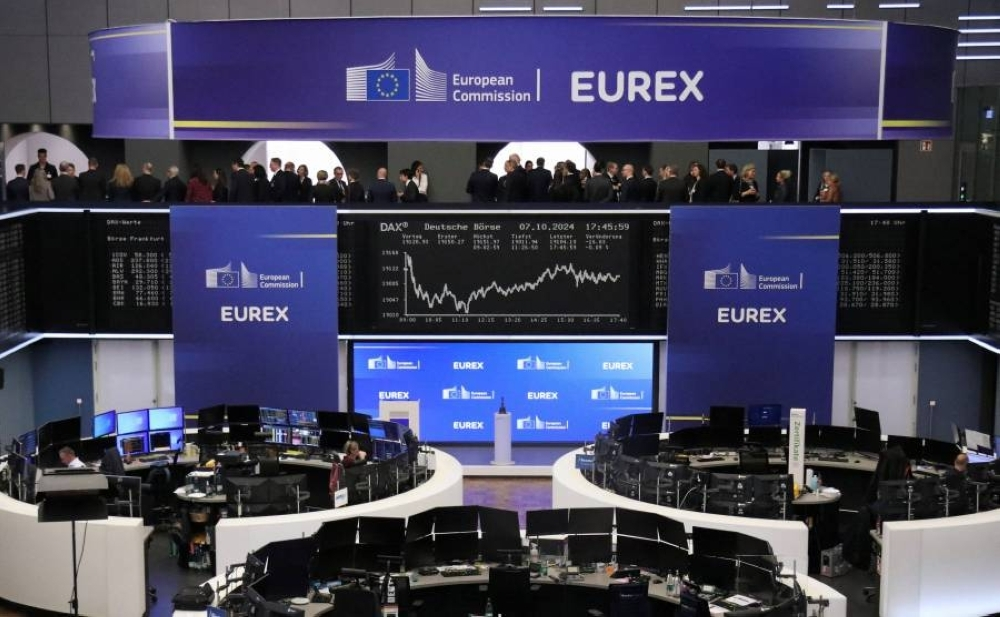
European stock markets ended trading today with mixed performance, as the main indices reflected a mixed picture of sentiment in the region. While the main European index managed to post gains, some major local markets showed slight declines, highlighting a cautious wait-and-see approach among investors regarding the economic trajectory and central bank policies.
Performance of major European indices
STOXX 600 index , which tracks the performance of 600 of the largest companies in 17 European countries, rose significantly by 0.58% to close at 613.10 points. This index is considered a broad gauge of the health of the continent's stock markets, and its rise indicates general optimism supported by the performance of specific sectors.
In contrast, DAX , which tracks Europe's largest economy, saw a slight decline of 0.10%, closing at 24,908.23 points. The DAX, heavily weighted towards the industrial and export sectors, often reflects concerns about global economic growth and trade tensions.
In contrast, the CAC 40 gained 0.27%, closing at 8152.82 points, supported by a strong performance from luxury goods and services companies that make up a large part of the index.
The economic context and the importance of divergent performance
This mixed performance comes against a complex economic backdrop. Investors in Europe are weighing several influencing factors, most notably inflation data and the European Central Bank's (ECB) interest rate outlook. While there are growing hopes that the central bank will soon begin cutting interest rates to curb slowing growth, concerns about persistently high inflation continue to weigh on markets.
Historically, European stock markets have shown considerable sensitivity to global monetary policies, particularly decisions by the US Federal Reserve, as well as economic data from China, Europe's main trading partner. The divergence between the performance of Germany's industrial DAX index and France's more consumer-dependent CAC 40 index reflects the different challenges facing national economies within the European Union.
Expected impact and future outlook
The performance of the Stoxx 600 index is a vital indicator for international investors, as its stability and growth bolster confidence in the European economy as a whole. Continued positive performance could attract further foreign investment inflows. However, the divergence in the performance of local indices warrants caution, suggesting that the economic recovery may not be uniform across the region. Traders are now awaiting upcoming corporate earnings reports and economic data releases for a clearer picture of market direction in the coming period.